Hydrogen Peroxide
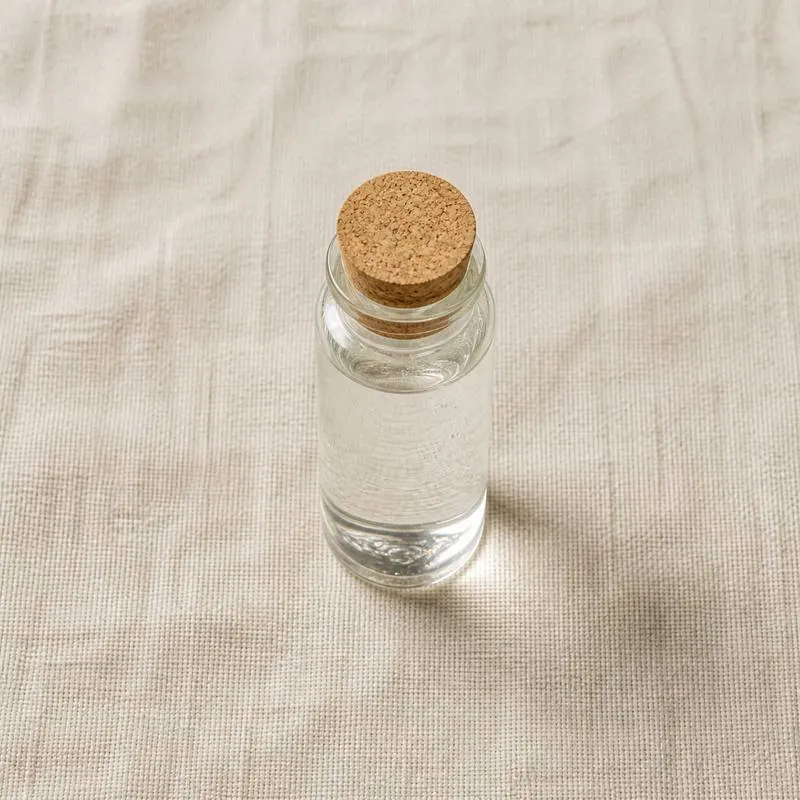
Hydrogen peroxide is the simplest peroxide, H2O2, a colourless liquid that is sold to the food industry as an aqueous solution and functions as an oxidising agent, bleach and antimicrobial. Its distinguishing property is that it decomposes to water and oxygen, leaving no residue of its own, which is why it is used where a treatment has to disappear before the food is eaten.
In food manufacture it is almost always a processing aid rather than an ingredient. It sterilises the inner surface of packaging laminate on aseptic filling lines, bleaches starch and gums, is used in the treatment of milk for certain cheeses where refrigeration is impractical, oxidises residual sulphur dioxide, and cleans and sanitises plant surfaces and process water. In each case the peroxide is either destroyed by heat, removed by hot sterile air, or broken down enzymatically with catalase so that the finished food carries no measurable residue.
Food grade solutions are traded at 35 and 50 percent by weight, clear, colourless, faintly sharp smelling and miscible with water in all proportions. The material is thermodynamically unstable and decomposes exothermically, a reaction catalysed strongly by transition metals, by alkali and by rough or contaminated surfaces, so commercial solutions carry very low levels of sequestering stabilisers and are stored in passivated aluminium or specific grades of polyethylene with vented closures. Food grade differs from technical grade chiefly in carrying a much lower stabiliser load, because the stabilisers themselves would otherwise remain on the food.
We source bulk Hydrogen Peroxide from top China manufacturers for our partners. The manufacturer is in Hubei. A smaller requirement can ship in a combined container with other ingredients.
Please send the grade you need, the volume and your destination port, and we will come back with a solution and a price.
or call +86-21-6858 0751
- Function
- Preservative
Specifications
| Item | Specification |
|---|---|
| Appearance | Clear colourless liquid, free from suspended matter |
| Assay (H2O2) | 34.5 to 35.5 percent by weight |
| Identification | Positive reaction with acidified potassium permanganate |
| Stability at 100 C | Not less than 97 percent of assay retained after 24 hours |
| Free Acid (as H2SO4) | Not more than 0.04 percent |
| Non Volatile Residue | Not more than 60 mg/kg |
| Total Organic Carbon | Not more than 100 mg/kg |
| Phosphate (as PO4) | Not more than 20 mg/kg |
| Nitrate (as NO3) | Not more than 15 mg/kg |
| Chloride | Not more than 5 mg/kg |
| Sulphate | Not more than 15 mg/kg |
| Iron | Not more than 0.5 mg/kg |
| Aluminium | Not more than 3 mg/kg |
| Lead | Not more than 0.5 mg/kg |
| Arsenic | Not more than 0.5 mg/kg |
| Heavy Metals (as Pb) | Not more than 5 mg/kg |
Common Markets Grades
Commercial strength is the first distinction. Thirty five percent is the general purpose food and aseptic packaging strength, fifty percent is traded where freight cost matters and the user dilutes on site, and seventy percent and above is industrial material that is not offered for food use. Below that, semiconductor and electronic grades exist at very high purity but are specified on metal traces rather than on food criteria and are not the same product commercially.
The second and more important distinction is stabiliser content. Technical grades carry phosphates, stannates and nitrate at levels that suppress decomposition in dirty steel systems. Food grade and aseptic packaging grade carry a minimum stabiliser load, are specified on total organic carbon and on non volatile residue, and are supported by a food grade certificate covering the absence of the additives that a technical grade would contain. Aseptic packaging grade is specified more tightly again on residue, because anything non volatile in the solution is deposited on the inner face of the carton when the peroxide is evaporated off. Every grade ships as bulk liquid in drums, intermediate bulk containers and road tankers, and none is offered as a solid.
Applications
- Aseptic packaging lines, where the laminate web is passed through a peroxide bath or spray and then dried with hot sterile air to sterilise the food contact face
- Bleaching of starch and modified starches, where it oxidises the colour bodies without the residues left by chlorine based bleaches
- Treatment of milk destined for certain cheeses, where the residual peroxide is destroyed with catalase before the milk is set
- Whey and whey product processing, where it decolourises the liquid before drying
- Bleaching of natural gums, gelatine and other hydrocolloids, where colour rather than composition is the target
- Removal of residual sulphur dioxide from juices, syrups and dried fruit, where the peroxide oxidises sulphite to sulphate
- Clean in place sanitation of tanks, lines and filling equipment, alone or in peracetic acid systems generated from it
- Disinfection of process and wash water in fruit and vegetable handling, where no chlorinated by products are wanted
- Oxidant in the manufacture of other food ingredients, including peracetic acid, sodium percarbonate and oxidised starches
- Bleaching of tripe, beef feet and similar offal, where it whitens the tissue before further processing
Brands Using Hydrogen Peroxide
Widely-distributed consumer products that list Hydrogen Peroxide on the ingredient label.
- Crest3D Whitestrips 1 Hour Express ↗The strip ingredient list runs PVP, water, PEG-8, hydrogen peroxide, acrylates copolymer, sodium hydroxide and sodium saccharin, with hydrogen peroxide as the whitening agent.Label verified 2026-08-31
- Crest3D White Brilliance Pro Ultra White Toothpaste ↗This whitening toothpaste is formulated with 4 percent hydrogen peroxide, the highest concentration in the brand's toothpaste range.Label verified 2026-08-31
Brand names, product names and logos are the property of their owners. They appear here as published evidence that the ingredient is used, taken from the brand's own label or website. Their appearance is not an endorsement, and it does not mean the brand buys from us or from any manufacturer listed on this site.
China Manufacturers of Hydrogen Peroxide
Top Hydrogen Peroxide manufacturers in China.

Company names and logos are the property of the manufacturers themselves. They are listed here because our own directory records them as producing this ingredient. A listing is not an endorsement by them, and we do not represent them or speak on their behalf.
Regulatory Status
In the United States hydrogen peroxide is affirmed as generally recognised as safe as a direct food substance at 21 CFR 184.1366, with its permitted uses defined by that regulation, which covers among other things treatment of milk used in cheese making, whey processing, starch modification and the preparation of certain emulsifiers, and requires that the peroxide be removed by an appropriate physical or chemical means before the food is finished. 21 CFR 178.1005 separately authorises its use as a sterilant for polymeric food contact surfaces on aseptic packaging equipment and sets the conditions of use and a residue limit in the packaged food. Sanitiser uses on food processing equipment are cleared under the food contact and sanitiser provisions, and antimicrobial uses on produce fall under the relevant food additive and pesticide frameworks.
In the European Union hydrogen peroxide is not authorised as a food additive and holds no E number. It is used lawfully as a processing aid, a category regulated at national level rather than by a Union list, on the basis that it decomposes and does not remain in the finished food, and its use in the sterilisation of food contact materials is covered by the framework regulation on food contact materials and the plastics regulation, which set a residue expectation for the finished pack. As a disinfectant it is an approved active substance under the Biocidal Products Regulation, and it is registered under REACH as an industrial chemical. The Joint FAO WHO Expert Committee on Food Additives has evaluated hydrogen peroxide in the context of milk preservation and aseptic packaging, and Codex texts recognise its use as a processing aid rather than as an additive, so no Codex maximum use level applies to it as an ingredient.
Manufacturing Process
Effectively all commercial hydrogen peroxide is made by the anthraquinone auto oxidation process, a cyclic route in which the quinone is a carrier and is not consumed. An alkylanthraquinone, usually 2 ethylanthraquinone, is dissolved in a mixed solvent to form the working solution. That solution is hydrogenated over a palladium catalyst under mild hydrogen pressure, reducing the quinone to the corresponding anthrahydroquinone, and the catalyst is then filtered off. The reduced working solution is contacted with compressed air in an oxidation column, which converts the hydroquinone back to the original quinone and forms hydrogen peroxide in the organic phase.
The peroxide is stripped from the working solution by counter current extraction with demineralised water, giving a crude aqueous solution of around thirty to forty percent. That crude liquor is washed with an organic solvent to strip out entrained quinone and solvent residues, passed through adsorbent beds to remove organic carbon, and concentrated by vacuum distillation to the traded strength, distillation under reduced pressure being necessary because the solution decomposes at atmospheric boiling temperature. The regenerated working solution is treated to remove degradation products and returned to the hydrogenator. Finished product is dosed with a small quantity of sequestrant, polish filtered and filled into passivated aluminium or high density polyethylene containers with vented closures, all wetted surfaces having been passivated because iron, copper and manganese catalyse rapid decomposition.