Ethyl Acetate
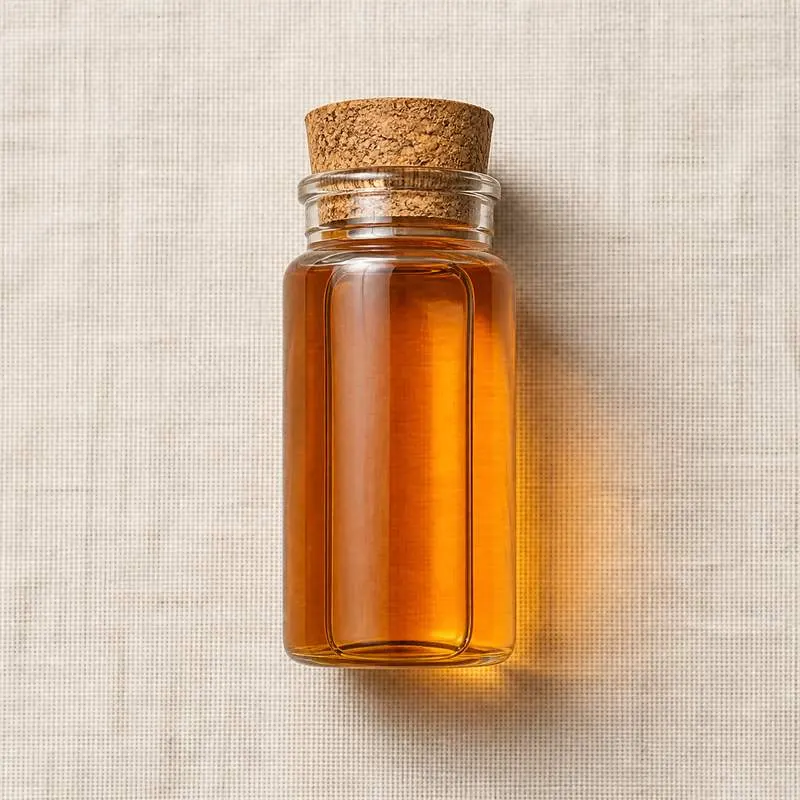
Ethyl acetate is the ethyl ester of acetic acid, formula C4H8O2, registered under CAS number 141-78-6 and carrying FEMA number 2414. It is a colourless, highly volatile, free flowing liquid boiling at about seventy seven degrees Celsius, with a sweet, fruity, ethereal odour recognisable as the smell of pear drops and of nail varnish remover.
In food it serves two quite different purposes. As a flavouring substance it occurs naturally in wine, beer, ripe fruit and many fermented products, where it is produced by yeast from ethanol and acetyl coenzyme A, and it contributes the light solvent like fruitiness that is characteristic of fermentation. At low levels it lifts a fruit compound and gives it freshness, while at higher levels it smells of varnish and is treated as a fault in wine and spirits. As a solvent it is one of the small number of organic solvents permitted for food extraction, and it is used to decaffeinate tea and coffee, to extract oleoresins and natural colours, and as the carrier in which many flavour compounds are sold.
It is miscible with ethanol, ethers, ketones and most organic solvents and only moderately soluble in water, at roughly eight percent by weight, and it forms azeotropes with water and with ethanol that dominate how it is purified. It is highly flammable, with a flash point below room temperature.
We source bulk Ethyl Acetate from top China manufacturers for our partners. The manufacturer is in Guangxi. A smaller requirement can ship in a combined container with other ingredients.
Please send the grade you need, the volume and your destination port, and we will come back with a solution and a price.
or call +86-21-6858 0751
- Function
- Flavours and Aromas
Specifications
| Item | Specification |
|---|---|
| Appearance | Clear colourless mobile liquid, free from suspended matter |
| Odour | Characteristic sweet, fruity and ethereal |
| Assay by GC | Not less than 99.5 percent |
| Identification | Infrared spectrum conforms to reference |
| Water Content | Not more than 0.1 percent |
| Acidity, as acetic acid | Not more than 0.01 percent |
| Relative Density (20°C) | 0.898 to 0.902 |
| Refractive Index (20°C) | 1.370 to 1.375 |
| Distillation Range | 76 to 78 °C |
| Non Volatile Residue | Not more than 0.005 percent |
| Colour, APHA | Not more than 10 |
| Ethanol | Not more than 0.2 percent |
| Acetaldehyde | Not more than 0.05 percent |
| Heavy Metals (as Pb) | Not more than 5 mg/kg |
Common Markets Grades
Grades are defined by assay, by water content and by the impurity profile, since the same molecule serves markets with very different tolerances. Technical and industrial grades, typically at ninety nine percent, are used in coatings, inks and adhesives. Food and flavour grade material runs at not less than ninety nine and a half percent, with tight limits on acidity, water and residual alcohol and with an odour specification, because trace acetic acid or acetaldehyde is immediately detectable in a flavour application. Pharmaceutical and pharmacopoeial grades carry a further set of identification and impurity tests.
A separate axis is origin. Material made from bioethanol and fermentation derived acetic acid can be certified as of natural origin and supports a natural declaration where the flavour regulations allow it, and it is bought at a higher price for that reason. Anhydrous grades, dried below a stated water content, are used where the solvent will meet water sensitive chemistry, and stabilised grades are unusual since the ester is comparatively stable. Bulk supply in road tankers and isotanks sits alongside drum quantities, and all grades are handled under flammable liquid controls.
Applications
- Fruit flavour compounds, contributing a light ethereal top note
- Wine, beer and spirit flavourings, reproducing a natural fermentation ester
- Confectionery and beverage flavours, as a component and as a carrier solvent
- Decaffeination of coffee and tea, as a permitted extraction solvent
- Extraction of oleoresins, natural colours and plant actives
- Solvent and diluent in flavour and fragrance compounding
- Printing inks, lacquers, coatings and adhesives
- Cleaning of electronics and as a laboratory solvent for chromatography
- Nail care products and cosmetic formulations
- Intermediate and reaction solvent in fine chemical manufacture
Brands Using Ethyl Acetate
Widely-distributed consumer products that list Ethyl Acetate on the ingredient label.
- Counter Culture CoffeeDecaf Urcunina ↗The product copy states the Colombian lot is decaffeinated with a sugarcane derivative called ethyl acetate, which extracts the caffeine from the green beans.Label verified 2026-08-31
- Counter Culture CoffeeDecaf K'uychi ↗A Narino decaf whose page names ethyl acetate, a derivative of sugarcane, as the agent used in the decaffeination process.Label verified 2026-08-31
- Fresh Roasted CoffeeDecaf Colombian Roasted Coffee ↗The page says the beans are decaffeinated using ethyl acetate derived from fermented sugarcane rather than a synthetic solvent.Label verified 2026-08-31
- Fresh Roasted CoffeeColombian Decaf Classic Coffee Pods ↗The pod listing describes the beans being bathed in a fermented sugarcane compound called ethyl acetate until they reach 97 percent decaffeination.Label verified 2026-08-31
Brand names, product names and logos are the property of their owners. They appear here as published evidence that the ingredient is used, taken from the brand's own label or website. Their appearance is not an endorsement, and it does not mean the brand buys from us or from any manufacturer listed on this site.
China Manufacturers of Ethyl Acetate
Top Ethyl Acetate manufacturers in China.

Company names and logos are the property of the manufacturers themselves. They are listed here because our own directory records them as producing this ingredient. A listing is not an endorsement by them, and we do not represent them or speak on their behalf.
Regulatory Status
In the United States ethyl acetate is used both as a flavouring substance, holding FEMA GRAS status under FEMA number 2414 and appearing among the synthetic flavouring substances and adjuvants generally recognised as safe, and as a solvent. Its use as an extraction solvent, notably in the decaffeination of coffee and tea and in the production of spice oleoresins and natural extractives, is permitted subject to residue limits, and coffee decaffeinated with it is often marketed as naturally decaffeinated because the solvent occurs naturally in the fruit. Occupational exposure is controlled separately as a workplace matter.
In the European Union it is a flavouring substance authorised under Regulation (EC) No 1334/2008 and included on the Union list, and it carries no E number. Separately it is an authorised extraction solvent under the directive on extraction solvents used in the production of foodstuffs, which sets the conditions of use and the maximum residue permitted in the finished food for each application. As a chemical it is registered under the chemicals regulation and classified under the classification, labelling and packaging regulation as a highly flammable liquid and vapour with eye irritation and drowsiness hazards, so transport and storage are governed by dangerous goods rules rather than by food law. Codex addresses the flavouring use through its general guidelines for the use of flavourings.
Manufacturing Process
Three industrial routes dominate. The classical one is Fischer esterification, in which ethanol and acetic acid are reacted over a strong acid catalyst, traditionally sulphuric acid and increasingly an acidic ion exchange resin, with the equilibrium driven towards the ester by continuously removing the water and product overhead. Modern plants carry this out in a reactive distillation column, where reaction and separation occur in the same vessel, which raises conversion and cuts energy use.
The second route is the Tishchenko reaction, in which two molecules of acetaldehyde are dimerised over an aluminium alkoxide catalyst to give the ester directly, and it is used where acetaldehyde is available cheaply from ethylene oxidation. The third is direct addition of acetic acid to ethylene over a supported heteropolyacid catalyst in the gas phase, which avoids the ethanol step entirely.
Purification is where the process character lies, because ethyl acetate forms a binary azeotrope with water at around seventy degrees Celsius and a ternary azeotrope with water and ethanol, so simple distillation cannot deliver a dry product. Plants use a combination of decanting the two phase overhead, azeotropic or extractive distillation, and in some cases molecular sieve or membrane dehydration, followed by a finishing column that takes off the light ends carrying acetaldehyde and the heavy ends carrying higher esters. Food grade material is polish filtered and often carbon treated to remove odour bodies, then filled into drums or tankers under nitrogen. Release covers assay, water, acidity, non volatile residue, colour and an odour test.