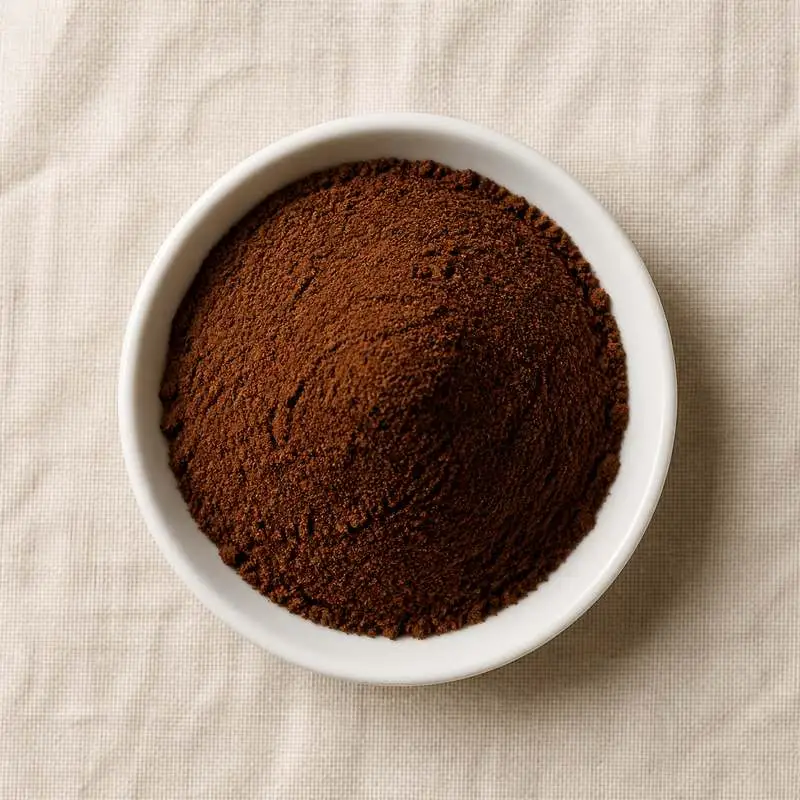
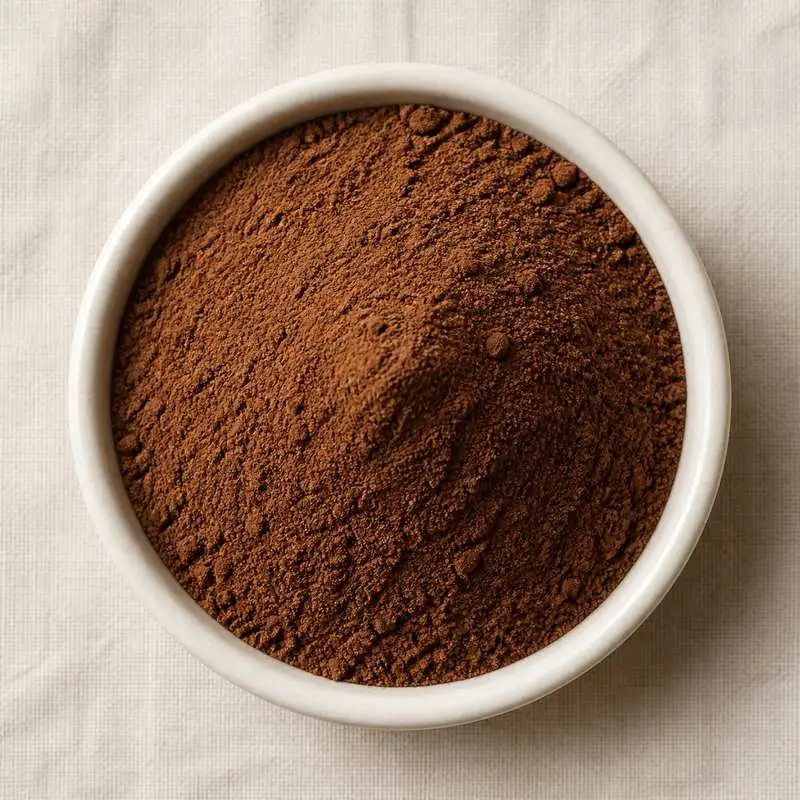
Roasted Coffee Beans
Roasted coffee beans are the seeds of the fruit of Coffea arabica or Coffea canephora, dried, hulled and then heated to between about 195 and 240 degrees Celsius until the characteristic aroma, colour and brittleness develop. The roast is the step that creates the product, since green beans have almost none of the flavour associated with coffee.
Roasting drives Maillard and Strecker reactions between sugars and amino acids, degrades chlorogenic acids into phenolic and lactone fragments, and generates several hundred volatile compounds including furans, pyrazines, pyrroles and sulphur-bearing thiols. Cell structure ruptures under internal pressure, oil migrates towards the surface at darker roasts, and carbon dioxide is trapped in the bean matrix and released slowly over the following days.
Roasters pack the beans whole in one-way valve bags or nitrogen-flushed foil, since staling is driven by oxygen ingress and by loss of the volatile top notes. Water content after roasting sits around 2 to 4 percent. Coffee is not soluble as such, so the bean is used by extraction, and grind size, water temperature and contact time decide how much of the roughly 28 to 30 percent extractable solids is recovered.
We source bulk Roasted Coffee Beans from top China manufacturers for our partners. The manufacturer is in Guangdong. A smaller requirement can ship in a combined container with other ingredients.
Please send the grade you need, the volume and your destination port, and we will come back with a solution and a price.
or call +86-21-6858 0751
- Function
- Beverage ingredient
Specifications
| Item | Specification |
|---|---|
| Appearance | Whole roasted beans, uniform colour, free of foreign matter |
| Roast Colour | Agtron 45-75 depending on roast level |
| Moisture | ≤ 5.0% |
| Total Ash | 3.5-5.0% on dry basis |
| Caffeine | 0.9-2.7% depending on species |
| Water Soluble Extract | 24.0-32.0% |
| Defective Beans | ≤ 2.0% by weight |
| Foreign Matter | Not detected |
| Ochratoxin A | ≤ 3.0 µg/kg |
| Lead | ≤ 0.5 mg/kg |
| Arsenic | ≤ 0.5 mg/kg |
| Total Plate Count | ≤ 10,000 cfu/g |
| Yeast and Mould | ≤ 100 cfu/g |
| Salmonella | Absent in 25 g |
Common Markets Grades
Beans are traded first by species and origin, arabica giving higher acidity and aromatic complexity and robusta giving more body, more caffeine and a heavier crema in espresso. Within that, lots are separated by screen size, by processing method at origin, washed, natural or honey, and by defect count, which is the basis of the speciality against commercial distinction.
Roast level is the main technical variable in the finished product, described by degree of roast measurement on a reflectance scale and running from light through medium to dark and Italian roasts. Blends are built to a target cup profile and are usually roasted separately before mixing. Decaffeinated beans, prepared by water, supercritical carbon dioxide or solvent extraction of the green bean before roasting, form a separate range, and organic, Fairtrade and Rainforest Alliance certified lots are held apart through the roastery.
Applications
- Espresso preparation, where a fine grind and short high pressure extraction demand a bean with enough solubles to build crema
- Filter and drip brewing in foodservice and household equipment
- Cold brew production, using a coarse grind and long ambient or chilled steeping
- Ready to drink coffee beverages, brewed as a liquid base before formulation with milk or sugar
- Soluble coffee manufacture, where roasted beans are ground and percolated under pressure to produce the extract
- Coffee extract and oleoresin production for flavour houses
- Bakery and confectionery, as ground coffee or as an infusion in creams, ganaches and doughs
- Chocolate coated coffee beans and similar whole bean confectionery
- Coffee liqueurs and beers, brewed or steeped into the base spirit or wort
- Ice cream and dairy desserts, infused into the mix before freezing
Brands Using Roasted Coffee Beans
Widely-distributed consumer products that list Roasted Coffee Beans on the ingredient label.
- Caffe Borbone100% Arabica Whole Bean Coffee ↗Bag of 2.2 lbs of Italian roasted whole Arabica coffee beans sourced from Africa, Central America and South America.Label verified 2026-08-31
- For WellnessOrganic Arabica Whole Bean Coffee ↗Whole bean coffee the brand describes as 100 percent Arabica beans roasted for its house profile.Label verified 2026-08-31
Brand names, product names and logos are the property of their owners. They appear here as published evidence that the ingredient is used, taken from the brand's own label or website. Their appearance is not an endorsement, and it does not mean the brand buys from us or from any manufacturer listed on this site.
China Manufacturers of Roasted Coffee Beans
Top Roasted Coffee Beans manufacturers in China.

Company names and logos are the property of the manufacturers themselves. They are listed here because our own directory records them as producing this ingredient. A listing is not an endorsement by them, and we do not represent them or speak on their behalf.
Regulatory Status
Roasted coffee is a conventional food rather than a regulated additive. In the United States it is subject to general food safety requirements under the Federal Food, Drug, and Cosmetic Act and to preventive controls for human food, with no standard of identity applying to the roasted bean itself. Decaffeinated products must meet the caffeine reduction implied by the label claim, and any residual extraction solvent is controlled under the food additive provisions covering that solvent.
In the European Union, roasted coffee is governed by general food law and by the contaminants framework, which sets maximum levels for ochratoxin A in roasted coffee and for acrylamide through a benchmark and mitigation obligation on roasters. Codex has issued a code of practice for the prevention and reduction of ochratoxin A contamination in coffee, which underpins the sampling and storage controls applied at origin and in the roastery.
Manufacturing Process
Green beans arriving at the roastery are cleaned over screens and destoners, graded, and blended to the target recipe either before or after roasting. Roasting takes place in a drum roaster, where the charge is heated by conduction from the rotating wall and by hot gas, or in a fluid bed roaster where a stream of hot air suspends the beans. Charge temperature, airflow and drum speed are controlled against a bean probe curve, with the first crack marking the point at which internal steam pressure fractures the cell walls.
At the target roast the batch is dropped into a cooling tray and quenched with forced air, sometimes with a controlled water spray. Chaff is removed by cyclone during roasting and the cooled beans pass a destoner and a metal detector. Beans are then rested for several hours to a few days so that carbon dioxide can escape, since packing too early swells the bag. Whole beans are packed under nitrogen with a one-way degassing valve, or ground on roller or disc mills to a defined particle distribution before packing.