Alkalized Cocoa
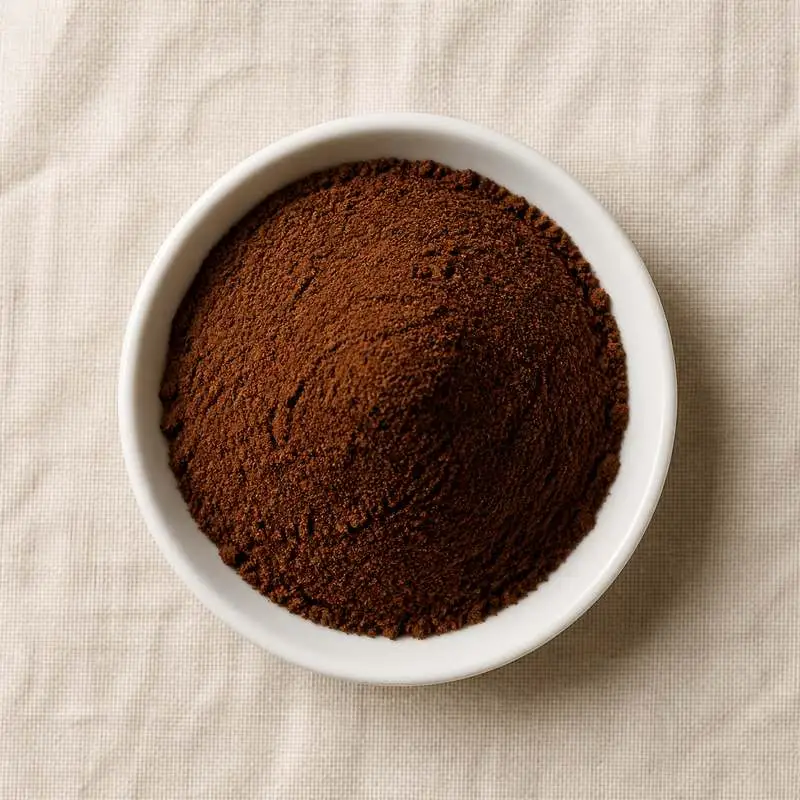
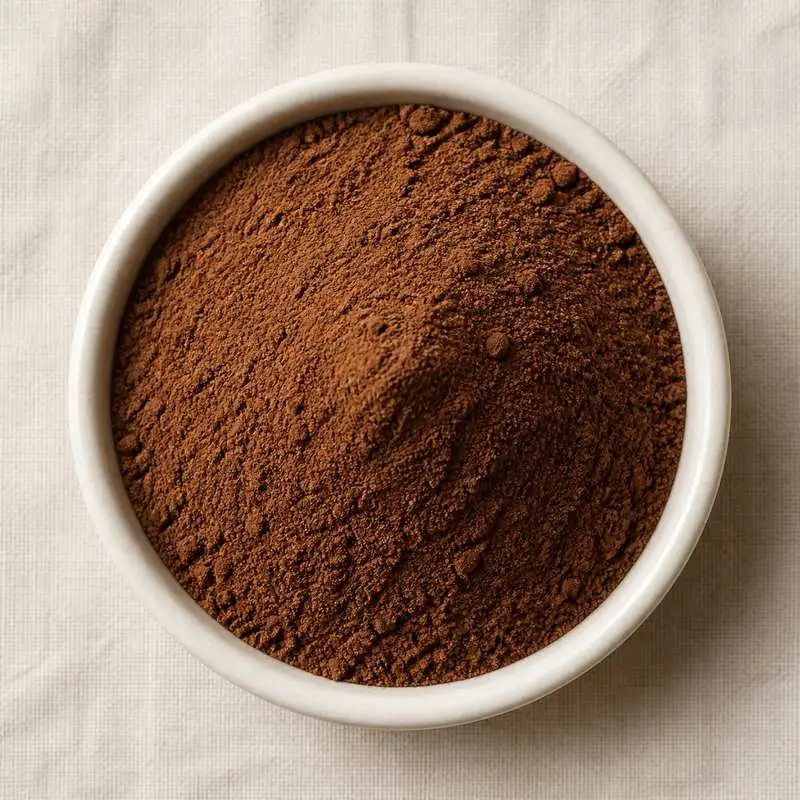
Alkalized cocoa is cocoa powder made from cacao material that has been treated with an alkaline solution, usually potassium carbonate, before or during roasting, which raises the pH of the finished powder from the natural range of about 5.2 to 5.8 up to somewhere between 6.8 and 8.0.
The treatment, known in the trade as Dutching, changes three things at once. Colour deepens from light reddish brown through mahogany to near black as the alkali drives condensation of polyphenols and shifts the anthocyanin equilibrium. Flavour becomes rounder and less acidic, because volatile acids are neutralised and the sharp fruity notes of natural cocoa recede. Dispersibility in milk and water improves markedly, since the neutral pH suppresses the protein interactions and sedimentation that make natural cocoa settle out of a beverage. The trade off is a loss of part of the flavanol content, which is degraded by the alkali.
It ships as a fine free flowing powder in multiwall paper bags with a liner, or in bulk boxes, at a residual cocoa butter content of either 10 to 12 percent or 20 to 24 percent depending on grade. The powder is hygroscopic, will pick up odours from surrounding stock, and softens or cakes if stored above the melting range of its residual fat, so it is held cool, dry and separate from strong smelling material.
We source bulk Alkalized Cocoa from top China manufacturers for our partners, working with several of them. The manufacturers are in Jiangsu and Zhejiang. A smaller requirement can ship in a combined container with other ingredients.
Please send the grade you need, the volume and your destination port, and we will come back with a solution and a price.
or call +86-21-6858 0751
Specifications
| Item | Specification |
|---|---|
| Appearance | Fine free flowing powder, free from lumps and foreign matter |
| Colour | Dark reddish brown to black according to grade, matched to the retained standard |
| Flavour and odour | Characteristic alkalized cocoa, no smoky, mouldy or hammy note |
| Cocoa butter content | 10 to 12 percent, reduced fat grade |
| pH, 10 percent suspension | 7.0 to 7.6 |
| Moisture | 5.0 percent maximum |
| Fineness | 99.5 percent through 200 mesh |
| Shell content | 1.75 percent maximum on nib basis |
| Lead | 0.5 mg/kg maximum |
| Cadmium | Within the limit of the destination market, tested each lot |
| Total plate count | 5,000 cfu/g maximum |
| Yeast and mould | 50 cfu/g maximum |
| Escherichia coli | Negative in 1 g |
| Salmonella | Negative in 25 g |
Common Markets Grades
Two axes define the trade. Fat content divides low fat or reduced fat powder, at 10 to 12 percent cocoa butter, from full fat or natural fat powder at 20 to 24 percent, with intermediate grades at around 15 to 17 percent traded for specific bakery uses. Alkalisation level then divides the colour range, from lightly alkalized powders at pH near 6.8 that retain a reddish brown tone, through medium alkalized mahogany and dark brown grades, to heavily alkalized black cocoa at pH approaching 8. The black grades are used where an intense colour is required and where the flavour has largely been traded away for it.
Colour is specified numerically as well as by name, using instrumental colour values on a standardised suspension or on the dry powder, because visual matching between lots is unreliable. Fineness is specified as the percentage passing a fixed sieve, typically 200 or 325 mesh. Beyond that, grades cover acid resistant powders formulated to hold colour in low pH systems, powders selected for beverage dispersibility, and organic and sustainably certified lines that are segregated through the mill.
Applications
- Chocolate flavoured drinks and instant beverage powders, where neutral pH keeps the powder in suspension instead of settling
- Biscuits and sandwich cookies, particularly dark and black grades used for the characteristic near black wafer
- Cakes and cake mixes, where alkalized powder is paired with baking powder rather than with bicarbonate alone
- Ice cream and frozen desserts, dispersed into the mix for colour and cocoa flavour
- Compound coatings and chocolate flavoured fillings, supplying cocoa solids without cocoa liquor
- Dairy desserts, mousses and puddings, where the powder must hydrate cleanly in a protein system
- Confectionery centres, wafer creams and spreads, dosed for both colour and flavour
- Cereal, granola and snack coatings, applied as a dry dust or in a fat based slurry
- Bakery decoration and dusting, where colour intensity is the main requirement
Brands Using Alkalized Cocoa
Widely-distributed consumer products that list Alkalized Cocoa on the ingredient label.
- Hershey'sHershey's Special Dark 100% Cacao Cocoa, 8 oz can ↗Baking cocoa whose entire ingredient statement reads Cocoa Processed With Alkali, the Dutch process treatment that darkens the powder and lowers its acidity.Label verified 2026-08-31
- Jell-OOreo Cookies 'n Creme Instant Pudding & Pie Filling Mix ↗Pudding mix whose cookie component lists cocoa processed with alkali among its ingredients.Label verified 2026-08-31
Brand names, product names and logos are the property of their owners. They appear here as published evidence that the ingredient is used, taken from the brand's own label or website. Their appearance is not an endorsement, and it does not mean the brand buys from us or from any manufacturer listed on this site.
China Manufacturers of Alkalized Cocoa
Top Alkalized Cocoa manufacturers in China.
- Wuxi Jinde Cocoa Food Co., Ltd.1 ingredient in the directory
 Wuxi Xinjingyuan Food Technology Co., Ltd.4 ingredients in the directory
 Zhejiang Qili Xingguang Cocoa Products Co., Ltd.3 ingredients in the directory
Company names and logos are the property of the manufacturers themselves. They are listed here because our own directory records them as producing this ingredient. A listing is not an endorsement by them, and we do not represent them or speak on their behalf.
Regulatory Status
In the United States the standards of identity for cacao products in 21 CFR Part 163 cover cocoa products, define cacao nibs, chocolate liquor and the cocoa powders and set out the alkali ingredients that may be used. Those are the carbonates and hydroxides of potassium, sodium, ammonium and magnesium, with quantity limits expressed against the weight of nib. Where the treatment has been applied, the label must carry a statement to the effect that the cocoa is processed with alkali, and that declaration follows the ingredient into finished products. Manufacture is otherwise subject to the preventive controls rules at 21 CFR Part 117.
In the European Union Directive 2000/36/EC on cocoa and chocolate products defines cocoa powder, fixes the minimum cocoa butter content for material sold as cocoa powder and sets a lower minimum for fat reduced cocoa powder, along with a maximum moisture content. The alkalising agents themselves are authorised food additives, potassium carbonates as E501, sodium carbonates as E500, ammonium carbonates as E503 and magnesium carbonates as E504, permitted as acidity regulators under Regulation 1333/2008 with purity criteria in Regulation 231/2012. Maximum levels for cadmium in cocoa powder sold to the final consumer are set in Commission Regulation (EU) 2023/915, and cadmium is the contaminant that most often drives origin selection for cocoa. Codex maintains a standard for cocoa powders and dry cocoa sugar mixtures, and JECFA has evaluated the carbonate alkalising agents.
Manufacturing Process
Cocoa beans are cleaned, then broken and winnowed to separate the nib from the shell. Alkalisation is applied most often at the nib stage: a solution of potassium carbonate, and sometimes sodium or ammonium carbonate, is sprayed onto warm nibs in a rotating vessel and allowed to soak in, then the nibs are heated so the reaction proceeds and the added water is driven off. The severity of the treatment, meaning the alkali dose, the temperature and the residence time, is what sets the final pH and colour, and it is the principal process variable in the whole plant. Some producers instead alkalize the liquor or the pressed cake, which gives a slightly different colour development.
Treated nibs are roasted, then ground in a series of mills, where friction melts the cocoa butter and produces cocoa liquor. The liquor is pumped hot into a horizontal hydraulic press, which expresses cocoa butter through screens and leaves a hard press cake at the target residual fat. Cake is broken into kibble, milled to powder in an impact or pin mill with air classification, and passed through a cooling and tempering section, which crystallises the residual cocoa butter into a stable form so the powder does not develop a grey bloom or cake in the bag. The finished powder is sieved, passed over magnets and a sifter, tested for colour and pH against a retained standard, and packed.