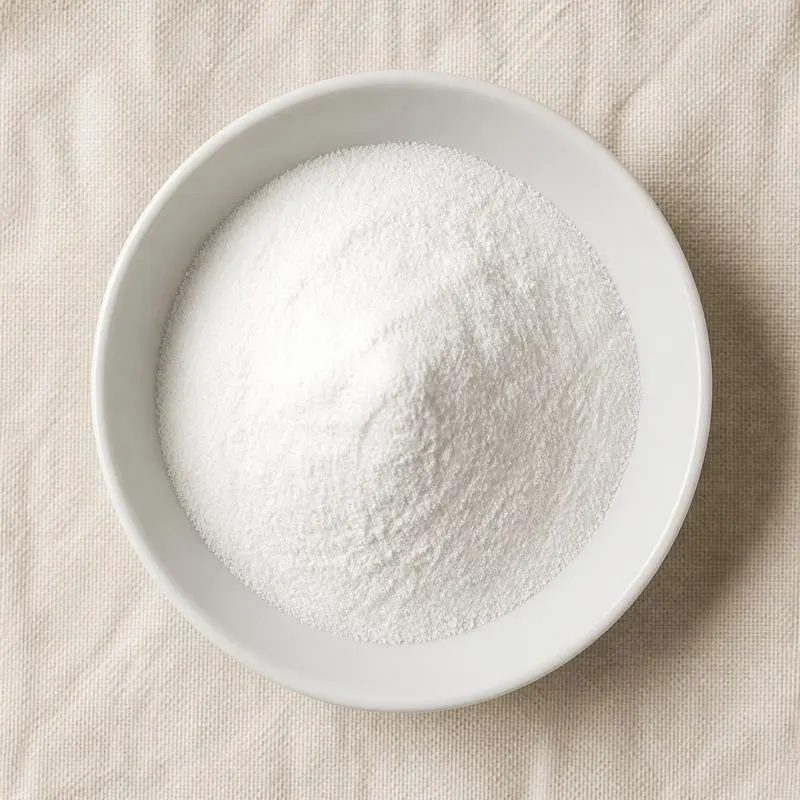
Betaine Citrate
Betaine Citrate is a 1:1 salt of trimethylglycine (betaine) and citric acid, CAS 17671-50-0, sold as a free-flowing white crystalline powder for use in animal feed, premixes, and digestive-aid formulations.
It combines the osmolyte and methyl donor functions of betaine with the acidifying and chelating properties of citrate, delivering both functions in a single non-hygroscopic ingredient suited to swine, poultry, aquaculture, and pet nutrition.
We source bulk Betaine Citrate from top China manufacturers for our partners. The manufacturer is in Shandong. A smaller requirement can ship in a combined container with other ingredients.
Please send the grade you need, the volume and your destination port, and we will come back with a solution and a price.
or call +86-21-6858 0751
- Packaging
- 25 kg kraft paper bag with PE inner liner
- ISO 9001
- HACCP
- Halal
- Kosher
Specifications
| Item | Specification |
|---|---|
| Appearance | White to off-white crystalline powder |
| Assay (total, dry basis) | ≥ 98.0% |
| Loss on drying | ≤ 1.0% |
| pH (5% solution) | 3.5 to 5.0 |
| Citrate content | Per declared specification |
| Heavy metals (as Pb) | ≤ 10 mg/kg |
| Arsenic | ≤ 2 mg/kg |
| Residue on ignition | ≤ 0.3% |
| Total plate count | ≤ 1,000 cfu/g |
| E. coli and Salmonella | Negative |
| Particle size | Per customer specification |
Common Markets Grades
Betaine Citrate splits into feed and supplement formats, differentiated by particle size and assay.
Standard feed grade typically delivers a minimum 97 percent assay on a dry basis, with controlled particle size for uniform premix distribution and minimal dusting.
Fine powder grade is produced for water-soluble premixes, drinking-water dosing, and aquaculture feed coating.
Granular grade is produced for direct top-dressing on compound feed and for premix systems requiring improved flow.
Feed-additive grades carry typical specifications for residual moisture, heavy metals, microbial profile, and free citric acid content.
Pharmaceutical and human-supplement grades, where available, meet tighter purity, microbial, and elemental impurity specifications.
Applications
- Swine starter and grower feeds for osmotic protection, methyl donation, and gut acidification
- Broiler and layer poultry diets for performance support under heat stress
- Aquaculture feeds for marine and freshwater finfish and shrimp as a feeding attractant and osmolyte
- Calf milk replacers and pre-ruminant starter feeds
- Pet food and treats for digestive support positioning
- Premix systems combining methyl donor and acidifier function in a single ingredient
- Water-soluble dosing formulations for in-water supplementation
- Companion-animal digestive aid supplements
- Equine performance and recovery feed supplements
- Specialty feed applications for fish hatcheries and shrimp larviculture
Brands Using Betaine Citrate
Widely-distributed consumer products that list Betaine Citrate on the ingredient label.
Brand names, product names and logos are the property of their owners. They appear here as published evidence that the ingredient is used, taken from the brand's own label or website. Their appearance is not an endorsement, and it does not mean the brand buys from us or from any manufacturer listed on this site.
China Manufacturers of Betaine Citrate
Top Betaine Citrate manufacturers in China.
Company names and logos are the property of the manufacturers themselves. They are listed here because our own directory records them as producing this ingredient. A listing is not an endorsement by them, and we do not represent them or speak on their behalf.
How We Help Source Betaine Citrate
Direct Factory Sourcing
We run the whole process: selecting the manufacturer from the top Chinese food ingredient producers, negotiating the price, verifying quality, and coordinating the logistics. You deal with us instead of with several factories at once.
Original Packaging and Documents from the Manufacturer
The manufacturer sends your Betaine Citrate out of its own factory in the original packing, through to your destination port. The COA, COO, MSDS, TDS and any certifications reach you from the manufacturer as well.
Free Samples and Lead Time
We send 100 to 500 g free for your own laboratory to test and you cover only the courier, usually within 2 to 3 working days. ETD is usually within 7 to 15 days once the order is confirmed, and we check that date against the factory's own manufacturing schedule before we give it to you.
Combined Shipment
We can load Betaine Citrate together with other ingredients such as Nutrient Premixes into one 20' FCL. If your quantity is small, we can also ship LCL.
Regulatory Status
Betaine Citrate is authorised as a feed additive in the European Union under Commission Implementing Regulation entries within the functional group of digestibility enhancers and as a nutritional feed additive, with the underlying components (betaine and citric acid) each holding long-standing authorisations.
In the United States it is recognised through AAFCO ingredient definitions for betaine and for citric acid as feed ingredients.
Anhydrous betaine and betaine hydrochloride are listed in the European Pharmacopoeia and the U.S. Pharmacopeia as established active substances, and citric acid carries monographs in essentially all major pharmacopoeias.
The combined salt form is principally regulated as a feed ingredient or processing aid, and where used in human supplements is subject to the relevant national supplement frameworks.
Halal, kosher, and non-GMO certifications are routinely available depending on the betaine source.
Manufacturing Process
Betaine Citrate is produced by direct salt formation between betaine (trimethylglycine) and citric acid in aqueous solution.
The betaine starting material is typically derived from sugar beet vinasse, the molasses-like residue of beet sugar production, where betaine is concentrated through chromatographic separation on ion-exchange or simulated moving bed systems and crystallised as anhydrous betaine.
Synthetic betaine, produced by alkylation of glycine with methyl chloride or by reductive methylation, is an alternative starting material for feed grades.
Citric acid is produced as the anhydrous or monohydrate form from fermentation of sucrose or glucose by Aspergillus niger.
The two components are dissolved in a defined stoichiometric ratio in water, the solution is concentrated under vacuum, and the salt is crystallised, filtered, dried in a fluid-bed or vacuum dryer, milled to the target particle size, and packed in moisture-barrier bags or supersacks.