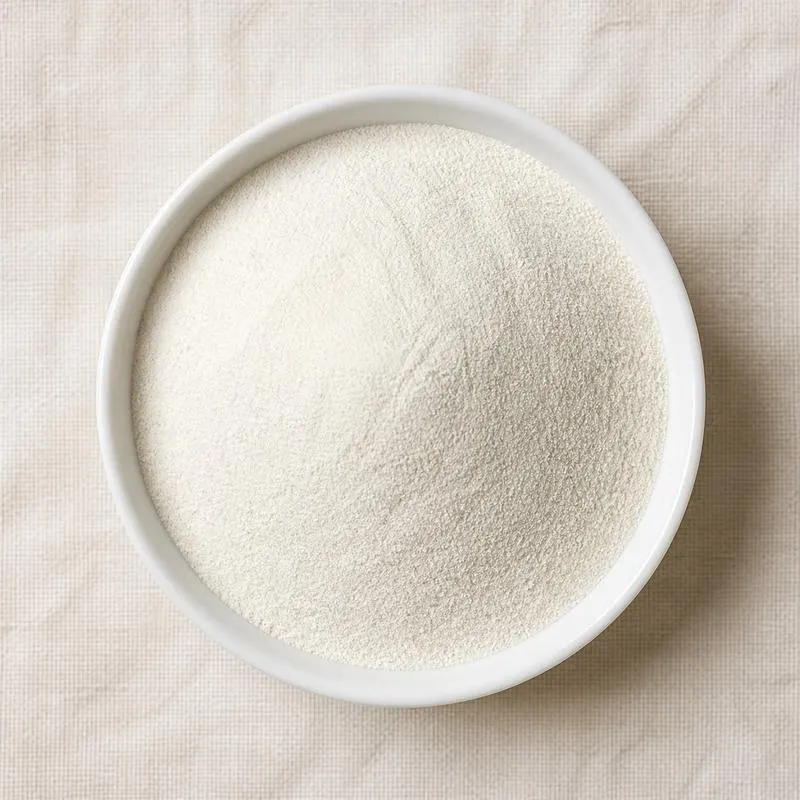
Beef Powder Essence
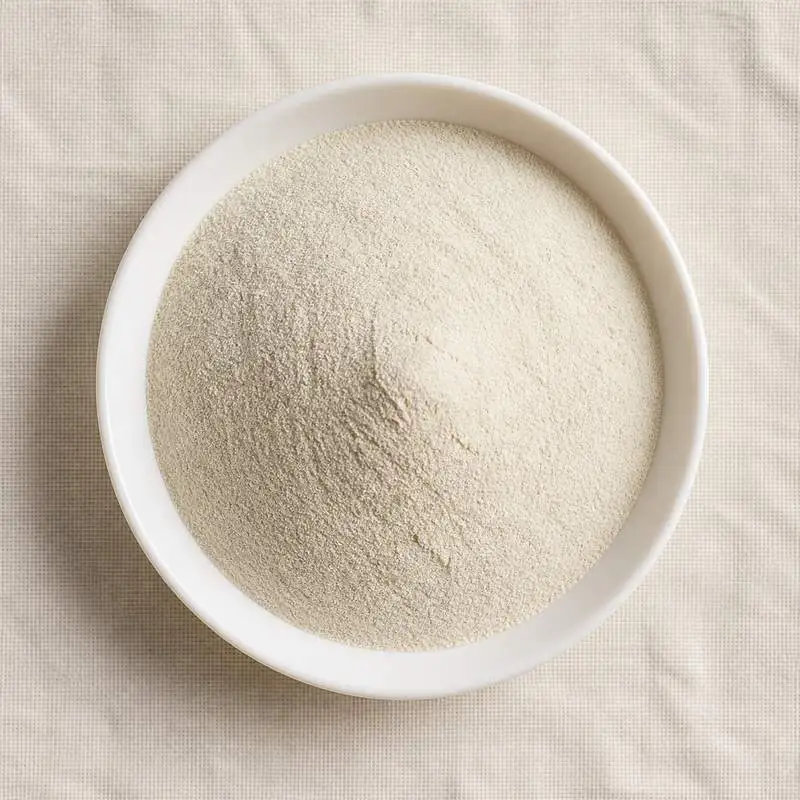
Beef powder essence is the spray dried form of a beef flavour, a free flowing tan to light brown powder in which the aroma is encapsulated inside a carbohydrate shell. It is the presentation used wherever the flavour has to be dosed into a dry system: a noodle seasoning sachet, a snack coating, a bouillon cube or a dry soup mix, none of which will tolerate a paste or a liquid.
Encapsulation is what defines the product. The flavour, whether a Maillard reaction mass or a compounded blend, is emulsified into a solution of maltodextrin, modified starch or gum acacia and dried so quickly that the carrier sets to a glass around each droplet. The resulting glassy matrix holds the volatile sulphur compounds and the fat fraction away from oxygen, which lifts shelf life from weeks to a year or more and prevents the flavour from bleeding into a dry blend during storage.
Flavour load is typically 10 to 25 percent, and the rest is carrier, salt and taste components. The powder disperses in hot water, releasing the flavour as the carrier dissolves. Bulk density, particle size and flowability matter as much as aroma, since the material is normally metered by volumetric filler on a high speed line.
We source bulk Beef Powder Essence from top China manufacturers for our partners. The manufacturer is in Hunan. A smaller requirement can ship in a combined container with other ingredients.
Please send the grade you need, the volume and your destination port, and we will come back with a solution and a price.
or call +86-21-6858 0751
- Function
- Flavours and Aromas
Specifications
| Item | Specification |
|---|---|
| Appearance | Free flowing tan to light brown powder, no lumps or dark specks |
| Odour and flavour | Characteristic cooked beef on reconstitution at 1 percent |
| Identification | Sensory and gas chromatographic comparison with reference batch |
| Flavour load | 10.0 to 25.0 percent as declared |
| Moisture | Not more than 5.0 percent |
| Surface oil | Not more than 2.0 percent |
| Particle size | 95 percent through 40 mesh |
| Salt, as sodium chloride | To formula, within plus or minus 2.0 percent absolute |
| Lead | Not more than 1.0 mg per kg |
| Arsenic | Not more than 1.0 mg per kg |
| Total plate count | Not more than 10000 cfu per g |
| Yeast and mould | Not more than 100 cfu per g |
| Escherichia coli | Absent in 1 g |
| Salmonella | Absent in 25 g |
Common Markets Grades
Grades are quoted on flavour load, on carrier system and on particle characteristics. A higher load gives a lower dosage but a more fragile particle; a lower load on a maltodextrin base is cheaper and more robust. Modified starch carriers give the best oxygen barrier and are chosen for long shelf life or high fat loads, gum acacia gives the cleanest solution, and maltodextrin alone is the economy option.
Physically the choice is between a fine spray dried powder, which disperses fast but dusts and can cake, and an agglomerated or fluid bed granulated version, which flows and wets far better and is preferred for sachet filling and for instant products. Flow agents are added where the blend is hygroscopic. As with the other beef flavour forms, the market separates meat containing grades from those built entirely from yeast and vegetable derived material, maintains halal and kosher lines separately, and distinguishes natural from artificial by how the flavour fraction was made.
Applications
- Instant noodle seasoning sachets, where the powder must survive a year on the shelf and dissolve in three minutes
- Bouillon cubes and stock powders, blended dry with salt and fat
- Dry soup and gravy mixes reconstituted with hot water
- Snack and crisp seasonings applied by tumble drum, where a fine particle adheres to the oiled surface
- Extruded and fried savoury snacks seasoned after frying
- Meat analogue dry blends, where the flavour is mixed into the protein before hydration and extrusion
- Sausage and meat product seasoning premixes
- Marinade and rub powders sold to caterers and to retail
- Instant rice, noodle cup and retail cooking sauce sachets
- Pet food coatings applied as a dry dust over the fat layer
China Manufacturers of Beef Powder Essence
Top Beef Powder Essence manufacturers in China.
Company names and logos are the property of the manufacturers themselves. They are listed here because our own directory records them as producing this ingredient. A listing is not an endorsement by them, and we do not represent them or speak on their behalf.
Regulatory Status
In the United States each component must be a permitted flavouring or food ingredient: substances listed at 21 CFR 172.515, GRAS flavourings at 21 CFR 182.60, spices and natural extractives at 21 CFR 182.10 and 182.20, or independently determined GRAS substances such as those on the FEMA GRAS list. The encapsulating carriers have their own status, with modified food starch regulated as a food starch modified under 21 CFR 172.892, gum acacia generally recognised as safe, and maltodextrin treated as a food. Monosodium glutamate and hydrolysed protein must be declared by name, and the natural or artificial flavour declaration follows 21 CFR 101.22.
In the European Union the flavour fraction falls under Regulation (EC) No 1334/2008, with thermal process flavourings subject to the specific production conditions that regulation lays down. Carriers, anticaking agents and flavour enhancers must be authorised for the food category under Regulation (EC) No 1333/2008 and declared by E number where they carry over at a functional level. Beef derived components bring the product within Regulation (EC) No 853/2004 and the associated import controls, while soya, wheat, milk and celery derived components are declared as allergens under Regulation (EU) No 1169/2011. Codex Alimentarius issues general principles for the use of flavourings rather than a compositional standard for encapsulated flavour powders.
Manufacturing Process
The flavour fraction is made first, usually by reacting hydrolysed protein, yeast extract, a reducing sugar, cysteine and thiamine with beef fat in a jacketed pressure kettle at around 100 to 130 degrees Celsius under controlled pH, then cooling rapidly at the sensory endpoint. Compounded top notes and taste components such as salt, glutamate and ribonucleotides are blended in afterwards, since they would be degraded or diluted by the cook.
That blend is then made into a spray dryable feed. Carrier is dissolved in warm water to a solids level of roughly 35 to 50 percent, the flavour and fat phase is dispersed into it, and the coarse emulsion is passed through a two stage high pressure homogeniser until the droplet size is small enough to be retained during drying. The feed is pumped to a co current spray dryer with inlet air near 180 degrees Celsius and outlet near 90, atomised through a rotary wheel or pressure nozzle, and dried in seconds so that the particle surface sets before the volatiles can escape. Powder is collected from the chamber and cyclones, optionally agglomerated in a fluid bed to build particle size, then sieved, tested for residual moisture and surface oil, metal detected and packed in foil laminate with a nitrogen flush.