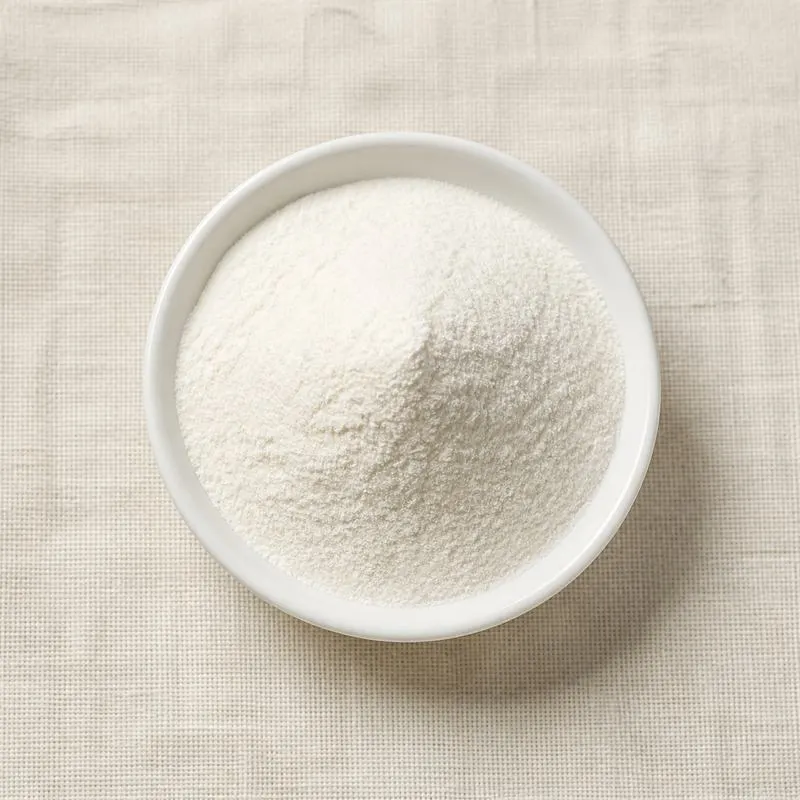
Alkali-Treated Spinosum Chips
Alkali treated spinosum chips are the chipped, dried form of Eucheuma denticulatum seaweed, traded as spinosum, that has been cooked in hot alkali, washed and dried. The species yields iota carrageenan rather than the kappa type obtained from cottonii, and that difference in polymer decides everything the material is used for.
Iota carrageenan carries two sulphate groups on each repeating disaccharide instead of one. The extra charge prevents the ordered helices from aggregating tightly, so instead of the firm brittle gel that kappa gives with potassium, iota forms a soft elastic gel in the presence of calcium ions. That gel stretches rather than fractures, shows almost no syneresis, and is thixotropic: broken by shear, it rebuilds on standing. Where kappa material is chosen for firmness, spinosum material is chosen for elasticity, freeze and thaw tolerance and suspension.
As with the cottonii equivalent, the alkali cook converts galactose 6-sulphate residues into 3,6-anhydrogalactose so the polymer can form its helix, while the carrageenan stays held inside the native cellulose matrix rather than dissolving. The chips are therefore a semi-processed seaweed, sold as brown to tan dried pieces at 10 to 14 percent moisture, with no functionality until they are milled into powder or extracted.
We source bulk Alkali-Treated Spinosum Chips from top China manufacturers for our partners. The manufacturer is in Fujian. A smaller requirement can ship in a combined container with other ingredients.
Please send the grade you need, the volume and your destination port, and we will come back with a solution and a price.
or call +86-21-6858 0751
- Function
- Thickener / Hydrocolloid
Specifications
| Item | Specification |
|---|---|
| Appearance | Brown to tan dried chips, uniform in size |
| Odour | Slight characteristic seaweed odour, free of putrid notes |
| Chip Size | 3 mm to 20 mm |
| Fines through 2 mm screen | Not more than 5.0% |
| Moisture | 10.0% to 14.0% |
| Viscosity of standard 1.5% extract at 75 degrees Celsius | Not less than 40 mPa s |
| Carrageenan Yield, dry basis | Not less than 55.0% |
| Sulphate, dry basis | 25.0% to 35.0% |
| Acid Insoluble Ash | Not more than 2.0% |
| Salt and Sand | Not more than 2.0% |
| Foreign Matter including rope and plastic | Absent on visual inspection |
| Lead | Not more than 2 mg/kg |
| Arsenic | Not more than 3 mg/kg |
| Cadmium | Not more than 1 mg/kg |
| Total Plate Count | Not more than 10,000 CFU/g |
| Salmonella | Absent in 25 g |
Common Markets Grades
Spinosum chips are graded on the viscosity and gel character of a standard extract rather than on the gel strength figure used for cottonii, since iota carrageenan does not produce the firm gel that a kappa gel strength test measures. Recoverable carrageenan yield, moisture, cleanliness and colour complete the commercial specification. The physical presentation is specified as well, covering chip size band, fines content and bulk density, because it determines how the material handles in the buyer's mill.
Colour tends to be darker than cottonii chips, and material intended for food grade powder is washed and bleached more thoroughly than material destined for pet food or technical use. Cleanliness is assessed by inspection for sand, shell, rope and plastic as well as by acid insoluble ash. Spinosum is a lower value and lower volume trade than cottonii, and blended lots combining the two species are common where a formulator wants both the firmness of kappa and the elasticity of iota, so the species split should be confirmed on a blended offer.
Applications
- Raw material for iota carrageenan production, whether refined by extraction and precipitation or milled into semi-refined powder
- Dairy desserts and flans requiring an elastic set that does not weep during chilled storage
- Frozen and chilled sauces, where the thixotropic iota gel rebuilds after pumping and survives freeze and thaw cycles
- Salad dressings and pourable sauces, suspending herbs and particulates in a low viscosity liquid
- Pet food gravies and jellies, giving a soft set that stays intact through retorting
- Plant based dairy alternatives, providing body and suspension in place of milk protein
- Cosmetic gels, lotions and toothpaste, contributing a soft elastic structure
- Blending stock with cottonii derived material, tuning gel texture between brittle and elastic
- Meat products needing a softer bind than kappa carrageenan gives
China Manufacturers of Alkali-Treated Spinosum Chips
Top Alkali-Treated Spinosum Chips manufacturers in China.

Company names and logos are the property of the manufacturers themselves. They are listed here because our own directory records them as producing this ingredient. A listing is not an endorsement by them, and we do not represent them or speak on their behalf.
Regulatory Status
The chips are an intermediate rather than a finished additive, and the regulatory position follows the product they are converted into.
In the European Union semi-refined material from Eucheuma and Kappaphycus seaweeds is authorised as E407a processed eucheuma seaweed, a listing whose name reflects the Eucheuma species from which spinosum material comes. The purity criteria accommodate the retained cellulose and require control of the molecular weight distribution, since degraded low molecular weight carrageenan is not permitted as a food additive. Material that is extracted and purified instead yields E407 carrageenan against tighter criteria. In the United States there is no separate semi-refined listing, and material complying with the carrageenan regulation at 21 CFR 172.620 is declared on the label as carrageenan. Codex and JECFA cover both forms within the carrageenan entry at INS 407. Contaminant limits for heavy metals in seaweed derived ingredients apply, with cadmium monitored particularly closely, and dried plant material shipments carry the usual phytosanitary and import documentation.
Manufacturing Process
Spinosum is farmed alongside cottonii on long line and off-bottom systems in tropical shallow water, harvested, sun dried at the farm and baled. At the processing plant the weed is cleaned of sand, shell, rope and epiphytes, rehydrated and cooked in an alkaline solution, usually potassium hydroxide or a potassium and sodium hydroxide mixture, at around 70 to 80 degrees Celsius. The cook converts the 6-sulphate precursor into 3,6-anhydrogalactose and develops the gelling structure while the polymer stays immobilised in the tissue. Iota carrageenan is more soluble and more readily lost to the cook liquor than kappa, so the alkali concentration, temperature and time are held more conservatively to protect yield.
The cooked weed is drained and washed repeatedly with fresh water to remove the alkali and the dissolved protein, pigment and salts, bleached where a paler product is required, and washed again. It is pressed to remove free water and dried in the sun or in a rotary or belt dryer to 10 to 14 percent moisture, then chipped to the contracted size band and screened to remove fines and foreign matter. Chips are sampled for moisture, extract viscosity and cleanliness, baled, wrapped and marked for shipment or for onward milling.