Coffee Grounds
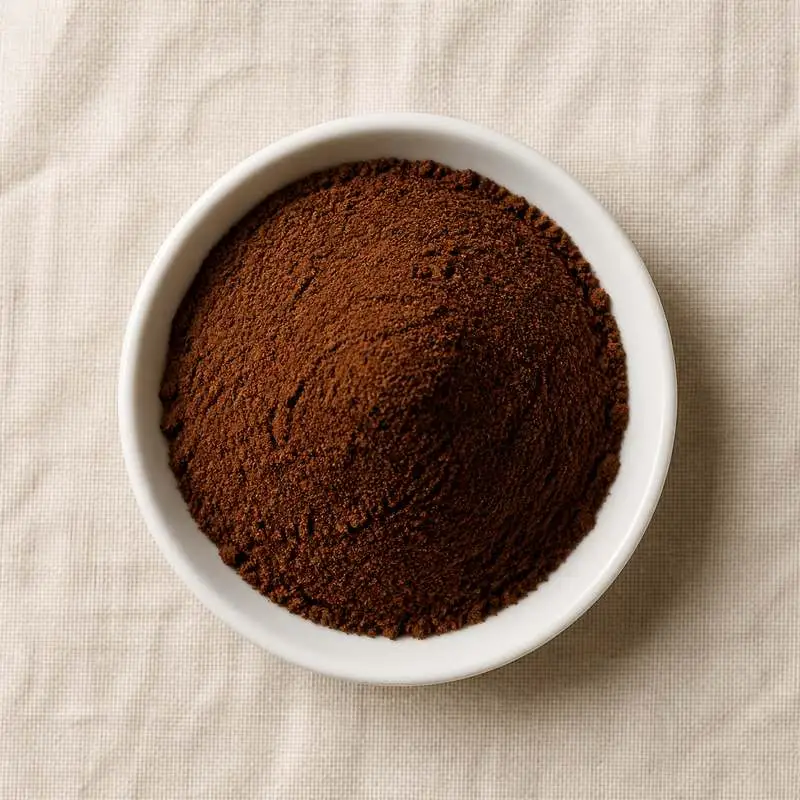
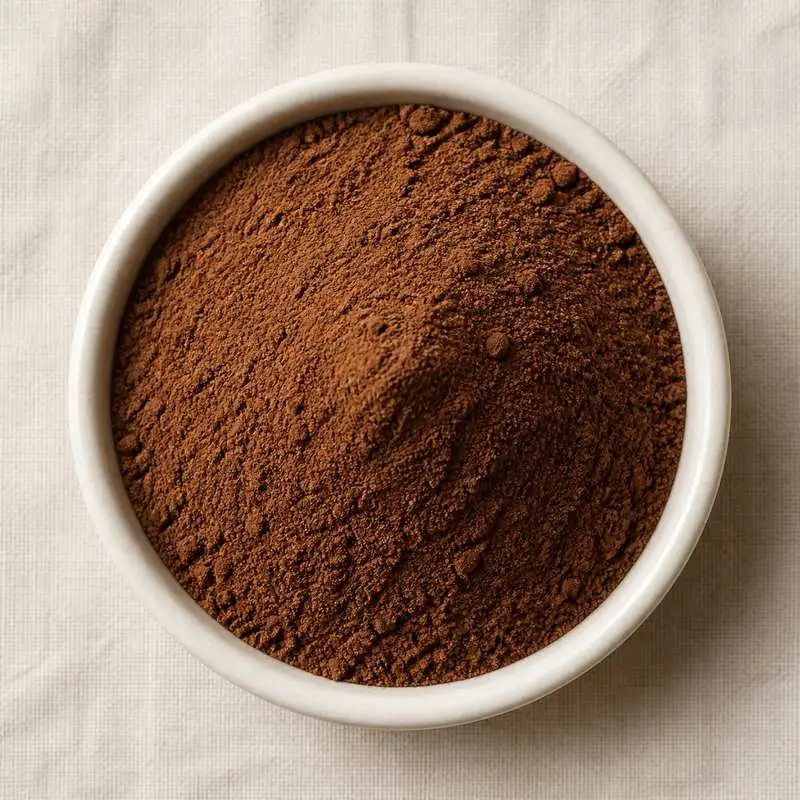
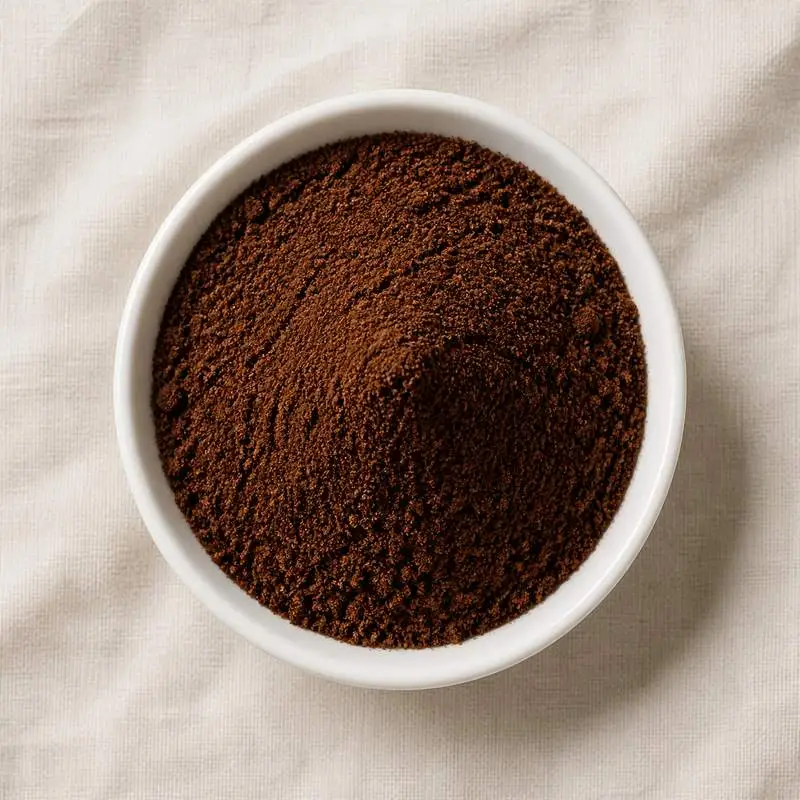
Coffee grounds are roasted coffee beans that have been reduced to particles of a controlled size, ready for extraction with hot or cold water, and the material is traded as roast and ground coffee.
The bean is the seed of Coffea arabica or Coffea canephora, the latter sold as robusta, and roasting is what converts it from a grassy green seed into the product. During roasting the bean loses moisture, doubles in volume as internal gas pressure ruptures the cell walls, and develops several hundred volatile compounds through Maillard reaction and Strecker degradation between its sugars, chlorogenic acids and proteins. Caffeine survives roasting largely unchanged, while chlorogenic acids break down into the quinic and caffeic acid derivatives that carry much of the perceived bitterness at darker roasts. Grinding then sets the surface area available to water, and it is the single variable that most affects extraction: a fine grind extracts quickly and is matched to short pressurised contact, a coarse grind extracts slowly and suits long immersion.
Ground coffee reaches the buyer in valved bags, vacuum bricks, capsules, pods and bulk cartons. It is far less stable than whole bean, because grinding exposes the interior surface to oxygen and lets the trapped carbon dioxide and aroma escape, so it is packed under vacuum or nitrogen and used quickly once opened.
We source bulk Coffee Grounds from top China manufacturers for our partners. The manufacturer is in Yunnan. A smaller requirement can ship in a combined container with other ingredients.
Please send the grade you need, the volume and your destination port, and we will come back with a solution and a price.
or call +86-21-6858 0751
- Function
- Beverage ingredient
Specifications
| Item | Specification |
|---|---|
| Appearance | Uniform ground particles, free from stones, hulls and foreign matter |
| Colour | Medium roast, within the agreed instrumental colour range |
| Flavour and aroma of the brew | Characteristic of the blend, no fermented, mouldy, phenolic or baked note |
| Moisture | 5.0 percent maximum |
| Particle size distribution | Within the agreed sieve profile for the brewing method |
| Caffeine, dry basis | Declared per blend, 0.1 percent maximum for decaffeinated grade |
| Water soluble extract | 24 to 35 percent on dry basis |
| Ochratoxin A | Within the limit of the destination market, tested each lot |
| Acrylamide | Managed against the applicable benchmark level, monitored per plan |
| Lead | 0.3 mg/kg maximum |
| Total plate count | 1,000 cfu/g maximum |
| Yeast and mould | 100 cfu/g maximum |
| Escherichia coli | Negative in 1 g |
| Salmonella | Negative in 25 g |
Common Markets Grades
Species and origin come first. Arabica gives higher acidity and aromatic complexity, robusta gives more caffeine, more body and a heavier crema, and blends of the two are specified by ratio. Green coffee grade, screen size and defect count are carried through from the origin contract, and specialty grades are cupped and scored rather than described by specification alone.
Roast degree is the second axis, expressed as a colour value on an instrumental scale and described as light, medium, medium dark or dark, with roast development determining acidity, body and bitterness. Grind size is the third and is matched to the brewing method: extra fine for Turkish preparation, fine for espresso, medium for filter and drip, and coarse for cafetiere and cold brew, each specified as a particle size distribution rather than a single figure. Beyond those, the trade covers decaffeinated grades produced by solvent, water or supercritical carbon dioxide processes, organic and certified sustainable lots, flavoured coffees carrying an added flavour on the ground bean, and instant coffee feedstock ground specifically for industrial extraction.
Applications
- Filter, drip and batch brewing in foodservice and at home, at a medium grind
- Espresso extraction, at a fine grind matched to pressurised short contact
- Capsules and single serve pods, dosed and sealed under gas flush
- Cold brew and nitro coffee, extracted at a coarse grind over many hours
- Instant and soluble coffee manufacture, extracted in industrial percolation columns before drying
- Ready to drink bottled and canned coffee, brewed then blended with milk or water and sterilised
- Coffee extracts and concentrates for beverage and flavour houses
- Ice cream, dessert and confectionery flavouring, infused or extracted into the base
- Bakery goods and fillings using ground coffee or coffee extract for flavour
- Spent grounds recovered after extraction, used as a fibre source and for oil recovery
China Manufacturers of Coffee Grounds
Top Coffee Grounds manufacturers in China.
Company names and logos are the property of the manufacturers themselves. They are listed here because our own directory records them as producing this ingredient. A listing is not an endorsement by them, and we do not represent them or speak on their behalf.
Regulatory Status
Roast and ground coffee is a food rather than a food additive, so it carries no E number and there is no additive listing. Manufacture falls under Regulation 852/2004 with the general food law in the European Union and the preventive controls rules at 21 CFR Part 117 in the United States. In the European Union the compositional rules of Directive 1999/4/EC apply to coffee extracts and chicory extracts rather than to roast and ground coffee itself, which falls under the general labelling rules in Regulation 1169/2011.
Two contaminants define the category. Acrylamide is formed during roasting from asparagine and reducing sugars, and Regulation (EU) 2017/2158 sets mitigation measures and benchmark levels for roasted coffee, instant coffee and coffee substitutes, requiring operators to apply the specified good practice and to verify their results, with the benchmark values acting as an operational trigger rather than a legal maximum. Ochratoxin A, produced by storage moulds on green coffee, is subject to maximum levels for roasted and instant coffee in Commission Regulation (EU) 2023/915, and control rests on green bean selection and storage rather than on roasting. Regulation 396/2005 controls pesticide residues on green coffee in the European Union, and tolerances at 40 CFR Part 180 control them in the United States. Decaffeinated coffee produced with solvents is subject to the extraction solvent rules, Directive 2009/32/EC in the European Union and 21 CFR 173 in the United States, which set the permitted solvents and their residue limits.
Manufacturing Process
Green beans are received, cleaned over screens and destoners, and blended to the target recipe either before or after roasting depending on whether the components need different roast profiles. Roasting is carried out in a drum, fluid bed or centrifugal roaster, with bean temperature taken from around ambient to somewhere between 195 and 230 degrees Celsius over several minutes, the profile controlling how far the first and second cracks are taken and therefore the colour and flavour. The roast is stopped by quenching with a water spray and by air cooling, and the beans are then destoned again to remove any stones released during roasting.
Roasted beans are held in degassing bins for a period, because carbon dioxide continues to evolve for hours or days after roasting and packing too early swells the pack while packing too late loses aroma. Grinding is done on multi stage roller grinders, in which pairs of fluted rolls at decreasing gap reduce the bean progressively and produce a narrower particle size distribution than an impact mill, with the grind checked on a sieve stack or laser diffraction. Normalising equipment removes the fine dust fraction where a clean cup is required. Ground coffee is filled immediately into vacuum bricks, valved bags flushed with nitrogen, or capsules and pods sealed under gas, since exposure to oxygen at this stage is what determines shelf life.