Barley Grass
Barley grass is the young green leaf of Hordeum vulgare, harvested at the vegetative stage before the plant begins to form a stem and set grain. Cutting at that point matters because the tissue is still leaf rather than stalk, so it is low in insoluble lignified fibre and high in chlorophyll, soluble protein and mineral content, and it contains no gluten forming storage proteins since the grain has not developed.
As an ingredient it is used for its nutrient density and its colour rather than for any single active compound. Dried leaf typically carries 20 to 30 percent protein, a substantial chlorophyll fraction, potassium, iron and calcium, along with vitamin K, folate and a set of flavone glycosides characteristic of the species. It is the archetype of the green superfood powder category, alongside wheatgrass and alfalfa.
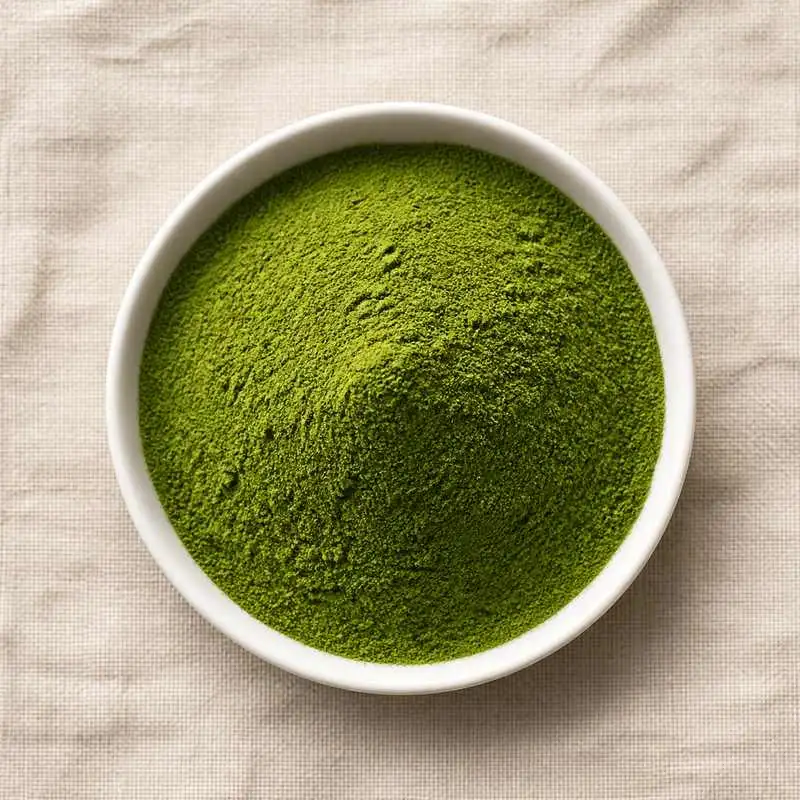
The commercial forms are dried leaf powder, spray dried or freeze dried juice powder, and pressed juice concentrate. Powder is a bright to deep green material with a hay like grassy odour and a distinctly vegetal taste that formulators either mask or lean into. Leaf powder disperses in water but does not dissolve, settling out as a suspension, whereas juice powder is largely water soluble. Chlorophyll degrades under heat, light and acid, so the green colour is the first thing lost in poor handling or in a low pH beverage.
We source bulk Barley Grass from top China manufacturers for our partners. The manufacturers are in Jiangsu. A smaller requirement can ship in a combined container with other ingredients.
Please send the grade you need, the volume and your destination port, and we will come back with a solution and a price.
or call +86-21-6858 0751
- Function
- Nutraceutical
Specifications
| Item | Specification |
|---|---|
| Appearance | Fine bright green powder, free of foreign matter |
| Odour and Taste | Characteristic grassy, free of musty notes |
| Identification | Botanical and microscopic examination conform to Hordeum vulgare leaf |
| Moisture | Not more than 6.0 percent |
| Crude Protein | Not less than 20.0 percent |
| Total Ash | Not more than 15.0 percent |
| Acid Insoluble Ash | Not more than 2.0 percent |
| Particle Size | Not less than 95 percent through 100 mesh |
| Gluten | Less than 20 mg/kg |
| Lead | Not more than 1.0 mg/kg |
| Arsenic | Not more than 1.0 mg/kg |
| Cadmium | Not more than 0.5 mg/kg |
| Total Plate Count | Not more than 10000 cfu/g |
| Yeast and Mould | Not more than 100 cfu/g |
| E. coli | Absent in 1 g |
| Salmonella | Absent in 25 g |
Common Markets Grades
The main commercial distinction is between whole leaf powder and juice powder. Whole leaf powder is milled from the dried cut grass and retains the full fibre and mineral content, with a higher yield and lower price. Juice powder is made by pressing the fresh grass, discarding the fibrous pulp and drying the juice, giving a finer, more soluble and more concentrated product at several times the raw material input per kilogram. The two are not interchangeable, and specifications state which is sold.
Within each type, lots are graded on particle size, colour, moisture, protein and microbiological load. Mesh sizes of 80, 100, 120 and 200 are commonly offered, with finer grades preferred for beverages and capsules and coarser grades for tablets. Some material is standardised on chlorophyll content or on total flavone content, though this is less established than for extract ingredients. Organic certification is widespread in this category, and irradiated and steam sterilised lots are traded separately because pathogen reduction treatment is often needed on a field harvested green leaf. Gluten free testing on the finished powder is a normal part of the specification, since harvest timing rather than species is what keeps the product free of gluten.
Applications
- Green superfood powder blends, where it is combined with wheatgrass, spirulina, chlorella and vegetable powders
- Ready to mix greens beverages and stick packs, using juice powder for its solubility and cleaner mouthfeel
- Tablets and capsules sold as whole food nutrient supplements
- Detox and alkalising positioned formulations, a long standing marketing category for the ingredient
- Smoothie and juice bar bases, where the powder supplies green colour and a vegetal note
- Natural green colouring in bakery, noodles and confectionery where a plant derived shade is wanted
- Protein shake and meal replacement powders, contributing micronutrients and fibre to the blend
- Snack bars and energy balls, where leaf powder is dry blended into the matrix
- Pet supplements and companion animal green blends
- Cosmetic and personal care preparations using the extract for chlorophyll and antioxidant claims
Brands Using Barley Grass
Widely-distributed consumer products that list Barley Grass on the ingredient label.
Brand names, product names and logos are the property of their owners. They appear here as published evidence that the ingredient is used, taken from the brand's own label or website. Their appearance is not an endorsement, and it does not mean the brand buys from us or from any manufacturer listed on this site.
China Manufacturers of Barley Grass
Top Barley Grass manufacturers in China.
 Jiangsu Qinggu Foods Co., Ltd.2 ingredients in the directory
- Topower Technology Limited1 ingredient in the directory
Company names and logos are the property of the manufacturers themselves. They are listed here because our own directory records them as producing this ingredient. A listing is not an endorsement by them, and we do not represent them or speak on their behalf.
Regulatory Status
Barley grass is a food rather than an additive and carries no E number. In the United States it is sold as a conventional food ingredient and as a dietary ingredient under the dietary supplement framework, with structure function claims permitted and disease claims not. Because the raw material is a field harvested green leaf eaten without a cook step, it falls under the produce safety and preventive controls provisions of food safety legislation, and validated pathogen reduction and irrigation water controls are expected in supplier programmes.
In the European Union barley grass has a history of consumption as a food before 1997 and is not treated as a novel food. Barley is a gluten containing cereal listed among the allergens requiring emphasis in the ingredient list, so labelling has to address the species even where the young leaf itself is free of gluten, and gluten free claims rest on analytical verification of the finished lot rather than on the botanical argument alone. No health claim for barley grass has been authorised, so European labelling is limited to compositional statements. Contaminant rules for lead, cadmium and pesticide residues apply as for other leafy plant material, and Codex has no commodity standard specific to the ingredient.
Manufacturing Process
Barley is sown as a dedicated grass crop rather than for grain, and the field is cut at the jointing stage, typically 10 to 14 days after emergence in a controlled operation, when leaf nutrient content peaks and before stem elongation raises fibre. Harvest timing is the single most important quality variable in the whole process. Cut grass is transported quickly to the plant, since respiration and enzymatic browning begin immediately, and it is washed to remove field soil, sand and insect matter.
For leaf powder the washed grass is chopped and dried, either in a low temperature hot air belt drier or by freeze drying, both run below the temperature at which chlorophyll degrades to olive brown pheophytin. The dried leaf is milled in a hammer or pin mill and sieved to the target mesh, often with a cryogenic or chilled mill where heat build up would dull the colour. For juice powder the washed grass is pressed in a screw or belt press, the fibrous cake is separated, and the juice is filtered, cooled and then spray dried with a low inlet temperature or freeze dried, sometimes with a small maltodextrin carrier to aid drying. Both routes finish with a pathogen reduction step, usually saturated steam or a validated equivalent, then metal detection, blending across sub lots for colour uniformity, and packing in foil laminate under nitrogen away from light.