Fish Essence Seasoning
Fish Essence Seasoning is a compound savoury seasoning in which a fish derived flavour concentrate is the character carrier, blended with salt, monosodium glutamate, the ribonucleotides disodium inosinate and disodium guanylate, sugar, and usually a small load of dried aromatics such as ginger, white pepper and spring onion. The fish fraction is normally an enzymatic hydrolysate of fish protein that has been reacted with sugars and amino acids, supplying both the free amino acid body and the cooked marine aroma. The seasoning is designed to be added as a single dry ingredient rather than built up from separate components on the production line.
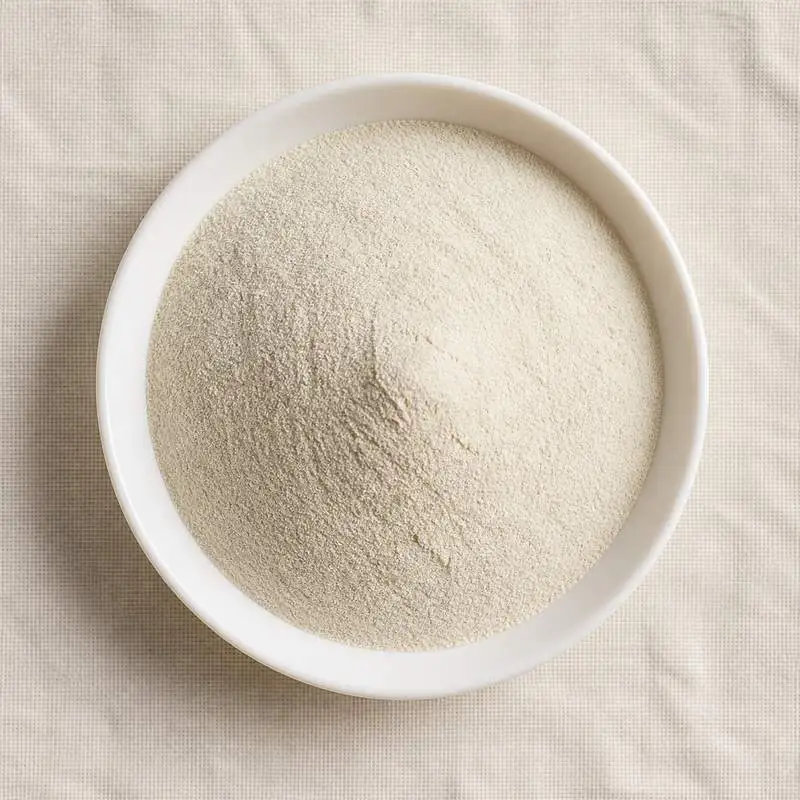
It is a free flowing light brown to tan powder or fine granule. The blend dissolves readily in hot water and is fully dispersible in wet batters and fillings. Salt and hydrolysate content make it hygroscopic, so it is packed in moisture barrier lined bags and stored below 25 degrees Celsius. The aroma fraction is volatile, and formulators generally add it late in a cooking process or specify an encapsulated grade where the product is retorted.
We source bulk Fish Essence Seasoning from top China manufacturers for our partners. The manufacturer is in Zhejiang. A smaller requirement can ship in a combined container with other ingredients.
Please send the grade you need, the volume and your destination port, and we will come back with a solution and a price.
or call +86-21-6858 0751
- Function
- Flavours and Aromas
Specifications
| Item | Specification |
|---|---|
| Appearance | Light brown to tan free flowing powder or granule |
| Odour and Taste | Characteristic cooked fish and savoury, no rancid note |
| Moisture | Not more than 5.0 percent |
| Sodium Chloride | As declared, plus or minus 2.0 percent |
| Total Nitrogen | Not less than 1.5 percent |
| Amino Acid Nitrogen | Not less than 0.5 percent |
| pH at 1 percent solution | 5.0 to 7.0 |
| Sieve Analysis | Not less than 95 percent through 40 mesh |
| Histamine | Not more than 200 mg per kg |
| Lead | Not more than 1.0 mg per kg |
| Arsenic | Not more than 0.5 mg per kg |
| Total Plate Count | Not more than 10000 cfu per gram |
| Yeast and Mould | Not more than 100 cfu per gram |
| Salmonella | Absent in 25 g |
Common Markets Grades
Grades separate mainly by salt load and by flavour intensity. Catering and retail grades run 40 to 60 percent salt and are dosed at a level where the seasoning supplies both salt and flavour. Industrial concentrate grades run below 20 percent salt so that the formulator retains control of the salting in the finished recipe. Flavour strength is quoted as a recommended dosage band rather than as an assay.
Beyond that, buyers specify species profile, most commonly anchovy, cod or a generic white fish character, particle size for dry blending, whether monosodium glutamate is present or the umami comes from yeast extract instead, and whether an anticaking agent is included. Encapsulated grades, in which the flavour is spray chilled into a fat matrix, are stocked for retort and extrusion work. Fish is a declarable allergen on every grade.
Applications
- Instant noodle seasoning sachets in seafood variants, dosed as the single flavour addition
- Fish ball, fish cake and surimi products, restoring the flavour washed out during mince refining
- Prawn cracker and seaweed snack seasoning dusts applied after frying
- Frozen dumpling and wonton fillings with seafood claims
- Congee and instant soup powders sold to retail and catering
- Batter and breading systems for frozen breaded fish portions
- Steamed and braised fish sauce sachets in ready to cook meal kits
- Retort seafood soups, where an encapsulated grade survives sterilisation
- Stir fry and hot pot bases where a marine savoury layer is wanted
- Pet food and aquaculture palatant coatings applied to extruded kibble
China Manufacturers of Fish Essence Seasoning
Top Fish Essence Seasoning manufacturers in China.
Company names and logos are the property of the manufacturers themselves. They are listed here because our own directory records them as producing this ingredient. A listing is not an endorsement by them, and we do not represent them or speak on their behalf.
Regulatory Status
In the United States the blend is regulated as a mixture of its components rather than as a single additive. Fish protein hydrolysate is an established food ingredient, process flavours are handled under 21 CFR 101.22, monosodium glutamate is affirmed as generally recognised as safe under 21 CFR 182.1, and the ribonucleotides are recognised flavour enhancers. Every component appears in the ingredient statement under its common name, and fish must be declared as a major allergen.
In the European Union the flavour fraction falls under Regulation (EC) No 1334/2008, with thermal process flavourings subject to the reaction conditions and by product limits set in that regulation. The enhancer components carry E numbers under Regulation (EC) No 1333/2008, monosodium glutamate as E 621, disodium inosinate as E 631 and disodium guanylate as E 627. Codex has adopted general standards covering the same enhancers and general guidelines for flavourings, and JECFA has evaluated the glutamates and ribonucleotides. Fish is a declarable allergen in both jurisdictions.
Manufacturing Process
The flavour base is made first. Minced fish or fish trimmings are cooked, deoiled by centrifugation and hydrolysed with a bacterial or fungal protease until the target degree of hydrolysis is reached. The enzyme is heat inactivated, insolubles are filtered out and the liquor is concentrated under vacuum, then reacted with reducing sugars and amino acids under controlled heat to develop the Maillard aroma fraction. The reacted concentrate is emulsified with maltodextrin or salt carrier and spray dried into a powder.
Compounding follows in a ribbon or plough share mixer, where the dried flavour base is blended with salt, monosodium glutamate or yeast extract, nucleotides, sugar and milled spices to a specified homogeneity. Granular grades pass through a fluid bed agglomerator to build particle size and improve wetting. The blend is sieved, metal detected and filled under controlled humidity, since the salt and hydrolysate will cake if the packing room is not dehumidified.