Spirulina Superfine
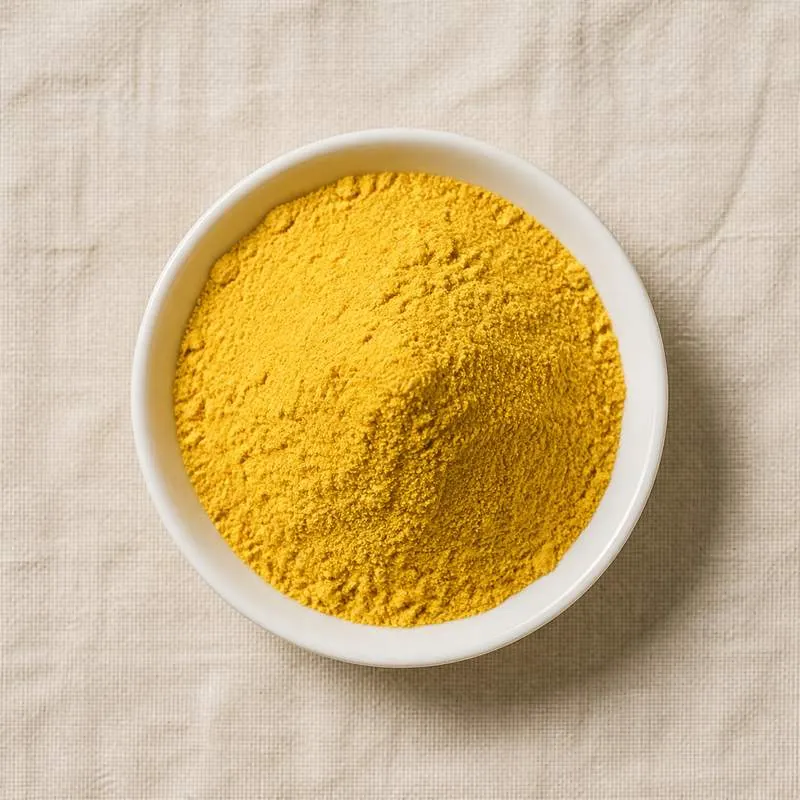
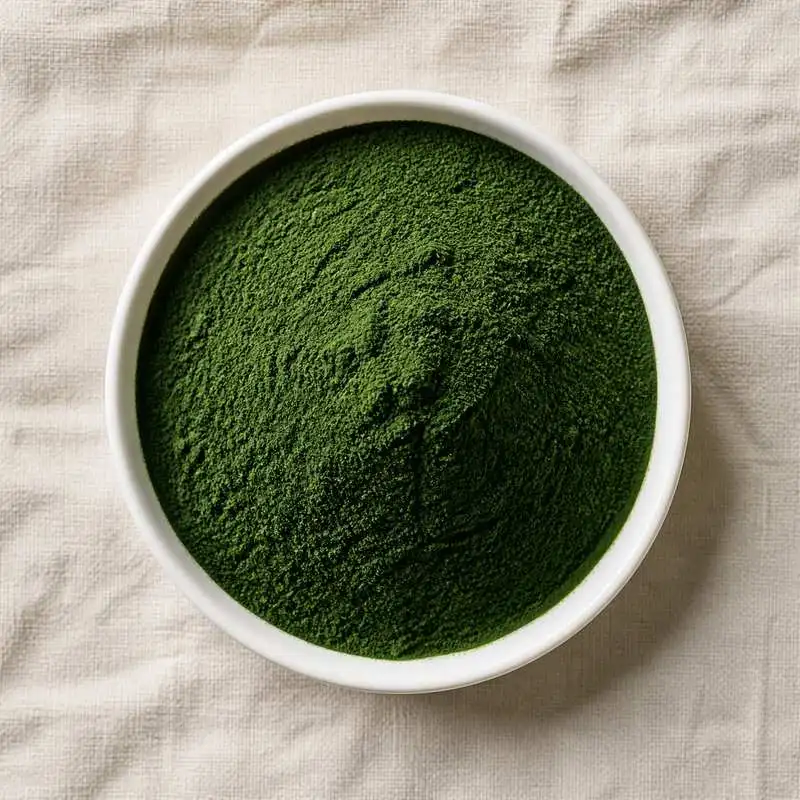
Spirulina superfine is a finely milled powder of the dried cyanobacterium Arthrospira platensis, ground to a much smaller particle size than standard spirulina powder so that it disperses evenly and colours uniformly. Typical superfine material passes 200 mesh or finer, against the 60 to 80 mesh of ordinary spirulina powder. The blue-green colour comes from the water-soluble phycobiliprotein phycocyanin together with chlorophyll and carotenoids held in the cell mass.
The powder is dark blue-green, with the characteristic marine and vegetal odour of the biomass. It is not a purified colourant, so it carries the whole cell composition, roughly 55 to 70 per cent protein on a dry basis, along with lipid, minerals and fibre. In water it forms a suspension rather than a true solution, and the fine grind is what keeps that suspension stable and free of visible specks in a finished product.
Colour behaviour follows the phycocyanin in the cell. The blue-green shade is stable in neutral and mildly acid systems but degrades on prolonged heating above about 60 degrees Celsius, under acid below roughly pH 4, and on exposure to light. Applications are therefore weighted towards cold-processed or short-process foods.
We source bulk Spirulina Superfine from top China manufacturers for our partners. The manufacturer is in Zhejiang. A smaller requirement can ship in a combined container with other ingredients.
Please send the grade you need, the volume and your destination port, and we will come back with a solution and a price.
or call +86-21-6858 0751
- Function
- Colorant
Specifications
| Item | Specification |
|---|---|
| Appearance | Dark blue-green fine powder |
| Particle Size | 98 per cent through 200 mesh |
| Protein | Not less than 55.0 per cent on dry basis |
| Phycocyanin | Not less than 8.0 per cent |
| Loss on Drying | Not more than 7.0 per cent |
| Ash | Not more than 9.0 per cent |
| Lead | Not more than 1.0 mg/kg |
| Arsenic | Not more than 1.0 mg/kg |
| Cadmium | Not more than 1.0 mg/kg |
| Microcystins | Not more than 1.0 mg/kg |
| Total Plate Count | Not more than 100000 cfu/g |
| Yeast and Mould | Not more than 500 cfu/g |
| Escherichia coli | Absent in 1 g |
| Salmonella | Absent in 25 g |
Common Markets Grades
Grading follows particle size first. Standard powder is around 80 mesh, superfine grades run 200 to 400 mesh, and micronised grades below 25 micrometres are sold where a completely smooth mouthfeel and no sedimentation are required. Colour and protein content are the other trade parameters, with phycocyanin content commonly stated as a percentage or as a colour value read at 618 nm.
Food grade is the main article, produced from photoautotrophic pond or photobioreactor culture and dried without additives. Feed grade material of lower protein and higher ash is traded separately for aquaculture and ornamental fish, and organic-certified lots are produced where the culture medium and downstream handling satisfy an organic scheme. Tablet-grade and capsule-grade powders differ from colouring grades mainly in flow and compressibility rather than in composition.
Applications
- Confectionery and gummies, giving a blue-green to teal shade in cold-filled or low-temperature systems
- Ice cream, frozen yoghurt and chilled desserts, where the low process temperature protects the phycocyanin
- Bakery decoration, icings and fondants coloured without synthetic blue dyes
- Noodles, dumpling wrappers and steamed buns, for a green tint carried into the dough
- Beverage powders, smoothie premixes and instant drink sachets, where the fine grind prevents grittiness
- Plant-based dairy analogues and protein drinks, contributing both colour and protein
- Nutritional supplements in tablet, capsule and stick-pack form
- Aquaculture feed and ornamental fish feed, where the carotenoids support pigmentation of the animal
- Pet food and treats sold on a natural-colour positioning
China Manufacturers of Spirulina Superfine
Top Spirulina Superfine manufacturers in China.

Company names and logos are the property of the manufacturers themselves. They are listed here because our own directory records them as producing this ingredient. A listing is not an endorsement by them, and we do not represent them or speak on their behalf.
Regulatory Status
Spirulina has a long history of use as a food and is treated as a food ingredient rather than as an additive in most markets. In the United States, dried Arthrospira platensis biomass is the subject of GRAS notifications for use as an ingredient in foods and beverages, and 21 CFR Part 73 separately lists spirulina extract as a colour additive exempt from certification for specified food categories. Whole spirulina powder used for its colour in the United States is normally handled under those provisions rather than as an uncharacterised colouring.
In the European Union, spirulina biomass is marketed as a food and as a food supplement ingredient with a history of consumption before the novel food cut-off, so it is not treated as a novel food. It carries no E number, and colour delivered by the whole biomass is regarded as coming from a food used for its colouring properties rather than from an added colour, a distinction that decides how it may be declared. Codex has no specific standard for spirulina powder, and specifications in trade follow pharmacopoeial and industry monographs for the dried algae.
Manufacturing Process
Arthrospira is cultured photoautotrophically in outdoor raceway ponds or in closed photobioreactors, in an alkaline bicarbonate medium at high pH that suppresses most competing organisms. The culture is harvested continuously by screening and filtration, since the filamentous trichomes are large enough to be retained on a fine mesh, then washed to remove residual salts from the medium.
The wet biomass is dewatered on a filter or centrifuge and dried, usually by spray drying, which takes the cells through the drying zone quickly enough to retain most of the phycocyanin. The dried flake or coarse powder is then milled, and it is this milling stage that defines the superfine article: air-classifying mills or jet mills reduce the particle size without generating the heat that would bleach the pigment. The milled powder is sieved to the target mesh, blended across lots to a uniform colour value and packed under nitrogen or with an oxygen absorber to slow pigment loss.