Phycocyanin
Phycocyanin is a brilliant blue protein-pigment complex extracted from the filamentous cyanobacterium Arthrospira platensis, commonly marketed as spirulina. It is one of the few naturally sourced blues available to food and beverage formulators.
The coloured component is a phycobiliprotein in which open-chain tetrapyrrole chromophores (phycocyanobilins) are covalently bound through thioether linkages to cysteine residues on a multi-subunit apoprotein. The intense blue arises from these chromophores rather than from a small-molecule pigment.
We source bulk Phycocyanin from top China manufacturers for our partners. The manufacturers are in Fujian and Zhejiang. For this ingredient the minimum order is 100 kg and a 20-foot container takes 16 MT, and a smaller requirement can ship in a combined container with other ingredients.
Please send the grade you need, the volume and your destination port, and we will come back with a solution and a price.
or call +86-21-6858 0751
- Minimum order
- 100 kg
- Qty in 20' FCL
- 16 MT
- Packaging
- 25 kg kraft paper bag with PE inner liner
- ISO 9001
- HACCP
- Halal
- Kosher
Specifications
Grades / Types Available: Food Grade, Feed Grade
| Item | Specification |
|---|---|
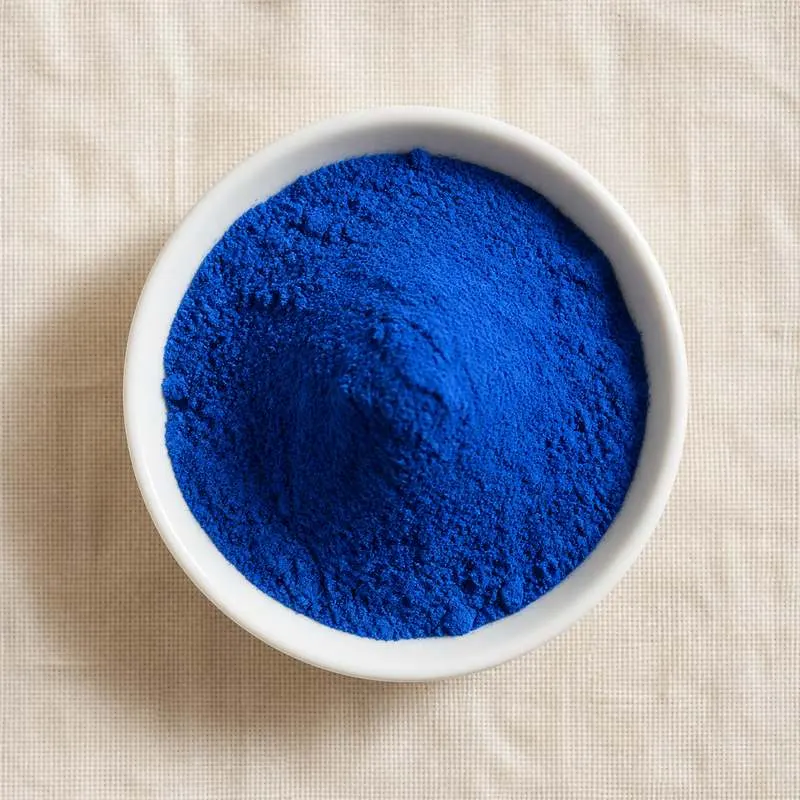
| Appearance | Vivid blue fine powder |
| Phycocyanin Content (E-ratio) | E18 / E25 / E40 / E60 |
| Protein | ≥ 65% |
| Moisture | ≤ 7.0% |
| Ash | ≤ 10% |
| Heavy Metals | ≤ 10 ppm |
| Total Plate Count | ≤ 10,000 cfu/g |
| Salmonella | Negative |
| Purity/Assay (Food Grade) | ≥ 15% |
| Moisture/Loss on Drying | ≤ 7% |
| pH | 6.0 - 8.0 |
| Lead | ≤ 1 ppm |
| Arsenic | ≤ 0.5 ppm |
| Yeast & Mold | ≤ 100 cfu/g |
Common Markets Grades
Phycocyanin is graded by chromatic purity, defined as the ratio of absorbance at 620 nanometers to absorbance at 280 nanometers.
Food-grade material typically sits between 0.7 and 1.5 A620/A280, suitable for confectionery, dairy, and beverage tinting. Reactive-grade and cosmetic-grade phycocyanin runs from 1.5 to 3.0 and is preferred where a cleaner blue with minimal protein background is needed.
Analytical and biotech grades reach 4.0 and above, and are produced by additional chromatographic polishing. These are used in fluorescence labelling, flow cytometry conjugates, and life-science reagents rather than food.
Spray-dried powders dominate the food market, while frozen liquid concentrates are produced for users who prefer to avoid the thermal stress of drying. Acid-stabilised and microencapsulated variants are also available for low-pH beverage applications where naked phycocyanin would precipitate.
Applications
- Confectionery: gummies, jellies, chewing gum, hard candies, and panned coatings in blue, green, and purple shades
- Ice cream, sorbets, and frozen novelties
- Flavoured milks, yogurt drinks, and dairy desserts
- Soft drinks, sports beverages, and ready-to-drink teas with controlled pH
- Frostings, fondants, and cake decorations
- Plant-based proteins and meat-analog seasonings calling for blue or teal accents
- Sushi-style imitation toppings and Asian confectionery
- Powdered drink mixes and effervescent tablets
- Dietary supplements: capsules, tablets, and superfood blends featuring spirulina positioning
- Cosmetics: eyeshadows, nail polishes, body paints, and rinse-off skincare
- Educational and craft products such as edible inks and decorating gels
- Colour-changing novelty products built on the pH and thermal transitions of phycocyanin
Brands Using Phycocyanin
Widely-distributed consumer products that list Phycocyanin on the ingredient label.
- SwansonSwanson Ultra Standardized Spirulina (10% Phycocyanin) 500 mg ↗Swanson product page specifies the patented spirulina delivers 10% phycocyanin per 500 mg vegan capsule.Label verified 2026-05-24
- SwansonSwanson Ultra Spirulina IL-4 (6% Phycocyanin) 500 mg ↗Swanson product page specifies the spirulina extract delivers 6% phycocyanin per 500 mg vegan capsule.Label verified 2026-05-24
- Smarties (Nestle UK)Smarties Chocolate Beans (UK) ↗Nestle UK Smarties Colours & Flavours page lists Spirulina (the source of phycocyanin) as the blue colour in Smarties chocolate beans.Label verified 2026-05-24
Brand names, product names and logos are the property of their owners. They appear here as published evidence that the ingredient is used, taken from the brand's own label or website. Their appearance is not an endorsement, and it does not mean the brand buys from us or from any manufacturer listed on this site.
China Manufacturers of Phycocyanin
Top Phycocyanin manufacturers in China.
 Fuqing King Dnarmsa Spirulina Co., Ltd.4 ingredients in the directory
 Zhejiang Binmei Biotechnology Co., Ltd.7 ingredients in the directory
Company names and logos are the property of the manufacturers themselves. They are listed here because our own directory records them as producing this ingredient. A listing is not an endorsement by them, and we do not represent them or speak on their behalf.
How We Help Source Phycocyanin
Direct Factory Sourcing
We run the whole process: selecting the manufacturer from the top Chinese food ingredient producers, negotiating the price, verifying quality, and coordinating the logistics. You deal with us instead of with several factories at once.
Original Packaging and Documents from the Manufacturer
The manufacturer sends your Phycocyanin out of its own factory in the original packing, through to your destination port. The COA, COO, MSDS, TDS and any certifications reach you from the manufacturer as well.
Free Samples and Lead Time
We send 100 to 500 g free for your own laboratory to test and you cover only the courier, usually within 2 to 3 working days. ETD is usually within 7 to 15 days once the order is confirmed, and we check that date against the factory's own manufacturing schedule before we give it to you.
Combined Shipment
We can load Phycocyanin together with other ingredients such as Beta Carotene, Caramel Colour and Lycopene into one 20' FCL. If your quantity is small, we can also ship LCL.
Regulatory Status
Phycocyanin sits in a somewhat unusual regulatory position because the coloured entity is a protein rather than a discrete small molecule.
In the European Union, spirulina extract is approved as a colouring foodstuff and may also be used as a food ingredient. Its colour contribution is declared as a food rather than as an E-numbered additive in many applications, although member-state interpretations vary.
The U.S. Food and Drug Administration approved spirulina extract as a colour additive for use in candy, chewing gum, and a number of other categories under 21 CFR 73.530, following a 2013 amendment. Subsequent amendments have expanded the list of permitted applications.
JECFA has reviewed spirulina-derived materials and considered them acceptable for use as colours within the limits of good manufacturing practice. Halal and Kosher certifications are routinely available, and the source organism is non-GMO in standard commercial supply.
Manufacturing Process
Production begins with cultivation of Arthrospira platensis in shallow open raceway ponds or in closed photobioreactors, typically in tropical or subtropical regions with abundant sunlight. Major production hubs include China, India, the United States, and parts of Southeast Asia.
Harvested biomass is dewatered by filtration or centrifugation and washed to remove salts from the cultivation medium. Cell disruption is then carried out by repeated freeze-thaw cycles, high-pressure homogenisation, or ultrasonication to release the soluble phycobiliproteins.
The crude blue extract is clarified by centrifugation and depth filtration, then concentrated by ultrafiltration with molecular-weight cutoffs that retain the phycocyanin trimers and hexamers while passing low-molecular-weight impurities. Ammonium sulphate precipitation or chromatographic polishing is used to raise chromatic purity for higher grades.
The concentrate is finally spray-dried under mild inlet temperatures, often with a protective carrier such as maltodextrin or trehalose to preserve colour and protein integrity. Final material is packed under inert atmosphere and stored cool to prevent denaturation and fading.