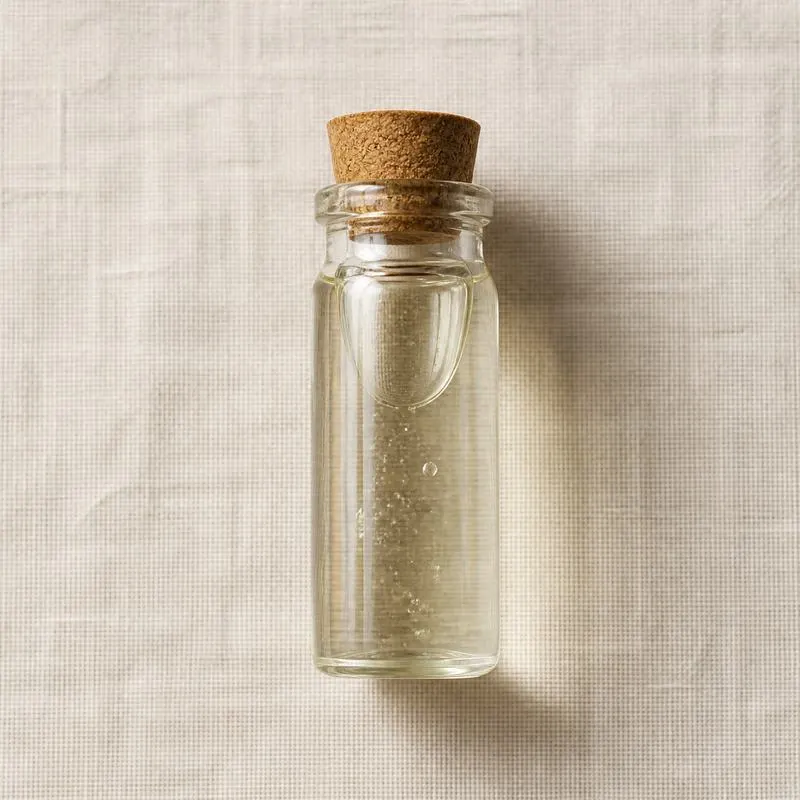
Star Anise Oil
Star anise oil is the essential oil distilled from the fruit, and to a lesser extent the leaves and twigs, of Illicium verum, an evergreen tree grown mainly in southern China and northern Vietnam. It is dominated by trans-anethole, which usually accounts for between eighty five and ninety five percent of the oil and supplies the entire sweet liquorice character, with foeniculin, estragole, limonene and anisaldehyde making up most of the remainder.
Because anethole is the same compound that dominates aniseed oil, the two oils are close substitutes in flavour terms, and star anise oil has largely displaced aniseed oil in volume applications on account of its yield and price. The fruit is also the traditional feedstock for shikimic acid, recovered from the spent material or from a parallel extraction stream.
The oil is a colourless to pale yellow liquid that crystallises or sets to a solid mass below about fifteen to eighteen degrees Celsius, since anethole has a melting point in that region, and drums are warmed and homogenised before use. It is practically insoluble in water, miscible with ethanol and oils, and sensitive to light and air, under which anethole isomerises to the cis form and oxidises to anisaldehyde, giving harsh off notes.
We source bulk Star Anise Oil from top China manufacturers for our partners, working with several of them. The manufacturers are in Jiangxi and Henan. A smaller requirement can ship in a combined container with other ingredients.
Please send the grade you need, the volume and your destination port, and we will come back with a solution and a price.
or call +86-21-6858 0751

Specifications
| Item | Specification |
|---|---|
| Appearance | Colourless to pale yellow liquid, may crystallise below 18 degrees Celsius |
| Odour and Flavour | Characteristic sweet anise, free from off notes |
| Botanical Source | Illicium verum dried fruit |
| trans-Anethole Content | 85.0% to 95.0% by gas chromatography |
| Estragole Content | ≤ 6.0% by gas chromatography |
| Congealing Point | 15.0 to 19.0 degrees Celsius |
| Specific Gravity (20 degrees Celsius) | 0.978 to 0.988 |
| Refractive Index (20 degrees Celsius) | 1.553 to 1.560 |
| Solubility in 90% Ethanol | Soluble in 3 volumes, clear solution |
| Acid Value | ≤ 1.0 mg KOH/g |
| Heavy Metals (as Pb) | ≤ 10 mg/kg |
| Lead | ≤ 2 mg/kg |
| Arsenic | ≤ 1 mg/kg |
| Pesticide Residues | Complies with destination market limits |
Common Markets Grades
The main grade distinction is fruit oil against leaf and twig oil. Fruit oil carries the highest anethole content and the cleanest profile and commands the flavour trade, while leaf and branch oil is lower in anethole and is used mainly as feedstock for anethole isolation rather than as a flavour in its own right. Origin is quoted because Chinese and Vietnamese material differ slightly in minor components.
Crude distilled oil is traded alongside rectified and redistilled grades, which are vacuum distilled to lift anethole content, remove colour and improve cold stability. Oil is specified against a declared anethole range, and buyers in some markets set a limit on estragole because of its toxicological profile. Anethole itself, crystallised from the oil, is sold as a separate article, as is star anise oleoresin.
Applications
- Anise flavoured spirits such as pastis, ouzo, raki and sambuca, where the oil supplies the liquorice character and the louche effect on dilution
- Confectionery, in liquorice sweets, aniseed balls and hard boiled sweets
- Bakery, in anise biscuits, breads and festive baked goods
- Savoury seasoning, as the dominant note in Chinese five-spice and in braising and red cooking stocks
- Meat processing, in marinades, sausage seasoning and pork and duck preparations
- Beverages, in herbal teas, root beer type formulations and non-alcoholic anise drinks
- Oral care and pharmaceutical flavours, masking bitterness in cough syrups and lozenges
- Feedstock for anethole isolation and for the synthesis of anisaldehyde and related aroma compounds
- Shikimic acid supply, where the fruit and processing residues are the traditional botanical source
- Fragrance and household products, in soaps and cleaning product perfumes
Brands Using Star Anise Oil
Widely-distributed consumer products that list Star Anise Oil on the ingredient label.
Brand names, product names and logos are the property of their owners. They appear here as published evidence that the ingredient is used, taken from the brand's own label or website. Their appearance is not an endorsement, and it does not mean the brand buys from us or from any manufacturer listed on this site.
China Manufacturers of Star Anise Oil
Top Star Anise Oil manufacturers in China.
 Jiangxi Baicao Pharmaceutical Co., Ltd.2 ingredients in the directory
- JiangXi HaiRui Natural Plant Co., Ltd.6 ingredients in the directory
- Nanyang Plant Essence Extraction Co., Ltd.18 ingredients in the directory
Company names and logos are the property of the manufacturers themselves. They are listed here because our own directory records them as producing this ingredient. A listing is not an endorsement by them, and we do not represent them or speak on their behalf.
Regulatory Status
In the United States 21 CFR 182.20 lists star anise oil among the essential oils, oleoresins and natural extractives generally recognised as safe for their intended use in food, and it carries FEMA GRAS status as a flavouring substance. The Food and Drug Administration has issued warnings about teas made from Japanese star anise, Illicium anisatum, which is a different and toxic species, so identity confirmation of the botanical source is a standing requirement for this material.
In the European Union star anise oil is a natural flavouring preparation under Regulation (EC) No 1334/2008 on flavourings, which also sets maximum levels for estragole and other biologically active principles that occur naturally in flavourings from botanical sources, and those limits are the reason estragole content appears on many specifications. No E number applies. The Joint FAO/WHO Expert Committee on Food Additives has evaluated anethole and related phenylpropanoid flavouring agents and publishes specifications for them.
Manufacturing Process
Fruit is harvested from mature trees, sun dried to the characteristic red brown star, and graded. For distillation the dried fruit is crushed or coarsely milled to open the seed cavities, then charged into stainless steel stills. Leaf and twig material is processed in a separate campaign because its profile differs.
Extraction is by steam or water distillation over several hours, with the vapour condensed and the oil separated from the distillation water in a Florentine flask. Because anethole has appreciable solubility in hot water, the aqueous phase is usually cohobated, returned to the still, to recover the dissolved fraction and lift yield. Crude oil is decanted, dried and filtered, then rectified under vacuum to raise anethole content and remove colour bodies and heavy residues. Some producers take a chilling and crystallisation step to isolate solid anethole. Finished oil is profiled by gas chromatography, blended to a standard anethole specification, and filled warm into lined drums protected from light and air.