Ultrafine Green Tea
Ultrafine green tea is whole green tea leaf reduced by ultrafine milling to a powder fine enough to be eaten rather than infused, with the bulk of the particle distribution below about 25 micrometres and often below 10. Because the whole leaf is consumed, the product delivers the insoluble fraction that a brewed infusion leaves behind: the fibre, the chlorophyll, the carotenoids and the fat soluble vitamins, alongside the catechins, caffeine and theanine that would go into a cup.
It is distinct from matcha, which comes from shade grown leaf stone milled by a specific traditional method, though the two are often substituted for one another. Ultrafine green tea is produced from ordinary steamed or pan fired green leaf by jet milling or ball milling, and its colour, aroma and price reflect the leaf used rather than a shading regime.
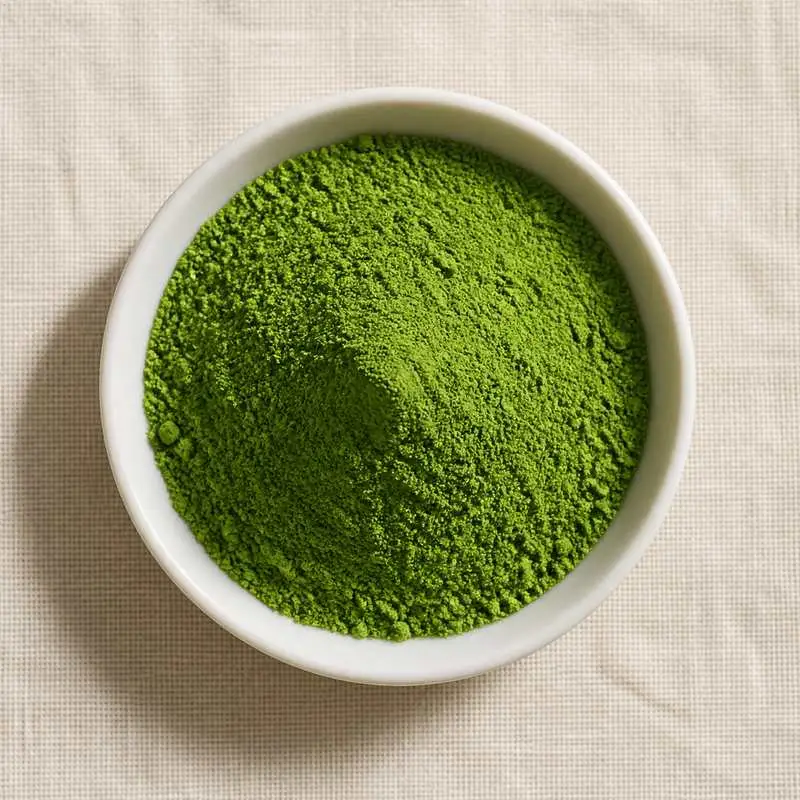
The material is a bright to dull green free flowing powder with a grassy vegetal aroma and a bitter astringent taste. It does not dissolve; it suspends, and particle size decides how long it stays suspended and how smooth it feels in the mouth. Chlorophyll fades from bright green to olive and brown under heat, light, oxygen and alkaline pH, so the powder is packed under nitrogen in opaque containers and held cold.
We source bulk Ultrafine Green Tea from top China manufacturers for our partners. The manufacturer is in Anhui. A smaller requirement can ship in a combined container with other ingredients.
Please send the grade you need, the volume and your destination port, and we will come back with a solution and a price.
or call +86-21-6858 0751
- Function
- Plant extract
Specifications
| Item | Specification |
|---|---|
| Appearance | Bright green fine free flowing powder |
| Odour and Taste | Fresh grassy green tea, bitter and astringent |
| Particle Size D50 | ≤ 10 µm |
| Fineness | ≥ 98% through 800 mesh |
| Moisture | ≤ 6.0% |
| Total Ash | ≤ 8.0% |
| Acid Insoluble Ash | ≤ 1.0% |
| Total Polyphenols | ≥ 12.0% |
| Epigallocatechin Gallate | ≥ 4.0% |
| Caffeine | 2.0 to 4.0% |
| Crude Fibre | ≤ 16.5% |
| Lead | ≤ 5.0 mg/kg |
| Arsenic | ≤ 1.0 mg/kg |
| Total Plate Count | ≤ 10,000 cfu/g |
| Yeast and Mould | ≤ 100 cfu/g |
| E. coli | Negative |
| Salmonella | Absent in 25 g |
Common Markets Grades
Grades are set by particle size, colour and the leaf used. Fineness is quoted as a D50 or as a percentage passing a given micrometre cut, with 300 mesh, 800 mesh and sub-10 micrometre grades commonly offered, and a finer grade commands a higher price because it suspends better and feels smoother. Colour is judged instrumentally on a green index or visually against a reference, and a bright colour normally indicates young leaf and a well controlled cold milling process.
Culinary grades made from later harvest leaf are coarser, more bitter and cheaper, and are intended for baking, ice cream and beverage blends where sugar and dairy mask the astringency. Ceremonial grades from early spring leaf are finer, sweeter and brighter and are used where the powder is tasted directly. Organic certified material is widely traded, and specifications state catechin, epigallocatechin gallate and caffeine content where the powder is being bought for its actives rather than for colour and flavour.
Applications
- Beverage powders and instant green tea drinks, where the whole leaf is suspended rather than brewed
- Milk tea and latte bases, where dairy softens the astringency of the powder
- Ice cream, frozen yoghurt and dairy desserts, providing both colour and flavour
- Bakery products including cakes, cookies and steamed buns, where it colours the crumb green
- Confectionery, chocolate and filled products in the green tea flavour category
- Noodles and pasta, where the powder is worked into the dough for colour and flavour
- Dietary supplements and green food blends sold as whole leaf rather than extract
- Sports nutrition and meal replacement powders, blended dry with protein
- Ready to drink bottled teas in the cloudy whole leaf style
- Cosmetic masks and cleansers, where the milled leaf is used as a mild abrasive and antioxidant
China Manufacturers of Ultrafine Green Tea
Top Ultrafine Green Tea manufacturers in China.

Company names and logos are the property of the manufacturers themselves. They are listed here because our own directory records them as producing this ingredient. A listing is not an endorsement by them, and we do not represent them or speak on their behalf.
Regulatory Status
In the United States green tea powder is a conventional food, and the leaf it is made from requires no additive approval. Pesticide tolerances for tea are set by the Environmental Protection Agency and enforced on import, and residues without a tolerance make a shipment adulterated, which is the main compliance risk for this material since a powder concentrates whatever the leaf carried. Green tea is not a listed colour additive, so it may not be used for the purpose of colouring food in the United States, and where it tints a product green it is declared as an ingredient rather than as a colour.
In the European Union green tea powder is a food carrying no E number, and consumption of tea leaf has a long history so the powder is not a novel food under Regulation 2015/2283. Regulation 396/2005 governs pesticide residues, with limits set for dried tea leaves that apply directly to milled leaf. Where a product supplies green tea catechins at supplement level, Regulation 2022/2340 restricts the epigallocatechin gallate that a daily portion may deliver and imposes specific labelling, so a high dose powder supplement is treated differently from a beverage. Codex has adopted maximum residue limits for pesticides in dried tea, and its general standard for contaminants applies alongside them.
Manufacturing Process
Green leaf is fixed shortly after plucking by steaming or pan firing, which denatures polyphenol oxidase and prevents the oxidation that would turn it into black tea, then rolled lightly and dried. For powder manufacture the dried leaf is destemmed and de-veined, since stem and vein mill poorly and dull the colour, and the remaining leaf blade is graded and cleaned by winnowing, sieving and metal detection.
Milling is the defining step. The cleaned leaf is first coarse ground, then reduced in a jet mill using compressed air or nitrogen, or in a ball mill or stone mill, with the process run cold because frictional heat drives off the aroma and turns the chlorophyll brown. Jet milling is the industrial route and gives the tightest particle distribution; cryogenic milling with liquid nitrogen is used for the finest and brightest grades. The powder is classified by air cyclone so that oversize material returns to the mill, then passed over a fine sieve and a metal detector. Finished powder is cooled, packed under nitrogen in aluminium laminate or opaque containers with an oxygen absorber, and held under refrigeration to protect the colour.