Matcha
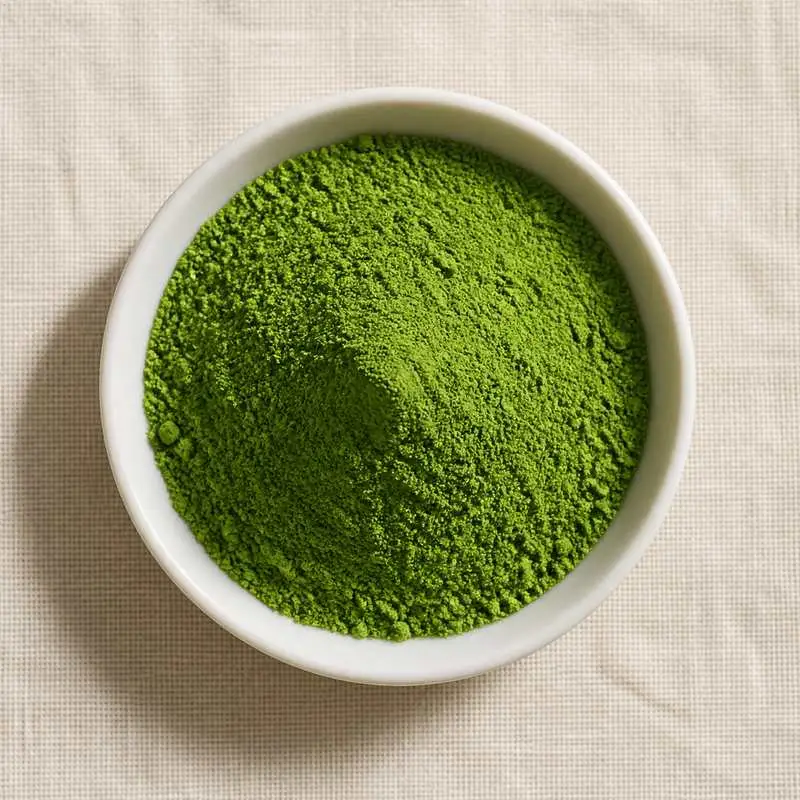
Matcha is a finely milled green powder produced by stone-grinding shade-grown Camellia sinensis leaves known as tencha.
The shading regime, typically 20 to 30 days under bamboo mats or synthetic netting before harvest, drives the leaves to elevate chlorophyll and L-theanine while suppressing catechin development. The result is the vivid jade colour and the soft, umami-forward profile that define the category.
Unlike steeped tea, matcha is consumed as a suspension of the whole leaf. A single bowl therefore delivers the full leaf load of chlorophyll, L-theanine, caffeine, catechins, and fibre.
We source bulk Matcha from top China manufacturers for our partners, working with several of them. The manufacturers are mostly in Zhejiang, Anhui and Hunan. For this ingredient the minimum order is 50 kg and a 20-foot container takes 4.8 MT, and a smaller requirement can ship in a combined container with other ingredients.
Please send the grade you need, the volume and your destination port, and we will come back with a solution and a price.
or call +86-21-6858 0751
- Minimum order
- 50 kg
- Qty in 20' FCL
- 4.8 MT
- Packaging
- 25 kg kraft paper bag with PE inner liner
- ISO 9001
- HACCP
- Halal
- Kosher
Specifications
| Item | Specification |
|---|---|
| Appearance | Bright jade-green ultra-fine powder |
| Odour & Taste | Fresh grassy aroma, umami sweet taste |
| Particle Size | D50 ≤10 μm / 800 mesh pass ≥95% |
| Moisture | ≤6.0% |
| Ash | ≤8.0% |
| Caffeine | 2.5–4.5% |
| Tea Polyphenols | ≥20.0% |
| L-Theanine | ≥1.0% |
| Chlorophyll | ≥0.5% |
| Heavy Metals (as Pb) | ≤2.0 mg/kg |
| Pesticide Residue | Meets EU / JP standards |
| Total Plate Count | ≤3,000 cfu/g |
| E. coli / Salmonella | Negative |
Common Markets Grades
Matcha is graded across a wide quality ladder, with grade determined by harvest, shading, leaf selection, and grinding method.
Ceremonial grade uses first-flush leaves (ichibancha) from late April and early May, shaded the full 21 to 30 days, with stem and vein removal before grinding. The powder is bright jade, fine to roughly 5 to 10 micrometers, and reserved for direct whisking with hot water.
Premium ceremonial and competition-grade material commands the top of the market. Origin is usually Uji (Kyoto), Nishio (Aichi), or Yame (Fukuoka).
Culinary or ingredient grade comes from later harvests, often with shorter shading and a coarser grind. It carries more astringency and a deeper tone, well-suited to baking, ice cream, and beverages where added sugar and dairy buffer the bitterness.
Industrial matcha for ready-to-drink beverages, food colouring, and confectionery is sold at lower price points, sometimes from Chinese production in Zhejiang province.
Applications
- Traditional whisked matcha (usucha and koicha) prepared with a bamboo chasen
- Matcha lattes with steamed dairy or plant milk
- Bottled and canned ready-to-drink matcha beverages
- Matcha-flavoured ice cream, gelato, and frozen yogurt
- Bakery applications including financiers, madeleines, cookies, and laminated pastries
- Confectionery: chocolate truffles, KitKat-style coatings, and Japanese wagashi
- Energy bars and protein cookies for natural green colour and caffeine
- Pre-workout and nootropic supplement blends leveraging L-theanine and caffeine
- Skincare powders, masks, and serums for the chlorophyll and EGCG profile
- Soft-serve and shaved-ice toppings
Brands Using Matcha
Widely-distributed consumer products that list Matcha on the ingredient label.
- AiyaOrganic Ceremonial Matcha (30g Tin) ↗USDA organic, shade-grown, first-harvest, stone-ground matcha from Nishio, Japan; single-ingredient ceremonial-grade green tea powder.Label verified 2026-05-24
- Jade Leaf MatchaOrganic Ceremonial Matcha - Teahouse Edition ↗100% organic Japanese first-harvest matcha green tea powder, stone-ground from Uji/Kagoshima farms; no fillers or additives.Label verified 2026-05-24
- EnchaOrganic Ceremonial Grade Matcha ↗First-harvest, stone-ground organic matcha from Uji, Japan; single-ingredient ceremonial matcha powder.Label verified 2026-05-24
- Ippodo TeaUmmon Matcha (40g Can) ↗Stone-milled Japanese green tea powder from Kyoto (Ippodo, est. 1717); ceremonial-grade matcha for usucha and koicha.Label verified 2026-05-24
- Ippodo TeaSayaka Matcha (40g Can) ↗Stone-milled ceremonial-grade matcha powder; rich and smooth profile for usucha, koicha and lattes.Label verified 2026-05-24
Brand names, product names and logos are the property of their owners. They appear here as published evidence that the ingredient is used, taken from the brand's own label or website. Their appearance is not an endorsement, and it does not mean the brand buys from us or from any manufacturer listed on this site.
China Manufacturers of Matcha
Top Matcha manufacturers in China.
- Eastsign Foods (Quzhou) Co., Ltd.3 ingredients in the directory
- Hangzhou Heronsbill Food Technology Co., Ltd.1 ingredient in the directory
 Hangzhou Mingbao Bio-tech Co., Ltd.2 ingredients in the directory
 Liling Xiangwang Food Manufacturing Co., Ltd.1 ingredient in the directory
 XiYe Matcha2 ingredients in the directory
 Yuzhi Forest Matcha (Chizhou) Co., Ltd.3 ingredients in the directory
 Yuzhi Senbanyuan (Shanghai) Tea Co., Ltd.3 ingredients in the directory
 Zhejiang Minghuang Natural Food Development Co., Ltd.2 ingredients in the directory
Company names and logos are the property of the manufacturers themselves. They are listed here because our own directory records them as producing this ingredient. A listing is not an endorsement by them, and we do not represent them or speak on their behalf.
How We Help Source Matcha
Direct Factory Sourcing
We run the whole process: selecting the manufacturer from the top Chinese food ingredient producers, negotiating the price, verifying quality, and coordinating the logistics. You deal with us instead of with several factories at once.
Original Packaging and Documents from the Manufacturer
The manufacturer sends your Matcha out of its own factory in the original packing, through to your destination port. The COA, COO, MSDS, TDS and any certifications reach you from the manufacturer as well.
Free Samples and Lead Time
We send 100 to 500 g free for your own laboratory to test and you cover only the courier, usually within 2 to 3 working days. ETD is usually within 7 to 15 days once the order is confirmed, and we check that date against the factory's own manufacturing schedule before we give it to you.
Combined Shipment
We can load Matcha together with other ingredients such as Astaxanthin, Dehydrated Garlic and Lutein into one 20' FCL. If your quantity is small, we can also ship LCL.
Regulatory Status
Matcha is a conventional food ingredient in essentially every market and does not require special approval.
In the United States it is treated as ground green tea. Caffeine content is the main labelling consideration, typically 30 to 70 mg per gram of powder depending on cultivar and grade.
In the European Union it is treated as ground green tea (Camellia sinensis) without novel food status. Importers track pesticide MRLs closely.
Japanese Agricultural Standard (JAS) Organic and EU Organic are widely available for premium grades from Uji, Nishio, Yame, and Kagoshima. Country-of-origin disclosure has become the dominant quality signal in the retail channel.
Manufacturing Process
The plants are Camellia sinensis var. sinensis, grown on traditional tea cultivars such as Yabukita, Samidori, Asahi, and Okumidori.
Three to four weeks before harvest, the rows are covered with shading material that blocks 70 to 95 percent of incoming light. The shading drives elevated chlorophyll and amino acid accumulation.
Harvest is by hand for top grades and by machine for culinary grades. The leaves are immediately steamed (about 15 to 20 seconds) to halt oxidation, then air-dried without rolling. At this stage the product is called aracha.
The aracha goes through stem and vein removal on a series of cutters and air-classifiers. The cleaned leaf flake is the tencha that feeds the mill.
Final grinding is done on granite stone mills turning at roughly 30 rpm. A single mill produces only 30 to 40 grams of ceremonial-grade matcha per hour. The slow speed and low temperature preserve colour and aroma.