Dehydrated Garlic
Dehydrated Garlic is the moisture-reduced form of Allium sativum cloves, processed into a shelf-stable ingredient that retains the pungent character and sulphur chemistry of the fresh bulb.
The starting material is mature, peeled cloves harvested at full bulb maturity. Water content is brought from roughly 65 percent down to 5 to 7 percent through controlled hot-air drying or, for premium grades, freeze drying. The resulting product can be sold as cloves, slices, granules, or powder depending on downstream use.
We source bulk Dehydrated Garlic from top China manufacturers for our partners, working with several of them. The manufacturers are mostly in Shandong, Jiangsu and Anhui. For this ingredient the minimum order is 500 kg and a 20-foot container takes 18 MT, and a smaller requirement can ship in a combined container with other ingredients.
Please send the grade you need, the volume and your destination port, and we will come back with a solution and a price.
or call +86-21-6858 0751
- Minimum order
- 500 kg
- Qty in 20' FCL
- 18 MT
- Packaging
- 25 kg kraft paper bag with PE inner liner
- ISO 9001
- HACCP
- Halal
- Kosher
Specifications
| Item | Specification |
|---|---|
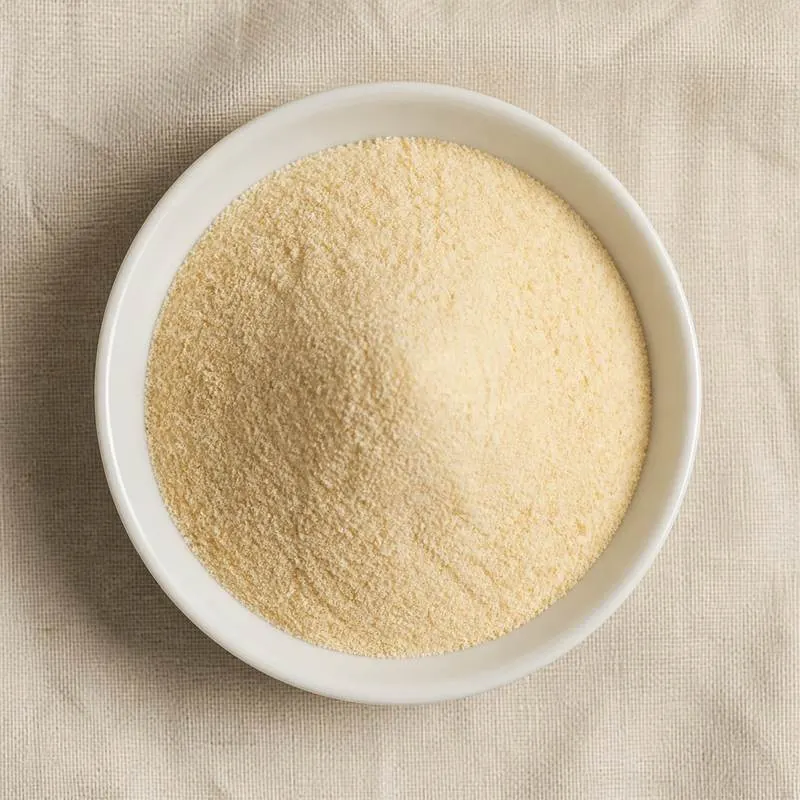
| Appearance | White to cream-white flakes / granules / powder |
| Moisture | ≤6.5% |
| Volatile Oil | ≥0.3% |
| Allicin Content | ≥0.4% |
| Ash | ≤5.0% |
| Foreign Matter | ≤0.5% |
| SO₂ Residue | ≤30 mg/kg |
| Pesticide Residue | Meets EU / GB 2763 |
| Lead | ≤0.5 mg/kg |
| Total Plate Count | ≤100,000 cfu/g |
| E. coli | Negative |
| Salmonella | Absent in 25g |
Common Markets Grades
Dehydrated Garlic is graded by particle size, drying method, and residual moisture.
Whole dried cloves and split halves are the coarsest grade, used where visual identity matters. Slices and large flakes are next, followed by minced (2 to 4 mm), granulated (0.5 to 1 mm), and powder (typically below 200 mesh).
Hot-air dried material is the commodity standard, with a strong cooked-garlic aroma due to thermal generation of secondary sulphur compounds. Freeze-dried grades retain a more raw, sharp profile and a lighter colour, and are preferred for seasoning blends marketed as fresh tasting.
Specifications usually call out volatile oil content (a proxy for pungency), allicin yield potential, and microbiological status. Steam-sterilised and ETO-free options are widely available for ready-to-eat applications.
Applications
- Seasoning blends for meat, poultry, and seafood rubs
- Sauce and dressing bases including marinara, pesto, and vinaigrettes
- Snack coatings for chips, crackers, and extruded snacks
- Instant noodle and ramen seasoning sachets
- Soup and bouillon mixes, both retail and food-service formats
- Sausage, salami, and cured-meat formulations
- Ready-meal and frozen-entree production where fresh garlic is impractical
- Bakery products such as garlic bread, focaccia, and savory crackers
- Pickling brines and condiment manufacturing
- Spice premixes for curries, taco seasoning, and barbecue blends
- Plant-based meat analogs requiring a savory base note
- Dietary supplements positioned around garlic actives
Brands Using Dehydrated Garlic
Widely-distributed consumer products that list Dehydrated Garlic on the ingredient label.
- McCormickMcCormick Garlic Powder (3.12 oz) ↗Single-ingredient pure dehydrated/ground garlic (Allium sativum) sold as garlic powder with no fillers or salt added.Label verified 2026-05-24
- McCormickMcCormick Garlic Salt (5.25 oz) ↗Ingredients: Salt, Garlic, Calcium Silicate (to make free flowing), and Garlic Oil. Garlic = dehydrated garlic.Label verified 2026-05-24
- Simply OrganicSimply Organic Garlic Powder (3.64 oz) ↗Single ingredient: organic dehydrated garlic (Allium sativum). No additives or fillers.Label verified 2026-05-24
- Frontier Co-opFrontier Co-op Garlic Powder, Organic (1 lb) ↗Made from dehydrated garlic bulbs (Allium sativum), kosher, non-irradiated. Single ingredient.Label verified 2026-05-24
- Spice IslandsSpice Islands Garlic Salt ↗Contains salt, dehydrated garlic, natural flavours, and less than 2% silicon dioxide to prevent caking.Label verified 2026-05-24
- Penzeys SpicesPenzeys Garlic Salt ↗Hand-mixed from coarse flake salt, granulated (dehydrated) garlic and minced parsley.Label verified 2026-05-24
- Hidden ValleyHidden Valley Garlic Ranch Dressing ↗Listed: 'Vegetable Oil... Salt, Sugar, Garlic (Dried), Less than 1% of: Buttermilk, Onion (Dried)...' Garlic (Dried) = dehydrated garlic.Label verified 2026-05-24
- Lipton (Unilever)Lipton Recipe Secrets Savory Herb with Garlic Soup & Dip Mix ↗Ingredients include 'Garlic (Dehydrated) (Sulfites)' along with onion powder, garlic powder, and seasonings.Label verified 2026-05-24
Brand names, product names and logos are the property of their owners. They appear here as published evidence that the ingredient is used, taken from the brand's own label or website. Their appearance is not an endorsement, and it does not mean the brand buys from us or from any manufacturer listed on this site.
China Manufacturers of Dehydrated Garlic
Top Dehydrated Garlic manufacturers in China.
- Fullrich Food & Spice Ingredients (Anhui) Co., Ltd.2 ingredients in the directory
 Hebei Huayu Yongcheng Food Co., Ltd.4 ingredients in the directory
 Henan Sunny Foodstuff Co., Ltd.5 ingredients in the directory
 Linquan Zerun Plant & Spice Co., Ltd.9 ingredients in the directory
 Linyi Hengmao Foods Co., Ltd.4 ingredients in the directory
 Qingdao Lulin Processed Vegetable Co., Ltd.1 ingredient in the directory
- Qingdao UnisonEco Technology Food Co., Ltd.1 ingredient in the directory
 Taizhou Shubenshu Food Co., Ltd.1 ingredient in the directory
 Xinghua Dongao Food Co., Ltd.1 ingredient in the directory
 Xinghua Kanghua Foods Co., Ltd.1 ingredient in the directory
Company names and logos are the property of the manufacturers themselves. They are listed here because our own directory records them as producing this ingredient. A listing is not an endorsement by them, and we do not represent them or speak on their behalf.
How We Help Source Dehydrated Garlic
Direct Factory Sourcing
We run the whole process: selecting the manufacturer from the top Chinese food ingredient producers, negotiating the price, verifying quality, and coordinating the logistics. You deal with us instead of with several factories at once.
Original Packaging and Documents from the Manufacturer
The manufacturer sends your Dehydrated Garlic out of its own factory in the original packing, through to your destination port. The COA, COO, MSDS, TDS and any certifications reach you from the manufacturer as well.
Free Samples and Lead Time
We send 100 to 500 g free for your own laboratory to test and you cover only the courier, usually within 2 to 3 working days. ETD is usually within 7 to 15 days once the order is confirmed, and we check that date against the factory's own manufacturing schedule before we give it to you.
Combined Shipment
We can load Dehydrated Garlic together with other ingredients such as Astaxanthin, Lutein and Matcha into one 20' FCL. If your quantity is small, we can also ship LCL.
Regulatory Status
Dehydrated garlic is treated as a food ingredient rather than an additive in most regulated markets. It is not assigned an E number.
The U.S. Food and Drug Administration considers dehydrated garlic a common spice and condiment, with relevant identity and quality guidance issued through the spice industry trade associations.
The European Spice Association (ESA) publishes quality minima covering ash content, moisture, volatile oil, and microbiological limits. Pesticide residues are controlled under standard EU MRLs for Allium crops.
Pharmacopoeial monographs for Allium sativum dried bulb appear in the European Pharmacopoeia and the United States Pharmacopeia for use in herbal preparations. Kosher and Halal certificates are routinely available.
Manufacturing Process
Garlic bulbs are harvested when the lower leaves dry down, then cured in ventilated sheds for several weeks to firm the skins and reduce surface moisture.
At the processing plant the bulbs are broken, peeled by mechanical or pneumatic separators, and washed. Cloves are sliced to a uniform thickness to ensure even drying. Slice thickness is one of the most important process parameters because it sets the drying time and the degree of enzymatic conversion that occurs during the heat-up phase.
Hot-air drying is conducted in multi-stage tunnel dryers. Initial stages run cooler (50 to 60 C) to preserve colour and limit caramelization. Final stages bring the temperature higher to drive off bound water and lock the product below the moisture threshold for microbial stability.
Freeze-dried garlic is produced by freezing the sliced material on trays and sublimating the ice under vacuum. The process is energy-intensive but yields a porous structure that rehydrates rapidly and preserves more of the volatile sulphur compounds.
Dried material is then milled, sieved, and blended to the requested specification before metal detection and packaging.