Caramel
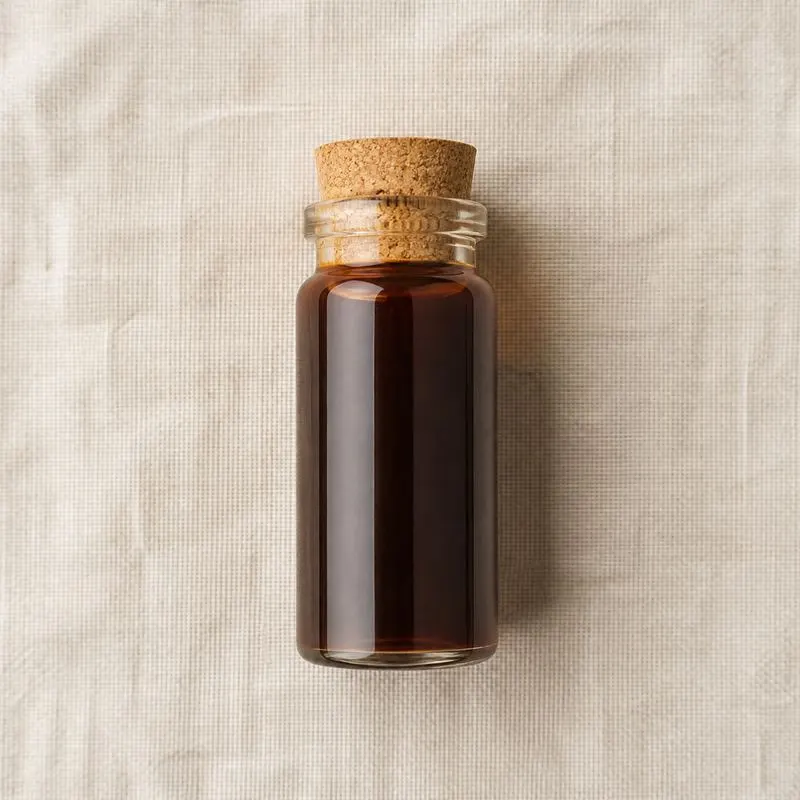
Caramel colour is the brown to almost black colouring matter obtained by controlled heat treatment of food grade carbohydrates, with or without acids, alkalis or salts acting as reaction promoters. It is not a single compound but a complex colloidal mixture of caramelan, caramelen and higher condensation products carrying a distribution of molecular weights, and it is by volume the most widely used food colour in the world.
Four classes are recognised, distinguished by the reactants used. Class I, plain caramel, uses no ammonium or sulphite compounds. Class II, caustic sulphite caramel, uses sulphites but no ammonium. Class III, ammonia caramel, uses ammonium compounds but no sulphites. Class IV, sulphite ammonia caramel, uses both. The classes differ in hue, in tinctorial strength and above all in the ionic charge of their colloid: Class I and III carry a positive charge at low pH, Class II and IV a negative one. Matching that charge to the charge of the substrate is what prevents flocculation.
The material trades as a viscous dark liquid at roughly 50 to 70 percent solids, and as a spray dried or vacuum dried powder. It is fully water soluble, insoluble in oil, and stable to heat, light and normal food pH, which is why it is used where anthocyanins and other plant pigments would fail.
We source bulk Caramel from top China manufacturers for our partners. The manufacturers are in Sichuan and Shanghai. A smaller requirement can ship in a combined container with other ingredients.
Please send the grade you need, the volume and your destination port, and we will come back with a solution and a price.
or call +86-21-6858 0751
- Function
- Colorant
Specifications
| Item | Specification |
|---|---|
| Appearance | Dark brown to black viscous liquid |
| Colour Intensity, absorbance 0.1% at 610 nm | 0.100 to 0.180 |
| Hue Index, A510 divided by A610 | 4.0 to 6.0 |
| Total Solids | 60.0% to 70.0% |
| pH | 2.5 to 3.5 |
| Specific Gravity at 20 degrees Celsius | 1.25 to 1.35 |
| Total Nitrogen | 3.5% maximum on colour solids |
| Total Sulphur | 3.5% maximum on colour solids |
| 4-Methylimidazole | 200 mg/kg maximum on colour solids |
| Lead | 2 mg/kg maximum |
| Arsenic | 1 mg/kg maximum |
| Mercury | 1 mg/kg maximum |
| Total Plate Count | 100 cfu/g maximum |
| Yeast and Mould | 50 cfu/g maximum |
Common Markets Grades
Grades are specified first by class, then by colour intensity and by the technical properties that follow from the class. Colour intensity is quoted as absorbance of a 0.1 percent solution in a 1 cm cell at 610 nm, running from roughly 0.01 for weak beverage grades to 0.6 and above for the strongest double strength Class IV products. Hue index, the ratio of absorbance at 510 nm to that at 610 nm, is quoted alongside it and describes whether the shade is a red brown or a neutral to yellow brown.
Beyond intensity, buyers select on isoelectric point and colloidal charge, on alcohol tolerance and salt tolerance, and on the tannin or acid stability the application demands. Class III grades are made in beer stable and soy sauce grades; Class IV is made in acid proof beverage grades for cola and in double strength versions for bakery and pet food. Both liquid and powder forms are traded, powder being chosen where freight and microbiological handling favour a dry ingredient. Sulphite free and ammonia free declarations follow directly from the class rather than being an option within a class.
Applications
- Cola and other dark carbonated soft drinks, using acid proof Class IV for stability at low pH and in the presence of phosphoric acid
- Beer, malt beverages and stout, where beer stable Class III sets colour without affecting foam
- Soy sauce, oyster sauce and dark seasoning liquids, deepening the colour of shorter brewed products
- Spirits including whisky, rum and brandy, where plain Class I caramel standardises colour between batches
- Bakery products, biscuits and dark breads, giving a baked appearance independent of oven browning
- Gravies, stocks, bouillon and instant soups, providing a roasted brown that survives long hold times
- Confectionery, toffee and liquorice, contributing colour where the sugar cook alone would not reach the target shade
- Meat products, marinades and glazes, imitating the colour of surface searing
- Pet food, kibble and treats, where high colour strength grades are dosed at low levels
- Vinegar, balsamic style condiments and pickles, standardising the depth of colour
Brands Using Caramel
Widely-distributed consumer products that list Caramel on the ingredient label.
Brand names, product names and logos are the property of their owners. They appear here as published evidence that the ingredient is used, taken from the brand's own label or website. Their appearance is not an endorsement, and it does not mean the brand buys from us or from any manufacturer listed on this site.
China Manufacturers of Caramel
Top Caramel manufacturers in China.
- Chengdu Wutou Caramel Biotechnology Co., Ltd.6 ingredients in the directory
- Shanghai LuoLuo Food Technology Co., Ltd.3 ingredients in the directory
Company names and logos are the property of the manufacturers themselves. They are listed here because our own directory records them as producing this ingredient. A listing is not an endorsement by them, and we do not represent them or speak on their behalf.
Regulatory Status
In the United States, 21 CFR 73.85 lists caramel as a colour additive exempt from certification and allows its use in foods generally in amounts consistent with good manufacturing practice. The regulation defines the permitted reactants and the class definitions used commercially. California requires a warning for exposures above a set threshold to 4-methylimidazole, a by-product of the ammonia caramel classes, which in practice has driven reformulation towards lower 4-methylimidazole Class IV grades in beverages sold in that state.
In the European Union, Regulation (EC) No 1333/2008 authorises the four classes as separate additives: E 150a plain caramel, E 150b caustic sulphite caramel, E 150c ammonia caramel and E 150d sulphite ammonia caramel, with identity and purity criteria in Regulation (EU) No 231/2012 covering colour intensity, nitrogen and sulphur content, 4-methylimidazole and 2-acetyl-4-tetrahydroxybutylimidazole. The European Food Safety Authority re-evaluated all four classes and they remain authorised. JECFA has evaluated caramel colours class by class and specifications appear in the Combined Compendium of Food Additive Specifications, with the classes carried through the Codex General Standard for Food Additives.
Manufacturing Process
The feedstock is a food grade carbohydrate, in practice glucose syrup, high dextrose corn syrup, sucrose, invert sugar or molasses. It is charged to a jacketed pressure reactor with water and with the reaction promoter appropriate to the class: none for Class I, sulphite salts for Class II, ammonium salts for Class III, and both for Class IV. The batch is heated under pressure at roughly 120 to 160 degrees Celsius, and the temperature, pressure, pH and hold time are held to a narrow window because they determine tinctorial strength, hue index and colloidal charge together.
When the target absorbance is reached the reaction is stopped by rapid cooling and neutralisation. The liquor is filtered or centrifuged to remove insoluble condensation products, then adjusted to the specified solids, colour intensity and pH. Liquid product is pasteurised and filled. Powder grades are taken from the same standardised liquor and spray dried, or vacuum dried and milled, to a hygroscopic dark powder that is packed with a moisture barrier. Process control for Class III and IV includes monitoring of the reaction by-product 4-methylimidazole, which is limited by specification and which the reaction conditions are tuned to suppress.