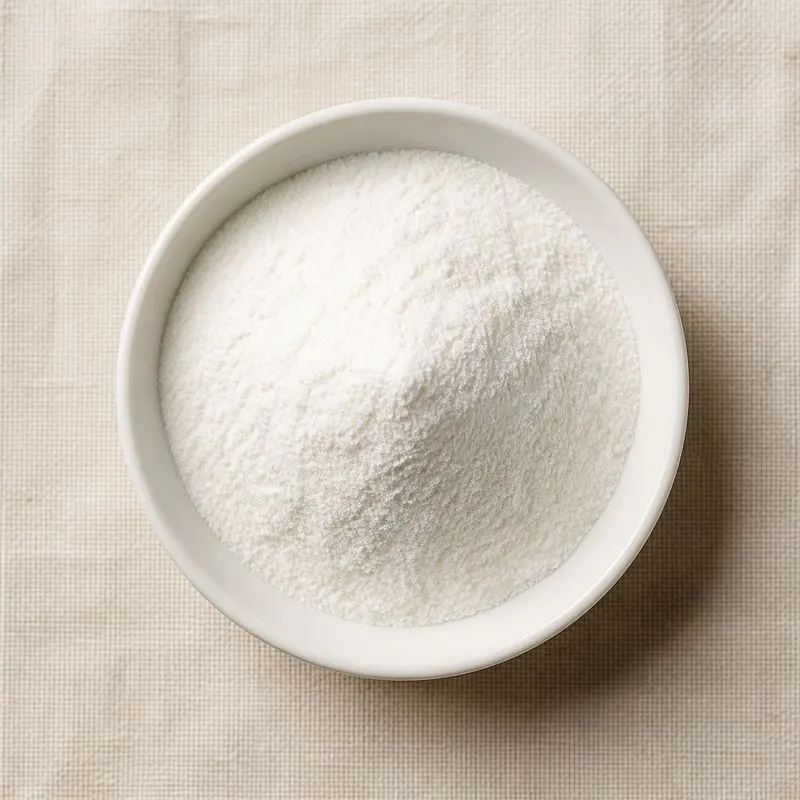
Organic Oat Flour
Organic oat flour is the milled product of heat stabilised, dehulled oat groats from Avena sativa, produced from grain grown and handled under certified organic rules. Because the whole groat is milled with its bran and germ intact, standard oat flour is a wholegrain flour rather than a refined endosperm flour.
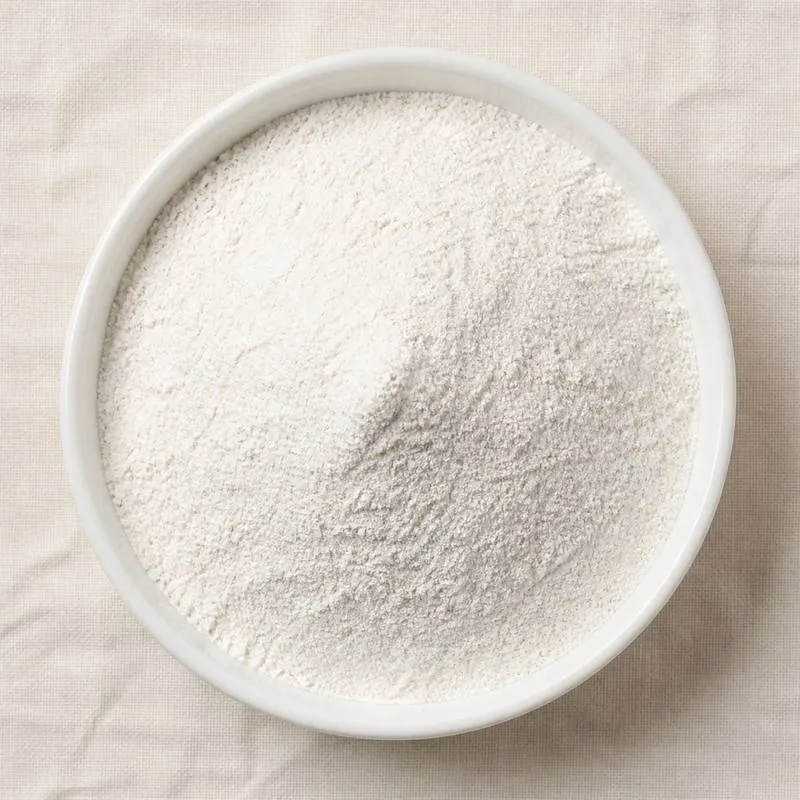
It is a fine cream to pale beige powder carrying starch, protein at 12 to 16 percent, oil at 5 to 9 percent and beta-glucan soluble fibre at 3.5 to 5 percent. Oat proteins form no gluten network, so the flour cannot raise a dough on its own and is used either as a partial replacement in wheat systems or as a base in gluten free formulas that rely on hydrocolloids or egg for structure. What it does contribute is water binding and viscosity: the beta-glucan dissolves and thickens the aqueous phase, which softens crumb and slows staling.
The flour hydrates rather than dissolving, forming a smooth colloidal suspension in which the fibre is soluble and the starch and protein are not. Shelf life depends entirely on the upstream kilning step, since unstabilised oat lipase generates free fatty acids and a soapy off flavour within weeks. Stabilised flour holds twelve months in cool dry storage.
We source bulk Organic Oat Flour from top China manufacturers for our partners. The manufacturer is in Beijing. A smaller requirement can ship in a combined container with other ingredients.
Please send the grade you need, the volume and your destination port, and we will come back with a solution and a price.
or call +86-21-6858 0751
- Function
- Nutraceutical
Specifications
| Item | Specification |
|---|---|
| Appearance | Fine free flowing powder, cream to pale beige |
| Identification | Conforms to milled Avena sativa groat |
| Particle size | 95 percent through 100 mesh |
| Moisture | 11.0 percent maximum |
| Protein, dry basis | 12.0 percent minimum |
| Fat | 5.0 to 9.0 percent |
| Beta-glucan | 3.5 percent minimum |
| Ash | 2.2 percent maximum |
| Free fatty acids, as oleic | 1.0 percent maximum |
| Lead | 0.2 mg/kg maximum |
| Arsenic | 0.5 mg/kg maximum |
| Cadmium | 0.1 mg/kg maximum |
| Total plate count | 10,000 cfu/g maximum |
| Yeast and mould | 500 cfu/g maximum |
| Escherichia coli | Absent in 1 g |
| Salmonella | Absent in 25 g |
Common Markets Grades
Oat flour is graded by particle size and by the fraction of the groat it represents. Standard wholegrain flour is milled to 80 to 100 mesh; fine grades at 120 to 200 mesh are specified for beverages, infant cereals and smooth textured bakery. Coarse grades and oat powders at 40 to 60 mesh sit between flour and cut groats and are used where a perceptible grain particle is wanted.
Fractionated grades are traded alongside the wholegrain material: oat bran flour, air classified to concentrate beta-glucan to 8 percent or more, and low fat or defatted oat flour produced by solvent or supercritical extraction for applications where the native oil limits shelf life. Buyers also specify gluten free certified flour from segregated fields and dedicated mills, low microbial or heat treated flour for ready to eat use, and pregelatinised flour that has been drum dried so it thickens in cold water. Organic certification is layered over any of these grades.
Applications
- Gluten free bakery blends, where oat flour supplies bulk, a mild sweet flavour and moisture retention that offsets the dryness of rice and starch bases
- Wheat bakery, where oat flour at 10 to 30 percent of the flour weight raises soluble fibre and slows crumb firming
- Biscuits, cookies and oatcakes, where the absence of gluten keeps the bite short and tender
- Instant beverage and drink powders, where fine flour disperses into a smooth suspension with body from the beta-glucan
- Infant and toddler cereals, where fine oat flour cooks to a smooth low allergen porridge
- Oat drink manufacture, where flour is slurried and enzymatically hydrolysed to a naturally sweet liquid base
- Meal replacement and sports nutrition powders, where oat flour is the slow releasing carbohydrate carrier
- Soups, sauces and gravies, where pregelatinised grades thicken without a separate cooking step
- Meat and vegetarian patty binders, where the flour absorbs free moisture and limits cook loss
- Coatings and batters for baked snacks, where the flour toasts to a nutty crust
Brands Using Organic Oat Flour
Widely-distributed consumer products that list Organic Oat Flour on the ingredient label.
- Anthony's GoodsOrganic Whole Grain Oat Flour ↗USDA certified organic whole grain oat flour sold as a gluten free alternative to wheat flour.Label verified 2026-08-31
- Terrasoul SuperfoodsOat Flour ↗Finely milled organic oat flour packaged for baking.Label verified 2026-08-31
Brand names, product names and logos are the property of their owners. They appear here as published evidence that the ingredient is used, taken from the brand's own label or website. Their appearance is not an endorsement, and it does not mean the brand buys from us or from any manufacturer listed on this site.
China Manufacturers of Organic Oat Flour
Top Organic Oat Flour manufacturers in China.
Company names and logos are the property of the manufacturers themselves. They are listed here because our own directory records them as producing this ingredient. A listing is not an endorsement by them, and we do not represent them or speak on their behalf.
Regulatory Status
In the United States oat flour is an ordinary food ingredient requiring no additive clearance, and whole oat flour is one of the eligible sources under the FDA authorised health claim on soluble fibre from certain foods and coronary heart disease risk at 21 CFR 101.81, provided the qualifying beta-glucan level per serving is met. Organic status is certified separately under the US Department of Agriculture National Organic Program, 7 CFR Part 205. Oats are not a major allergen in their own right in the United States, but any gluten free claim requires compliance with the 20 parts per million threshold of 21 CFR 101.91, which in practice means segregated grain and dedicated milling.
In the European Union oat flour is a normal food under general food law, with organic production and labelling controlled by Regulation (EU) 2018/848. Oats are listed among the cereals containing gluten that must be declared under the Food Information to Consumers Regulation, with the recognised qualification that uncontaminated oats are tolerated by most people with coeliac disease. Statutory maximum levels for mycotoxins in cereals apply, with T-2 and HT-2 toxins of particular relevance to oats, and pesticide maximum residue levels apply as to any crop. Codex Alimentarius covers the material through its general standards for contaminants in cereals and its guidelines for organically produced foods.
Manufacturing Process
Certified organic oats are cleaned on scalpers, aspirators, destoners, magnets and optical sorters, with wheat, barley and rye kernels targeted specifically where gluten free flour is the destination. Cleaned grain is kilned in steam and hot air, which denatures lipase and lipoxygenase and fixes the shelf life of the finished flour, then dried, cooled and dehulled on impact hullers. Hulls are aspirated away and gravity tables return unhulled kernels for a second pass, leaving clean groats.
Groats go to the mill, where the route depends on the fat content of the grain. Hammer mills with screen classification handle standard flour, while roller mills or pin mills fitted with air classifiers are used for finer grades, since the oil in the groat makes oat stock prone to smearing and screen blinding and the stock is often chilled to keep it friable. Milled flour passes through rotary or plansifters to the target mesh, with oversize returned to the mill. Where a bran enriched or beta-glucan concentrated grade is wanted, air classification separates the light protein and fibre rich fines from the heavier starch fraction. Finished flour is passed over a security sieve, magnets and metal detection and either bulk loaded or bagged. Where a low microbial count is specified, a steam or infrared pasteurisation pass is added after milling. Organic and gluten free integrity is held by segregated intake, dedicated or flushed lines and audited chain of custody.