Vegetable Carbon Black
Vegetable Carbon Black is a finely divided black pigment produced by the controlled carbonisation of plant material such as coconut shell, peat, or selected hardwoods. It is registered in the European Union as E153 and carries CAS number 7440-44-0 as elemental carbon.
The material is essentially insoluble in water and oil and functions as a dispersed pigment rather than a true dye. It delivers a dense, neutral, blue-undertone black at low use levels and is the leading natural alternative to synthetic blacks such as brilliant black PN.
We source bulk Vegetable Carbon Black from top China manufacturers for our partners, working with several of them. The manufacturers are in Shandong, Anhui and Zhejiang. A smaller requirement can ship in a combined container with other ingredients.
Please send the grade you need, the volume and your destination port, and we will come back with a solution and a price.
or call +86-21-6858 0751
- Packaging
- 25 kg kraft paper bag with PE inner liner
- ISO 9001
- HACCP
- Halal
- Kosher
Specifications
| Item | Specification |
|---|---|
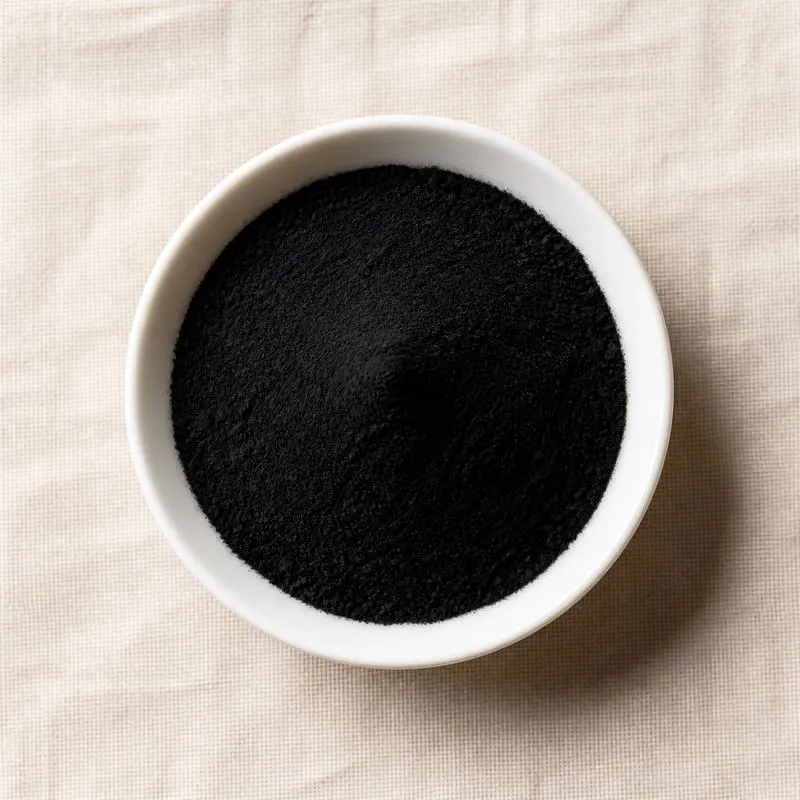
| Appearance | Dull black to deep black powder |
| Source | Coconut shell, bamboo, or mixed vegetable origin |
| Carbon content | ≥ 95.0% |
| Solubility | Insoluble in water and oil; dispersible |
| Light stability | Excellent |
| Heat stability | Excellent; fully stable through baking and retort |
| pH stability range | Full food pH range |
| Total PAH (16 EU priority) | ≤ 50 µg/kg |
| Benzo(a)pyrene | ≤ 1 µg/kg |
| Loss on ignition | Per declared grade |
| Lead | ≤ 2 mg/kg |
| Arsenic | ≤ 1 mg/kg |
| Total plate count | ≤ 1000 CFU/g |
Common Markets Grades
Food-grade Vegetable Carbon Black is graded by particle size, oil-absorption number, and trace polycyclic-aromatic-hydrocarbon (PAH) content.
Standard powder grades have a mean primary particle size of 10 to 30 nanometers and assemble into aggregates that disperse readily into water-continuous and fat-continuous matrices.
Pre-dispersed liquid grades at 10 to 30 percent active in glycerol, propylene glycol, or sugar syrup are produced for high-throughput beverage and confectionery lines that cannot wet out a powder efficiently.
Tablet- and capsule-grade material conforms to USP, BP, and Ph. Eur. monographs for medicinal charcoal where the same activated-carbon family is used as an adsorbent rather than as a pigment. PAH and heavy-metal limits are tightened compared with the food-colour grade.
Stricter low-PAH grades, with benzo[a]pyrene below 5 micrograms per kilogram and the sum of four marker PAHs within the EU 231/2012 specification, are the standard for European food use.
Applications
- Black bakery items such as charcoal buns, croissants, focaccia, and pizza bases
- Black ice cream, gelato, and soft-serve in novelty and premium product lines
- Confectionery: licorice, jellies, hard candies, and chocolate decorations
- Pasta and noodle products in black or grey shades as an alternative to squid ink
- Beverages: black lemonades, charcoal smoothies, cocktail mixers, and detox drinks
- Decorative coatings, glazes, and edible inks for pastries and chocolate
- Cheese rinds and cheese coatings for an aged-ash visual
- Plant-based meat and seafood analogs for marbling and char effects
- Pharmaceutical capsules, tablet coatings, and activated-charcoal supplements
- Cosmetics: mascara, eyeliner, soap bars, toothpaste, and face masks
Brands Using Vegetable Carbon Black
Widely-distributed consumer products that list Vegetable Carbon Black on the ingredient label.
- Little DamageLittle Damage Black Charcoal Waffle Cone (soft serve) ↗The brand's About page states that its black waffle cones are coloured with activated charcoal and hand rolled minutes before serving.Label verified 2026-05-24
- Nature's WayNature's Way Activated Charcoal Capsules ↗Capsules contain 560 mg of activated charcoal per 2-capsule serving; sourced from coconut husks.Label verified 2026-05-24
- Nature's BountyNature's Bounty Activated Charcoal Capsules ↗Supplement contains 520 mg activated charcoal per serving.Label verified 2026-05-24
Brand names, product names and logos are the property of their owners. They appear here as published evidence that the ingredient is used, taken from the brand's own label or website. Their appearance is not an endorsement, and it does not mean the brand buys from us or from any manufacturer listed on this site.
China Manufacturers of Vegetable Carbon Black
Top Vegetable Carbon Black manufacturers in China.
 Biocon Colors (Qingdao) Co., Ltd.7 ingredients in the directory
 Linquan Spring River Nano Plant New Material Co., Ltd.1 ingredient in the directory
 Zhejiang Wanglin Bio-Tech Co., Ltd.2 ingredients in the directory
Company names and logos are the property of the manufacturers themselves. They are listed here because our own directory records them as producing this ingredient. A listing is not an endorsement by them, and we do not represent them or speak on their behalf.
How We Help Source Vegetable Carbon Black
Direct Factory Sourcing
We run the whole process: selecting the manufacturer from the top Chinese food ingredient producers, negotiating the price, verifying quality, and coordinating the logistics. You deal with us instead of with several factories at once.
Original Packaging and Documents from the Manufacturer
The manufacturer sends your Vegetable Carbon Black out of its own factory in the original packing, through to your destination port. The COA, COO, MSDS, TDS and any certifications reach you from the manufacturer as well.
Free Samples and Lead Time
We send 100 to 500 g free for your own laboratory to test and you cover only the courier, usually within 2 to 3 working days. ETD is usually within 7 to 15 days once the order is confirmed, and we check that date against the factory's own manufacturing schedule before we give it to you.
Combined Shipment
We can load Vegetable Carbon Black together with other ingredients such as Beta Carotene, Caramel Colour and Lycopene into one 20' FCL. If your quantity is small, we can also ship LCL.
Regulatory Status
Vegetable Carbon Black is approved as a food colour in most regulated markets, with regional differences in source restrictions and PAH specifications.
In the European Union, Regulation (EC) No 1333/2008 lists it as E153 in Annex II. Identity and purity criteria are defined in Commission Regulation (EU) No 231/2012, which sets a maximum of 50 micrograms per kilogram for the sum of four marker PAHs and 5 micrograms per kilogram for benzo[a]pyrene.
In the United States, vegetable carbon is not approved as a colour additive for general food use, although activated charcoal of botanical origin is recognised for various non-colour uses and is widely available as a dietary supplement. Use of E153 as a food colourant in U.S.-marketed foods is therefore generally not permitted under 21 CFR Part 73 or 74.
JECFA has evaluated vegetable carbon black and considered it acceptable for use within established purity specifications. Pharmacopoeial monographs for medicinal charcoal appear in the USP, BP, and Ph. Eur. and govern the related adsorbent grade.
Manufacturing Process
Production begins with the selection of a high-carbon plant feedstock. Coconut shell is the most common starting material because of its dense lignified structure, low ash, and consistent global supply. Peat and selected hardwood char are alternatives in regional markets.
The feedstock is pyrolyzed in the absence of air at 600 to 900 degrees Celsius. Volatile hydrocarbons are driven off, leaving a carbonaceous skeleton of fused aromatic sheets.
Activation follows under steam or carbon dioxide at 800 to 1000 degrees Celsius. The activation step burns out residual tars, opens up the internal pore network, and reduces the polycyclic-aromatic-hydrocarbon load on the surface to within the food-grade specification.
The activated char is milled and air-classified to a mean particle size of 10 to 30 nanometers, then washed and dried. Food-grade lots are tested for PAH markers, heavy metals, ash, and microbiological load before release.