Coffee Sauce
Coffee Sauce is a sweetened, coffee flavoured paste sold to bakeries and beverage plants as a ready to use filling, swirl or topping base.
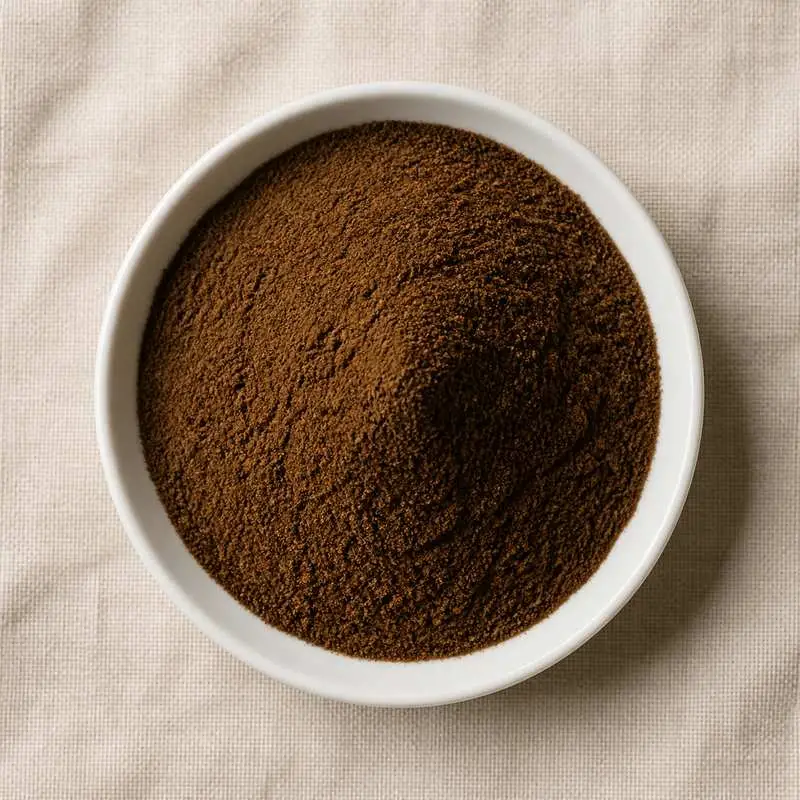
It is built on a sugar and glucose syrup phase that carries roasted coffee solids, delivered either as spray dried soluble coffee, a concentrated liquid coffee extract, or a combination of the two supported by coffee flavouring. Vegetable fat, milk solids and an emulsifier are usual, and body comes from a thickener system based on modified starch, pectin or a starch and gum blend. Soluble solids generally sit between 60 and 72 Brix, high enough that the sealed, pasteurised product is stable at ambient temperature.
The finished sauce is a smooth dark brown to near black paste that holds a deposited shape at rest but flows under shear, so it can be pumped and piped. Bake stable versions are formulated so the starch and pectin network resists boil out at oven temperature and the filling stays inside the pastry rather than running. Cold process versions are thinner and are used where the sauce is applied after baking, on ice cream, or in cold drinks, where it disperses into milk without leaving grain.
We source bulk Coffee Sauce from top China manufacturers for our partners. The manufacturer is in Beijing. A smaller requirement can ship in a combined container with other ingredients.
Please send the grade you need, the volume and your destination port, and we will come back with a solution and a price.
or call +86-21-6858 0751
- Function
- Bakery ingredient
Specifications
| Item | Specification |
|---|---|
| Appearance | Smooth homogeneous paste, free from lumps and foreign matter |
| Colour | Dark brown to blackish brown |
| Flavour and odour | Characteristic roasted coffee, sweet, no burnt or rancid note |
| Soluble solids | 62.0 to 70.0 Brix |
| Moisture | Not more than 33.0% |
| Fat | 4.0 to 12.0%, per specified recipe |
| pH at 20 degrees Celsius | 4.5 to 6.0 |
| Water activity | Not more than 0.85 |
| Viscosity at 25 degrees Celsius | 15000 to 45000 mPa.s, Brookfield RVT |
| Lead | Not more than 0.5 mg/kg |
| Arsenic | Not more than 0.5 mg/kg |
| Total plate count | Not more than 1000 cfu/g |
| Yeast and mould | Not more than 50 cfu/g |
| Coliforms | Not more than 10 cfu/g |
| Salmonella | Absent in 25 g |
Common Markets Grades
Two functional grades dominate. Bake stable coffee sauce is formulated with a cross linked starch and a high solids level so it survives 180 to 200 degrees Celsius in an open or enclosed pastry without collapsing or boiling out. Cold application sauce carries lower solids, a softer texture and a cleaner coffee note, and is used for drizzling, swirling into cream, or dosing into beverages.
Within each grade the variables a buyer specifies are coffee strength, expressed as coffee solids in the finished sauce or as an equivalent extract ratio, Brix, viscosity at a stated temperature, and whether the product contains dairy. Sugar reduced versions built on maltitol or a polyol and sweetener blend are made for reduced sugar bakery lines. Sauce intended for chocolate coated or frozen products is adjusted to a lower water activity to control moisture migration.
Applications
- Injected fillings for doughnuts, filled buns and choux pastry, where the bake stable grade holds position through proving and baking
- Swirl and ripple phase in coffee flavoured cakes, muffins and marble loaves
- Layering and masking between sponge layers in coffee gateaux and tiramisu style desserts
- Flavour base for coffee milk drinks and bottled lattes, where it supplies both sweetness and coffee character in one dosing step
- Topping sauce for ice cream, soft serve and frozen yoghurt, formulated to stay pourable at low temperature
- Filling for moon cakes and steamed buns in the Chinese bakery trade, where high solids control water migration into the dough
- Coffee note in ganache, buttercream and mousse, added without introducing brewing water
- Base for coffee flavoured biscuit and wafer creams, blended into the fat phase
China Manufacturers of Coffee Sauce
Top Coffee Sauce manufacturers in China.

Company names and logos are the property of the manufacturers themselves. They are listed here because our own directory records them as producing this ingredient. A listing is not an endorsement by them, and we do not represent them or speak on their behalf.
Regulatory Status
Coffee sauce is regulated as a compound food rather than as a food additive, so it carries no E number of its own. Its status is determined by the ingredients in the recipe, each of which must be permitted in the destination market. In the European Union pectin, modified starches, sorbates and the emulsifiers commonly used all appear in the additive framework of Regulation 1333/2008 with assigned E numbers, and their use in fine bakery wares and sauces is set out in the annexes to that regulation. In the United States the corresponding components are either affirmed as generally recognised as safe or cleared under specific food additive regulations, and the sauce itself is manufactured under the preventive controls rules for human food.
Labelling obligations follow the recipe. Milk is a declarable allergen where dairy solids are present, and products carrying soya lecithin declare soya. Caffeine content originates from the coffee solids and is not separately regulated in bakery use, although some markets require a caffeine declaration on ready to drink beverages made with the sauce. Codex general standards for food additives and for contaminants apply to the finished product in international trade.
Manufacturing Process
Manufacture begins with a sugar and glucose syrup solution prepared in a jacketed vessel with high shear mixing. Soluble coffee powder or concentrated coffee extract is dispersed into the hot syrup, along with vegetable fat, milk solids where used, emulsifier and salt. The starch and hydrocolloid thickener is added as a dry blend pre mixed with part of the sugar so it hydrates without lumping.
The batch is then cooked, most often under vacuum in an evaporating cooker, which drives the mixture to the target soluble solids at a lower temperature than atmospheric boiling and limits the burnt note that coffee solids develop under prolonged heat. Homogenisation follows to reduce fat globule size and give the sauce a glossy, uniform body. The sauce is pasteurised in line, hot filled into pails or bag in box at above 85 degrees Celsius, sealed, and cooled in a water tunnel or cold room. Where preservatives are used, potassium sorbate is dosed after cooking. Final checks cover Brix, pH, viscosity and colour before release.