Food Grade Colored Flakes
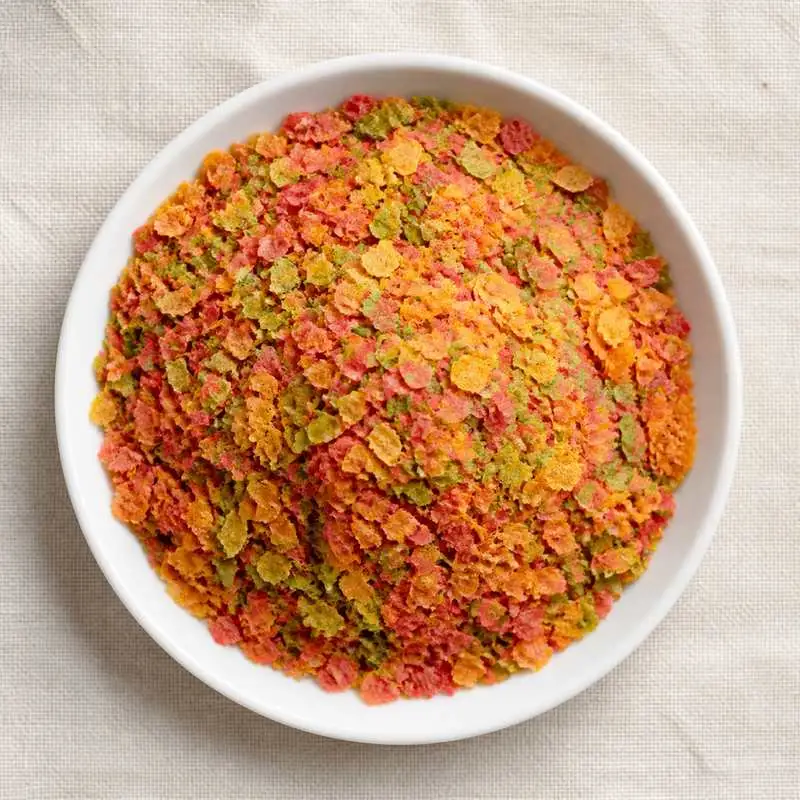
Food grade coloured flakes are thin, brittle fragments of a dried edible film in which an approved food colour has been dispersed, used as a decorative and dosing form of colour rather than as a colouring substance in its own right.
The flakes are built on a carrier system. Sugar, maltodextrin and modified starch give a dissolving flake, while film formers such as shellac, hydroxypropyl methylcellulose and carnauba wax give one that stays discrete on a surface. Certified dyes, aluminium lakes or natural pigment preparations are dispersed into the carrier mass, the mass is spread as a thin sheet, dried, and broken into irregular flakes of controlled thickness and screen size.
Behaviour in use follows the carrier rather than the pigment. Sugar and maltodextrin flakes hydrate in moist confectionery and in aqueous systems, bleeding colour outward into a diffuse speckle, whereas shellac and wax flakes survive panning and remain as defined specks. All grades are hygroscopic to some degree and are held sealed and away from direct light, since the pigment sits in a thin, surface exposed layer.
We source bulk Food Grade Colored Flakes from top China manufacturers for our partners. The manufacturer is in Jiangsu. A smaller requirement can ship in a combined container with other ingredients.
Please send the grade you need, the volume and your destination port, and we will come back with a solution and a price.
or call +86-21-6858 0751
- Function
- Colorant
Specifications
| Item | Specification |
|---|---|
| Appearance | Thin brittle irregular flakes of uniform shade, free from foreign matter |
| Colour System | Conforms to declared certified dye, aluminium lake or natural pigment preparation |
| Total Colouring Matter | 1.0 - 10.0% (declared per grade, ± 5% relative) |
| Flake Size (standard cut) | 1 - 3 mm; ≥ 90% within the stated pass and retain screens |
| Flake Thickness | 0.10 - 0.30 mm |
| Moisture | ≤ 5.0% |
| Bulk Density | 0.30 - 0.60 g/mL |
| Solubility (sugar and maltodextrin carriers) | Disperses and dissolves within 5 minutes in water at 50 °C |
| Dispersion (film former carriers) | Remains discrete; no bleed after 30 minutes in water at 20 °C |
| Water-Insoluble Matter (dissolving grades) | ≤ 0.5% |
| Heavy Metals (as Pb) | ≤ 10 mg/kg |
| Lead | ≤ 2 mg/kg |
| Arsenic | ≤ 1 mg/kg |
| Total Plate Count | ≤ 1,000 cfu/g |
| Salmonella | Negative/25g |
Common Markets Grades
Flakes are traded by carrier type, by the colour system carried, and by screen size. Water dissolving grades on sugar or maltodextrin are separated from film former grades on shellac, cellulose ether or wax. Screen fractions are typically sold as a fine speckle in the region of 0.5 to 1 mm, a standard flake of 1 to 3 mm, and a coarse decorative flake above 3 mm, each cut to a stated pass and retain specification.
The colour system is specified separately. Certified dye and aluminium lake grades are used where shade reproducibility matters, and natural pigment grades built on anthocyanin, paprika, curcumin or spirulina preparations are used where a colouring foodstuff or natural declaration is required. Metallic and pearlescent variants carry mica based pigment and are restricted to markets and applications that permit those colours.
Applications
- Panned confectionery and dragees, where flakes are applied in the final coating passes to give a speckled shell
- Compound chocolate and cocoa butter coatings, where wax bound flakes hold their edges without bleeding into the fat phase
- Ice cream and frozen desserts, where a dissolving flake releases colour slowly during storage rather than tinting the whole mix
- Bakery toppings and icings applied before setting, giving visible colour points on an otherwise uniform surface
- Dry beverage and instant dessert mixes, where the flake acts as a visual cue that the powder has been dosed
- Gummy and jelly surface decoration applied over an oiled or waxed finish
- Seasoning and snack coating blends, where coloured flakes mark a flavour variant on the surface of the piece
- Tablet and lozenge confectionery, where flakes are pressed into the surface layer during compression
China Manufacturers of Food Grade Colored Flakes
Top Food Grade Colored Flakes manufacturers in China.
Company names and logos are the property of the manufacturers themselves. They are listed here because our own directory records them as producing this ingredient. A listing is not an endorsement by them, and we do not represent them or speak on their behalf.
Regulatory Status
A coloured flake has no status of its own. It is regulated as the sum of its parts, so the colour it carries must be permitted for the food it is used in, and the carrier and any glazing agent must be permitted additives or ordinary food ingredients in the same market. In the United States that means certified dyes and their aluminium lakes are subject to batch certification, while exempt colours are used within their individual listings. In the European Union the colour carried appears on the label by name or E number under the food additive framework, and the warning statement required for certain azo colours follows the colour rather than the flake.
Because the flake is a preparation, declaration is made in terms of the functional colour and the carrier rather than as a single additive. Metallic and pearlescent flake grades are the most restricted, since the pigments involved are permitted for a narrower list of applications and in some markets only for external decoration.
Manufacturing Process
Production starts by dissolving or plasticising the carrier, sugar syrup, maltodextrin solution, a shellac or cellulose ether solution, or molten wax, and dispersing the colour into it under high shear until no pigment agglomerates remain. Lakes and insoluble natural pigments are milled into the carrier, while soluble dyes are added as a filtered stock solution.
The coloured mass is then laid down as a thin sheet, either on a chilled drum, on a moving belt, or on trays, and dried or set until it becomes brittle. The dried sheet is lifted and broken in a low energy flaker rather than a hammer mill, since aggressive milling produces dust rather than flakes. The broken material is screened into the specified size fractions, oversize is returned to the breaker, undersize is recovered into the next carrier batch, and the graded flakes are packed under low humidity.