Galactomannan
Galactomannans are a family of plant polysaccharides built on a linear backbone of 1,4-linked beta-D-mannose units carrying single alpha-D-galactose units attached as side branches at the 6 position. They occur as the seed endosperm reserve of leguminous plants, where they hold water and protect the germinating embryo from drying, and that water binding is what makes them useful as food hydrocolloids.
Everything that distinguishes one galactomannan from another comes down to the mannose to galactose ratio and to how evenly the galactose branches are distributed. Fenugreek gum sits near one to one and is fully substituted; guar gum is about two to one; tara gum about three to one; locust bean gum about four to one; cassia gum about five to one. The more galactose, the more soluble the polymer, so guar hydrates fully in cold water while locust bean gum needs heating to about 80 degrees Celsius. The fewer galactose branches, the longer the stretches of bare mannan backbone, and those bare stretches are what associate with the ordered helices of xanthan gum or kappa carrageenan to form the synergistic gels that no galactomannan makes alone.
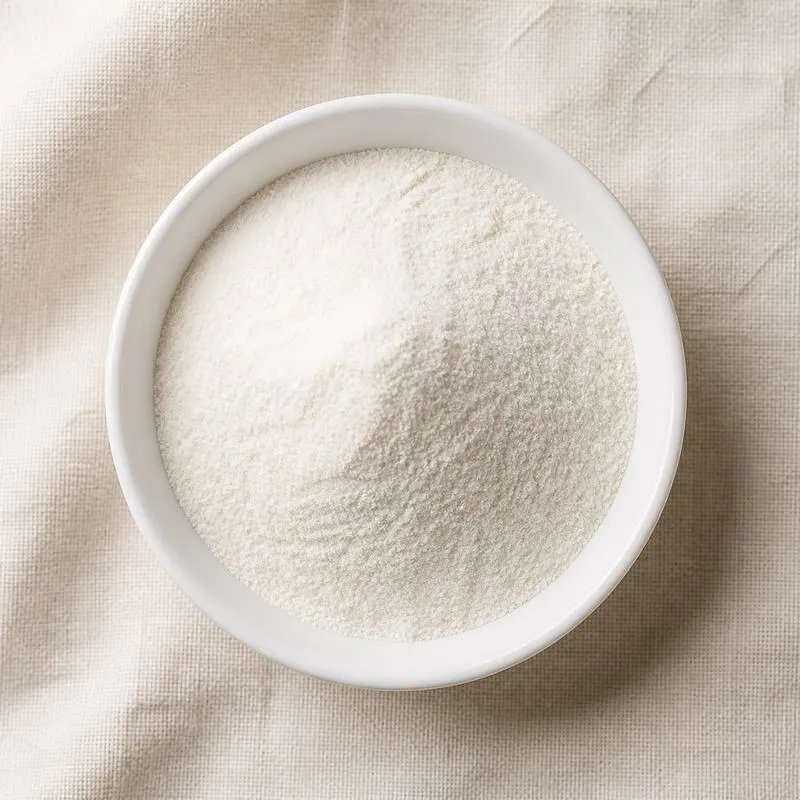
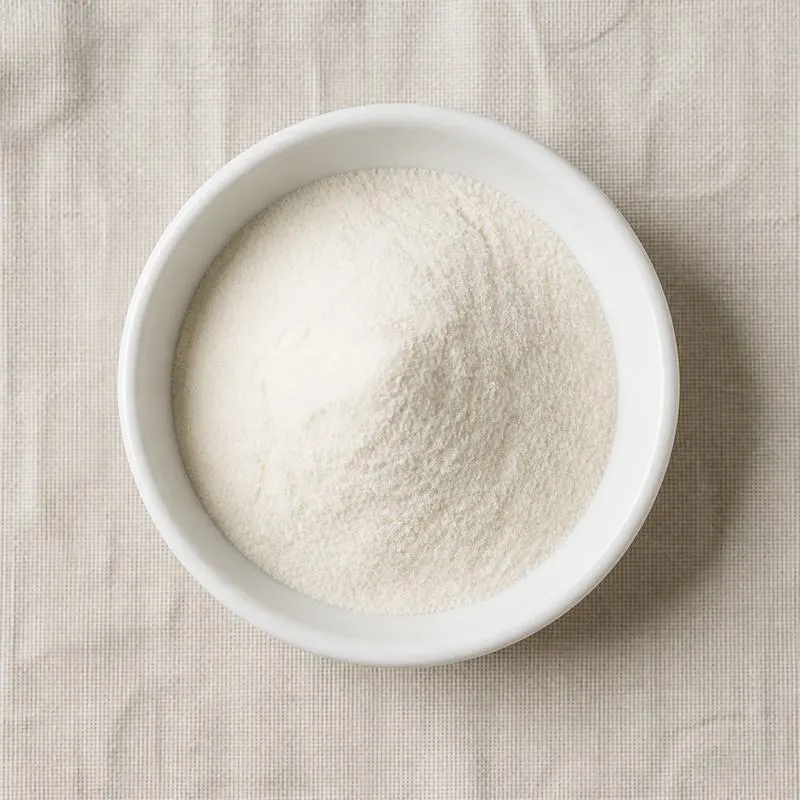
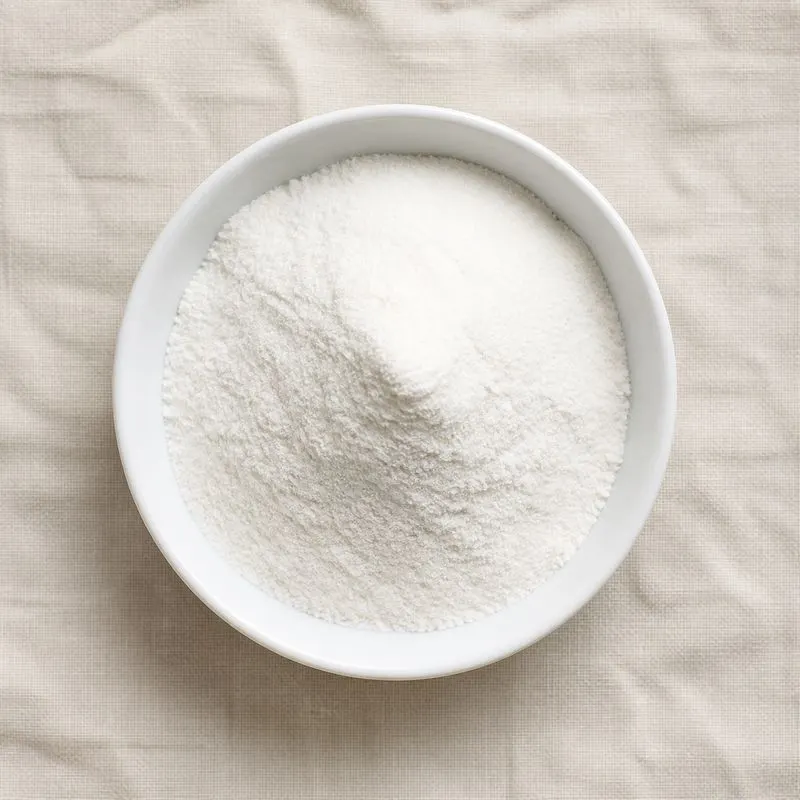
All are white to pale beige powders, bland and odourless, giving high viscosity pseudoplastic solutions at low concentration. None of them gels by itself, and all are stable across a broad pH range but hydrolyse under prolonged hot acid conditions.
We source bulk Galactomannan from top China manufacturers for our partners. The manufacturer is in Hubei. A smaller requirement can ship in a combined container with other ingredients.
Please send the grade you need, the volume and your destination port, and we will come back with a solution and a price.
or call +86-21-6858 0751
- Function
- Thickener / Hydrocolloid
Specifications
| Item | Specification |
|---|---|
| Appearance | White to pale beige powder, free of foreign matter |
| Odour and Taste | Almost odourless, bland |
| Identification | Positive for galactomannan, mannose and galactose on hydrolysis |
| Galactomannan, dry basis | Not less than 75.0% |
| Viscosity, 1% solution at 25 degrees Celsius | Not less than 3,000 mPa s |
| Loss on Drying | Not more than 15.0% |
| Total Ash, dry basis | Not more than 1.5% |
| Acid Insoluble Matter | Not more than 4.0% |
| Protein | Not more than 7.0% |
| Starch | Absent |
| pH, 1% solution | 5.0 to 7.5 |
| Particle Size | Not less than 95% through 100 mesh |
| Lead | Not more than 2 mg/kg |
| Arsenic | Not more than 3 mg/kg |
| Total Plate Count | Not more than 5,000 CFU/g |
| Yeast and Mould | Not more than 500 CFU/g |
| E. coli | Absent in 1 g |
| Salmonella | Absent in 25 g |
Common Markets Grades
The family is bought by species first, because the ratio is fixed by the plant and cannot be adjusted. Guar gum is the cheapest and highest volume, locust bean gum the most expensive and the most supply constrained, tara gum a functional substitute for locust bean gum, and fenugreek and cassia gum smaller specialities, with cassia gum authorised for pet food rather than for human food in several jurisdictions.
Within a species, viscosity on a 1 percent solution is the primary specification, together with particle size, which sets hydration rate, and galactomannan content, which reflects how cleanly the endosperm was separated from hull and germ. Clarified grades washed with alcohol are used where residual protein and fibre would cloud the solution. Depolymerised low viscosity grades are produced for high solids applications and for dietary fibre use. Hydroxypropylated and carboxymethylated guar derivatives exist for industrial use and are separate regulated substances. Organic certified material is available for guar, locust bean and tara.
Applications
- Ice cream and frozen desserts, controlling ice crystal growth and giving a smooth body through heat shock
- Sauces, dressings and soups, providing pseudoplastic viscosity that pours and then clings
- Dairy desserts and yoghurt, adding body and preventing whey separation
- Gel systems combined with xanthan gum, where the bare mannan stretches form a cohesive gel that neither component makes alone
- Carrageenan systems, softening the brittle kappa gel and suppressing syneresis
- Bakery and gluten-free doughs, supplying viscoelasticity and improving crumb and moisture retention
- Processed meat and pet food, binding water through cooking and retorting
- Beverages with suspended pulp or cocoa, holding particles in a low viscosity liquid
- Dietary fibre and satiety products, using the high water binding of the depolymerised grades
- Industrial applications including paper, textile printing, mining flotation and oilfield fluids
Brands Using Galactomannan
Widely-distributed consumer products that list Galactomannan on the ingredient label.
- Oregon's Wild HarvestVitamin C Capsules ↗The whole food base of this vitamin C capsule lists Sunfiber galactomannan soluble fibre alongside organic mushroom mycelium and a triphala fruit blend.Label verified 2026-08-31
- Oregon's Wild HarvestB Complex Capsules ↗Galactomannan soluble fibre appears in the organic whole food blend that carries the B vitamins in this capsule.Label verified 2026-08-31
- CodeageAmen Glutathione-SR+ ↗This sustained release glutathione capsule uses a time-release matrix built from hydroxypropyl methylcellulose, galactomannans from fenugreek seed and sunflower lecithin.Label verified 2026-08-31
Brand names, product names and logos are the property of their owners. They appear here as published evidence that the ingredient is used, taken from the brand's own label or website. Their appearance is not an endorsement, and it does not mean the brand buys from us or from any manufacturer listed on this site.
China Manufacturers of Galactomannan
Top Galactomannan manufacturers in China.
Company names and logos are the property of the manufacturers themselves. They are listed here because our own directory records them as producing this ingredient. A listing is not an endorsement by them, and we do not represent them or speak on their behalf.
Regulatory Status
The individual galactomannans are separately authorised food additives rather than a single listed substance, so the specific gum must be identified rather than described by the family name.
In the European Union locust bean gum is E410, guar gum E412, tara gum E417 and cassia gum E499, each with its own identity and purity criteria covering galactomannan content, loss on drying, ash, acid insoluble matter, protein, starch and heavy metals. Most are generally permitted at quantum satis in the categories where they are allowed, and cassia gum is restricted in scope. Their use in foods for infants and young children is limited rather than open. In the United States guar gum and locust bean gum are affirmed as generally recognised as safe as direct food ingredients, tara gum is likewise accepted for food use, and each is declared by its own name on the label. Codex and JECFA recognise the gums individually as INS 410, 412, 417 and 499 with published specifications. Because these are legume seed products, the supplier addresses allergen assessment, and fenugreek in particular is treated with care in markets where it is a recognised allergen.
Manufacturing Process
All galactomannans are recovered by the same physical route, which is a separation problem rather than a chemical one. Pods are harvested, dried and threshed to release the seeds, which are cleaned of pod fragments, dust and stones. Each seed has three parts: a hard outer hull, a translucent endosperm holding the galactomannan, and a soft oil and protein rich germ. The whole of manufacture consists of getting the endosperm out clean, because hull fragments carry colour and insoluble specks into the finished gum while germ material carries protein and fat that cloud solutions and shorten shelf life.
Dehulling is done either thermomechanically, by roasting or heating the seed so the brittle hull cracks and can be removed by abrasion and aspiration, or chemically, by treating with dilute sulphuric acid that chars the hull so it washes off, followed by neutralisation and rinsing. Locust bean seed, whose hull is exceptionally hard, is almost always acid dehulled. The dehulled seed is split and the endosperm halves are separated from the germ by differential milling and air classification, using the fact that the hard endosperm shatters into coarse pieces while the soft germ flattens. The recovered splits are milled to the specified mesh, sieved and blended across batches to a uniform viscosity. Higher purity grades take an additional aqueous alcohol wash and re-drying to strip residual protein and colour.