Natural Benzaldehyde
Natural benzaldehyde is the simplest aromatic aldehyde, C7H6O, molar mass 106.12, CAS number 100-52-7, produced from botanical raw material rather than by petrochemical synthesis. It is the compound that carries the smell of bitter almond and is the backbone of almond, cherry and marzipan flavours.
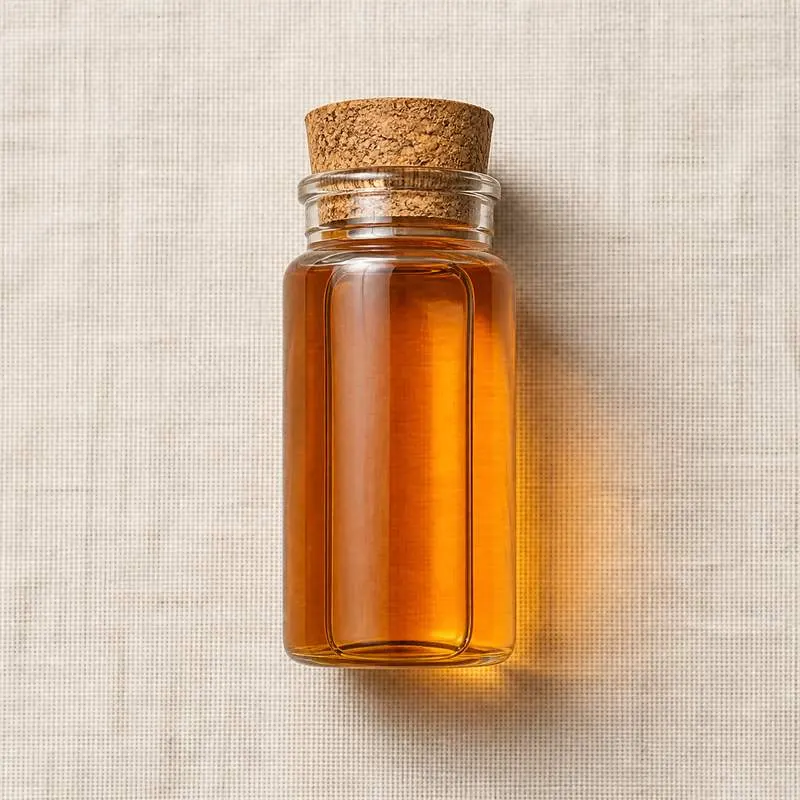
The molecule is a clear colourless to faintly yellow liquid boiling near 179 degrees Celsius, with an intense sweet almond odour detectable at very low levels. It is only slightly soluble in water, at roughly 0.3 grams per hundred millilitres, and miscible with ethanol, propylene glycol and vegetable oils, so aqueous applications rely on a solubilised or emulsified premix.
Benzaldehyde oxidises readily in air to benzoic acid, which shows up as an acid value rise and as white crystals in the drum, so the material is stored cool, in filled containers under nitrogen, and is often protected with a permitted antioxidant. What separates the natural grade from the synthetic one is not the molecule but its carbon source, and authenticity is demonstrated by stable isotope and radiocarbon testing rather than by ordinary purity analysis.
We source bulk Natural Benzaldehyde from top China manufacturers for our partners. The manufacturer is in Hunan. A smaller requirement can ship in a combined container with other ingredients.
Please send the grade you need, the volume and your destination port, and we will come back with a solution and a price.
or call +86-21-6858 0751
- Function
- Flavours and Aromas
Specifications
| Item | Specification |
|---|---|
| Appearance | Clear mobile liquid, free from suspended matter |
| Colour | Colourless to pale yellow |
| Odour | Characteristic bitter almond, true to reference sample |
| Assay by gas chromatography | 99.0 percent minimum |
| Identification by infrared spectrum | Conforms to reference spectrum |
| Free acid as benzoic acid | 1.0 percent maximum |
| Chlorinated compounds | Not detected |
| Hydrocyanic acid | Not detected |
| Relative density at 25 degrees Celsius | 1.041 to 1.046 |
| Refractive index at 20 degrees Celsius | 1.5440 to 1.5460 |
| Solubility in 60 percent ethanol | Clear solution in 3 volumes |
| Water content | 0.2 percent maximum |
| Lead | 1.0 mg/kg maximum |
| Arsenic | 1.0 mg/kg maximum |
Common Markets Grades
Two natural routes define the grades in trade. Cassia derived benzaldehyde, made by cleaving the cinnamaldehyde in cassia oil, is by far the larger volume and is the standard natural flavour grade at 99 percent or better. Benzaldehyde recovered from apricot, peach or bitter almond kernels through the hydrolysis of amygdalin is sold as natural bitter almond derived material, in much smaller quantity and at a higher price, and it is the grade specified where a from the named fruit declaration is wanted.
Both come as the neat liquid and as dilutions in ethanol, triacetin or propylene glycol. Buyers distinguish grades further by the absence of chlorinated impurities, a requirement carried over from the older synthetic chlorination route, and by the isotope ratio and radiocarbon data reported with the batch, which are the documents that support a natural claim. Antioxidant protected and unprotected versions are separate items, since some finished applications cannot accept the added antioxidant.
Applications
- Almond, marzipan and amaretto flavours, where it is the dominant character impact compound
- Cherry flavours for confectionery, syrups and soft drinks
- Bakery flavours for biscuits, cakes and frangipane fillings
- Ice cream and dairy dessert flavours in the stone fruit and nut directions
- Alcoholic beverage flavourings, particularly nut liqueurs and bitters
- Chewing gum and hard candy, dosed low because of its strength
- Fine fragrance and household perfumery, as a sweet almond note in heliotrope and cherry accords
- Soap and personal care perfumery, where it survives moderately alkaline bases
- Chemical intermediate for cinnamaldehyde, benzyl alcohol and mandelic acid derivatives
China Manufacturers of Natural Benzaldehyde
Top Natural Benzaldehyde manufacturers in China.
Company names and logos are the property of the manufacturers themselves. They are listed here because our own directory records them as producing this ingredient. A listing is not an endorsement by them, and we do not represent them or speak on their behalf.
Regulatory Status
In the United States benzaldehyde is generally recognised as safe for use in food as a synthetic flavouring substance and adjuvant under 21 CFR 182.60, and it holds FEMA GRAS status as a flavouring substance under FEMA number 2127. Material made from botanical sources and labelled as natural must meet the definition of a natural flavour in the food labelling regulations, which is where the isotope documentation matters. Benzaldehyde produced from kernels must be free of hydrogen cyanide residues, and the United States Pharmacopeia and the Food Chemicals Codex monographs set the purity expectations most contracts reference.
In the European Union benzaldehyde is an authorised flavouring substance on the Union list established under Regulation (EC) No 1334/2008 and carries a FLAVIS number in the aldehyde group. Flavourings take no E number. That regulation also controls hydrocyanic acid as a substance naturally present in certain flavourings and foods, which is directly relevant to kernel derived material. The Joint FAO and WHO Expert Committee on Food Additives has evaluated benzaldehyde within the benzyl derivatives group, and Codex flavouring guidance applies where national law adopts it.
Manufacturing Process
The dominant route starts from cassia oil, the steam distilled bark oil of Cinnamomum cassia, which is typically 80 percent or more cinnamaldehyde. The oil is treated in an alkaline aqueous medium, where a retro aldol cleavage removes the two carbon side chain of cinnamaldehyde and releases benzaldehyde together with acetaldehyde. Some plants run the equivalent transformation oxidatively rather than in base. The reaction mass is neutralised and the crude benzaldehyde is separated from the aqueous phase by decantation and solvent extraction.
Purification is by vacuum fractional distillation, which removes unreacted cinnamaldehyde and heavy resinous material at the base and light aldehydes overhead. The heart cut is washed with dilute alkali to strip benzoic acid formed by oxidation, dried, polish filtered and blended against a retained reference by a trained assessor. The kernel route runs differently: pressed and defatted apricot or bitter almond kernels are held in warm water, where the plant enzyme emulsin hydrolyses amygdalin to release benzaldehyde and hydrogen cyanide, the mixture is steam distilled, and the distillate is washed repeatedly with ferrous salt or lime solutions until the cyanide is removed before final rectification.