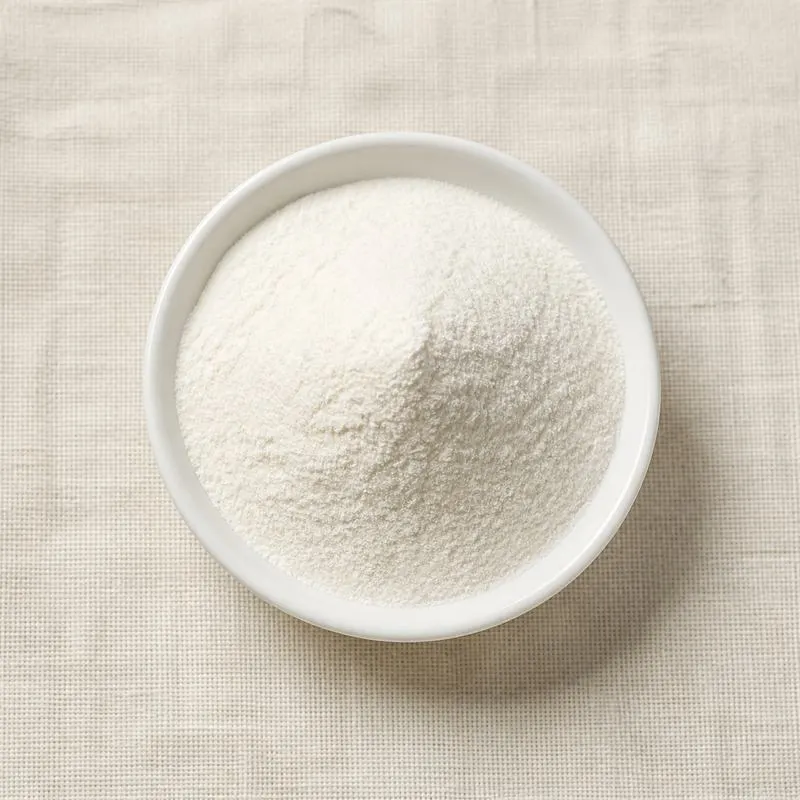
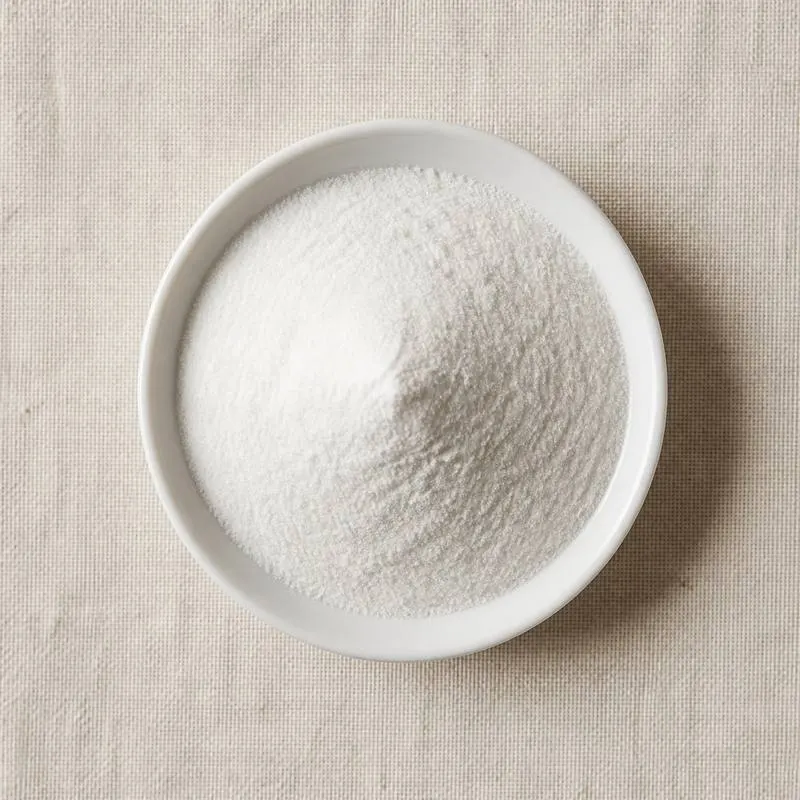
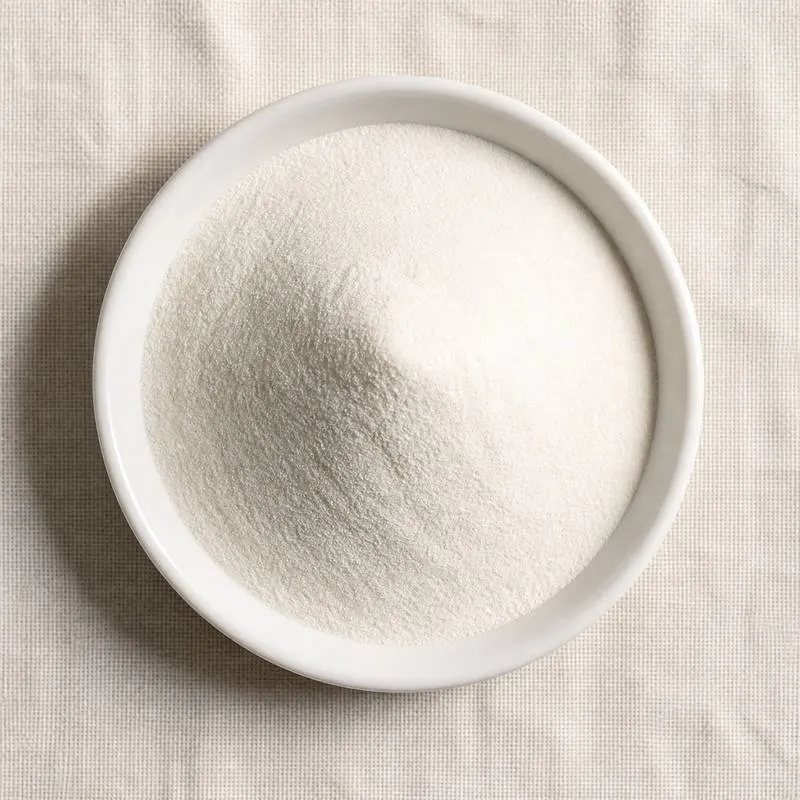
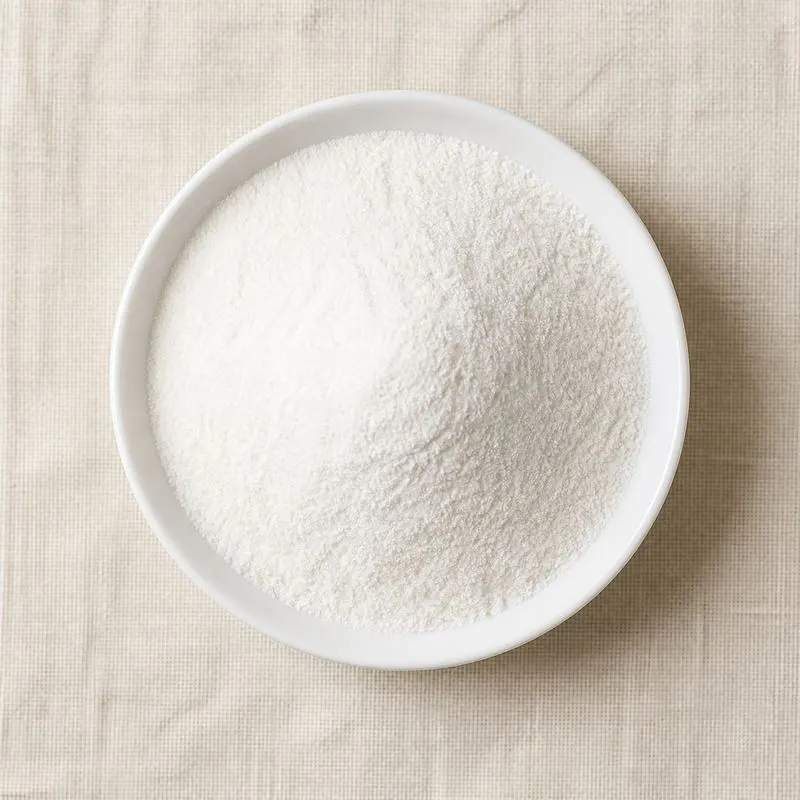
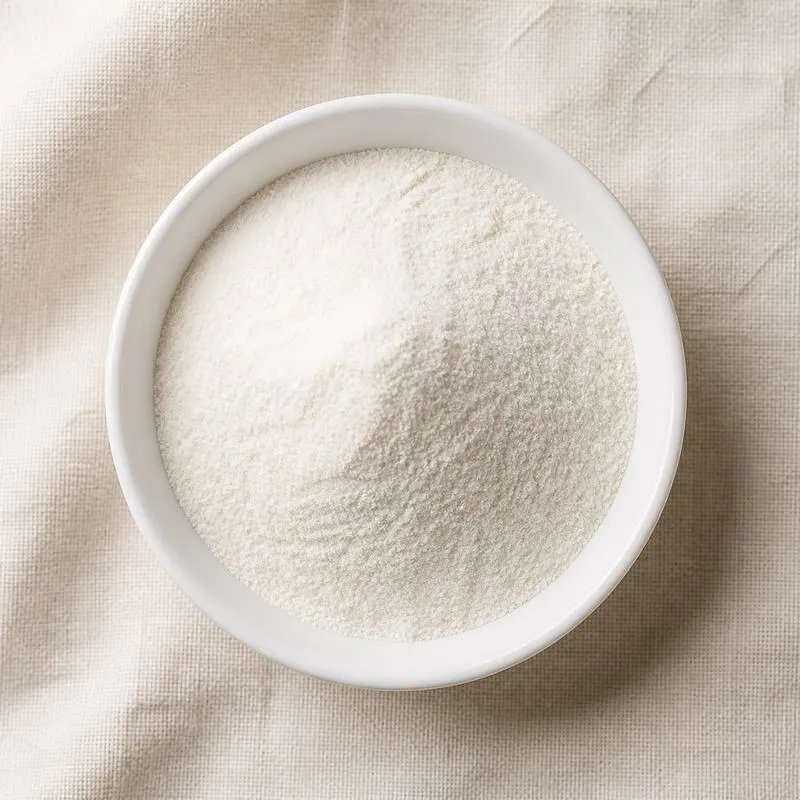
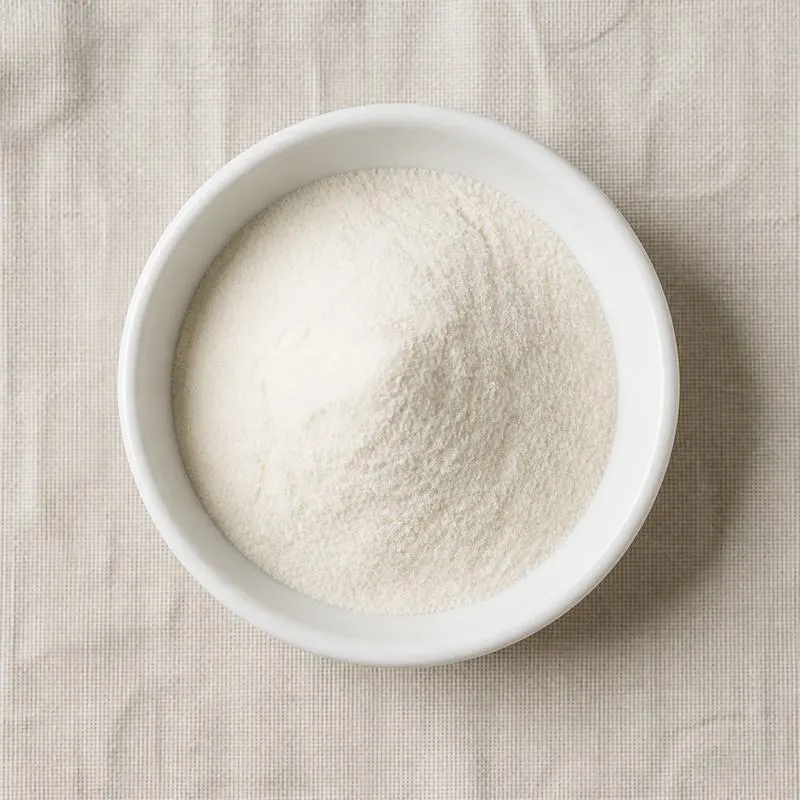
Purified Konjak Flour
Purified Konjak Flour is konjac flour that has been alcohol washed to strip out starch, soluble sugars, protein fragments, pigments and residual sulphite, leaving a concentrated glucomannan powder that typically assays above 90 percent.
Glucomannan, the functional polysaccharide of the Amorphophallus konjac tuber, is a linear chain of β-1,4-linked D-mannose and D-glucose with acetyl groups distributed along the backbone. Purification does not alter that chain, but removing the non-gum solids raises viscosity per unit weight, lightens the colour, and clears the earthy odour that limits ordinary flour in delicately flavoured systems.
The product is a white to pale cream powder, higher in cost and lower in dose than crude gum. It hydrates into a highly viscous, clear to slightly cloudy solution, holds viscosity across a wide pH band but degrades under sustained acid heating, and forms a thermo-irreversible gel once the acetyl groups are removed by alkali. Synergy with xanthan gum and with kappa carrageenan is stronger and more reproducible than with unpurified flour, because the interfering starch and protein have been taken out.
We source bulk Purified Konjak Flour from top China manufacturers for our partners. The manufacturer is in Shaanxi. A smaller requirement can ship in a combined container with other ingredients.
Please send the grade you need, the volume and your destination port, and we will come back with a solution and a price.
or call +86-21-6858 0751
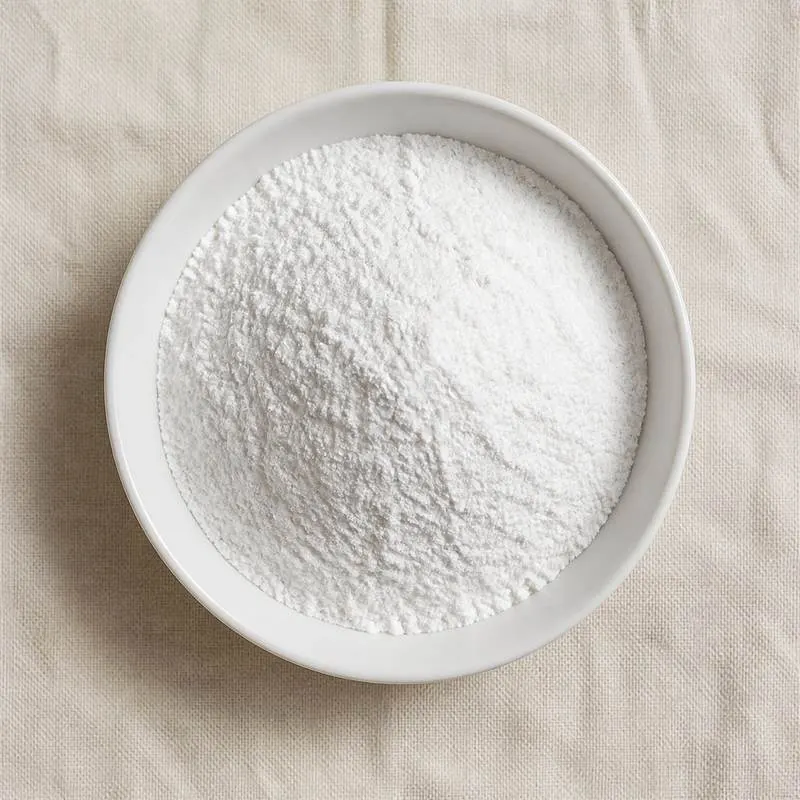
- Function
- Thickener / Hydrocolloid
Specifications
| Item | Specification |
|---|---|
| Appearance | White to pale cream fine powder |
| Odour and Taste | Neutral, free from earthy or foreign notes |
| Glucomannan Content | ≥ 90% on dry basis |
| Viscosity, 1% solution | ≥ 30,000 mPa.s |
| Identification | Positive for glucomannan by Congo red and infrared |
| Particle Size | ≥ 95% through 120 mesh |
| Loss on Drying | ≤ 10% |
| Ash | ≤ 2.0% |
| Starch | ≤ 1.0% |
| pH, 1% solution | 5.0 to 7.0 |
| Sulphur Dioxide | ≤ 0.1 g/kg |
| Residual Ethanol | ≤ 0.5% |
| Lead | ≤ 1.0 mg/kg |
| Total Plate Count | ≤ 3,000 cfu/g |
Common Markets Grades
Grades are defined by glucomannan assay, one percent viscosity and mesh. Assay steps commonly run at 85, 90 and 95 percent, with viscosity ranging from about 28,000 mPa.s to above 40,000 mPa.s on the highest lots. Standard mesh options are 80, 120 and 200; the finer cuts go to instant powders and capsule filling, and the coarser cuts to systems where slow controlled hydration avoids lumping.
Sulphite-free and low-sulphite grades are made for markets that restrict residual sulphur dioxide, using sulphur-free drying of the raw chips rather than relying on the ethanol wash alone. Deacetylated grades, in which alkali treatment has already removed part of the acetyl substitution, are sold for gel and film use, and partially hydrolysed low-viscosity grades are produced for dietary fibre products where handling viscosity is a drawback.
Applications
- Dietary fibre capsules, tablets and satiety powders, where high assay allows a smaller dose per serving
- Clear jellies, dessert gels and konjac candies, where the low pigment load keeps the gel bright
- Vegetarian meat analogues and konjac noodles, as the gelling backbone of the alkali-set structure
- Surimi, fish balls and emulsified sausage, to raise gel strength and reduce cook loss
- Instant beverage and shake powders, where the clean odour and taste profile matter
- Ice cream and frozen novelties, for ice crystal control and slower meltdown
- Gluten-free bakery, as a water binder and extensibility aid substituting for gluten
- Edible films and fruit coatings, where purified glucomannan casts a coherent transparent layer
- Reduced-fat dressings and sauces, to give body at low addition levels
- Pharmaceutical and nutraceutical matrices, as a swelling excipient and controlled release carrier
Brands Using Purified Konjak Flour
Widely-distributed consumer products that list Purified Konjak Flour on the ingredient label.
- Miracle NoodleKonjac Spaghetti ↗Shirataki style pasta made from water, konjac flour and a little citric acid, with the konjac flour supplying the glucomannan fibre that holds the noodle together.Label verified 2026-08-31
- Well LeanOrganic Shirataki Konjac Noodles ↗Noodle whose ingredient list is purified water, organic konjac flour, organic oat fibre and calcium hydroxide.Label verified 2026-08-31
Brand names, product names and logos are the property of their owners. They appear here as published evidence that the ingredient is used, taken from the brand's own label or website. Their appearance is not an endorsement, and it does not mean the brand buys from us or from any manufacturer listed on this site.
China Manufacturers of Purified Konjak Flour
Top Purified Konjak Flour manufacturers in China.
Company names and logos are the property of the manufacturers themselves. They are listed here because our own directory records them as producing this ingredient. A listing is not an endorsement by them, and we do not represent them or speak on their behalf.
Regulatory Status
The European Union authorises konjac as E425, split into konjac gum E425(i) and konjac glucomannan E425(ii), under Regulation (EC) No 1333/2008. Purified flour falls under the same listing, and so does the specific prohibition on the use of konjac in jelly mini-cup confectionery that the EU adopted after choking incidents.
In the United States konjac flour is marketed as a food ingredient on a GRAS basis, and GRAS notifications covering konjac glucomannan have gone to the FDA without objection; konjac jelly mini-cups remain subject to import alert on choking grounds. JECFA has published identity and purity specifications for konjac flour, and Codex lists konjac in the General Standard for Food Additives as a thickener, stabiliser and gelling agent.
Manufacturing Process
Dried konjac chips are impact milled and air classified, which separates the dense glucomannan-bearing cells from lighter starch, fibre and protein and yields ordinary konjac flour at roughly 70 to 80 percent glucomannan. That flour is the feedstock for purification.
The flour is slurried in aqueous ethanol, usually in the 50 to 70 percent range, in which glucomannan is insoluble while starch fines, mono and disaccharides, free amino acids, pigments and residual sulphite dissolve. The slurry is agitated, then separated on a centrifuge or filter press, and the cake is rewashed one or more times with progressively stronger ethanol to displace water. The final cake is pressed, dried under vacuum or in a low-temperature flash dryer to protect molecular weight, milled, screened to mesh and blended across batches to a declared viscosity. Ethanol from every wash stage is recovered by distillation and returned to the circuit.