Edible Alcohol
Edible alcohol is food grade ethanol, the two carbon primary alcohol with formula C2H5OH and CAS number 64-17-5, produced by fermentation and rectification to a purity fit for use in food, beverages and extraction.
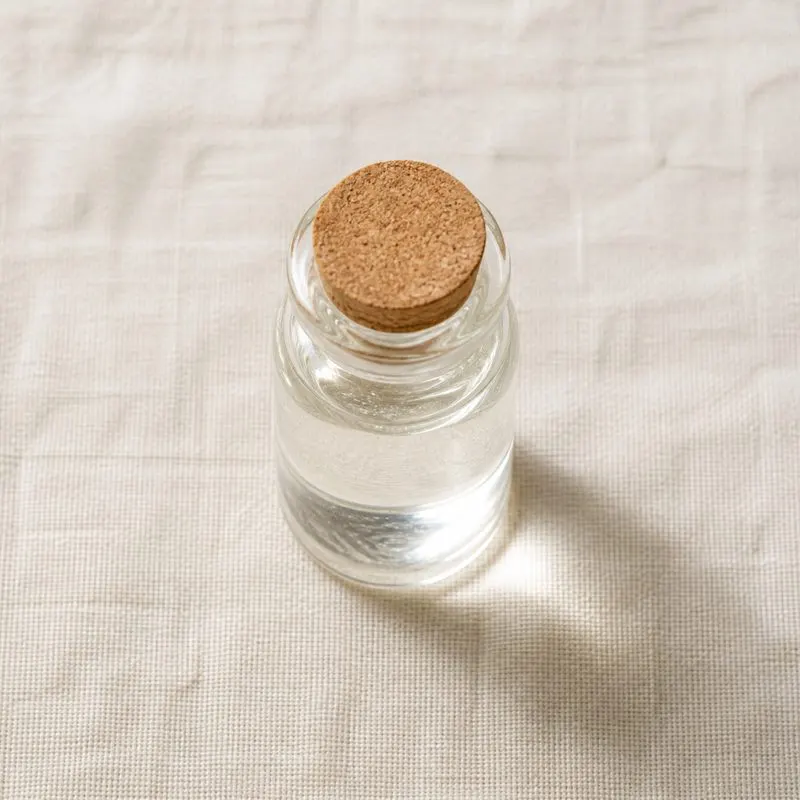
It is a clear, colourless, mobile liquid with a characteristic spirituous odour and a burning taste, boiling at 78 degrees Celsius and miscible with water in all proportions as well as with most polar organic solvents. That combination of full water miscibility and useful solvency for non-polar material is what makes it the standard solvent of the food and botanical industries: it dissolves flavour compounds, essential oils, resins, alkaloids and polyphenols that water alone will not carry, and it can then be removed by evaporation without leaving a residue.
In food systems ethanol also acts as an antimicrobial, a carrier and a freezing point depressant. It is hygroscopic and forms an azeotrope with water at roughly 95.6 percent by weight, which is why straightforward distillation cannot exceed that concentration and why anhydrous grades require an additional dehydration step. It is volatile and flammable, so it is stored and handled in bonded, temperature controlled and electrically classified facilities.
We source bulk Edible Alcohol from top China manufacturers for our partners. The manufacturer is in Guangxi. A smaller requirement can ship in a combined container with other ingredients.
Please send the grade you need, the volume and your destination port, and we will come back with a solution and a price.
or call +86-21-6858 0751
- Function
- Nutraceutical
Specifications
| Item | Specification |
|---|---|
| Appearance | Clear colourless mobile liquid |
| Odour and Taste | Characteristic, free from foreign notes |
| Identification | Infrared spectrum conforms to reference |
| Alcohol Content, by volume at 20 C | 96.0% to 96.5% |
| Relative Density at 20 C | 0.8060 to 0.8090 |
| Methanol | Not more than 30 mg/L |
| Higher Alcohols, as isobutanol | Not more than 5 mg/L |
| Aldehydes, as acetaldehyde | Not more than 3 mg/L |
| Esters, as ethyl acetate | Not more than 5 mg/L |
| Total Acidity, as acetic acid | Not more than 5 mg/L |
| Non-Volatile Residue | Not more than 10 mg/L |
| Permanganate Time Test | Not less than 30 minutes |
| Furfural | Absent |
| Lead | Not more than 0.1 mg/L |
Common Markets Grades
The primary trade grades are neutral spirit and rectified spirit at 95 to 96 percent alcohol by volume, which is the azeotropic ceiling and the standard article for beverage and extraction use, and anhydrous or absolute alcohol at 99.5 percent or higher, produced by molecular sieve dehydration for applications where residual water cannot be tolerated. Both are sold as food or pharmaceutical grade against the relevant pharmacopoeial monograph, with limits on methanol, higher alcohols, aldehydes, esters and non-volatile residue.
Beyond concentration, grades are separated by feedstock and by whether the alcohol is denatured. Cane molasses, corn, wheat, cassava and sugar beet are the usual substrates, and the declared source matters commercially for gluten free, non-genetically modified, organic, kosher and halal positioning even though the purified ethanol is chemically identical. Denatured alcohol, to which a bittering agent or other denaturant has been added for excise purposes, is far cheaper but is not permitted in food. Organic certified and pharmaceutical low endotoxin grades are handled as separate streams.
Applications
- Botanical and herbal extraction, where hydroalcoholic mixtures pull compounds water cannot carry
- Flavour and essential oil solutions, as the standard carrier solvent for liquid flavourings
- Vanilla extract manufacture, where the alcohol to water ratio is set by the standard for the product
- Beverage manufacture, as the neutral base for vodka, liqueurs, bitters and ready to drink products
- Baking and confectionery glazes and colour solutions, where rapid evaporation is needed
- Antisolvent crystallisation in ingredient manufacture, precipitating amino acids, salts and sugars from aqueous liquor
- Surface antimicrobial sprays for bakery and packaged goods, extending mould free shelf life
- Tincture and liquid supplement formulation, where the alcohol both extracts and preserves
- Processing aid in resin washing, decolourisation and solvent recovery loops
Brands Using Edible Alcohol
Widely-distributed consumer products that list Edible Alcohol on the ingredient label.
Brand names, product names and logos are the property of their owners. They appear here as published evidence that the ingredient is used, taken from the brand's own label or website. Their appearance is not an endorsement, and it does not mean the brand buys from us or from any manufacturer listed on this site.
China Manufacturers of Edible Alcohol
Top Edible Alcohol manufacturers in China.

Company names and logos are the property of the manufacturers themselves. They are listed here because our own directory records them as producing this ingredient. A listing is not an endorsement by them, and we do not represent them or speak on their behalf.
Regulatory Status
In the United States, ethanol used in food is regulated on two tracks. As a food substance, ethyl alcohol is a permitted ingredient and an approved extraction solvent, with residual solvent limits set for the categories in which it is used, and standards of identity govern products such as vanilla extract and distilled spirits. As a taxable commodity it falls under the Alcohol and Tobacco Tax and Trade Bureau, which controls production, denaturing and the permits under which industrial and beverage alcohol move, and the labelling of alcoholic beverages sits with that agency rather than with FDA.
In the European Union, ethanol is an authorised extraction solvent under the extraction solvents directive, permitted under good manufacturing practice conditions, and is used as a carrier and solvent for flavourings under the flavourings regulation. It is not assigned an E number as a food additive in its own right. Production and movement are governed by the excise duty framework for alcohol and alcoholic beverages, with specific rules on denaturing for non-beverage use, and agricultural ethanol for beverages must meet the compositional requirements set out in the spirit drinks regulation. JECFA has evaluated ethanol and publishes specifications for it as a food grade solvent, and Codex addresses it through its specifications for food additives and processing aids.
Manufacturing Process
Production is fermentation followed by rectification. A sugar or starch feedstock, molasses, cane juice, corn, wheat or cassava, is prepared: sugar feedstocks are diluted and clarified, while starch feedstocks are milled, slurried, liquefied with alpha-amylase and saccharified with glucoamylase to fermentable sugars. The mash is cooled, pitched with distiller's yeast, and fermented for one to three days to a beer of around 8 to 12 percent alcohol, with carbon dioxide vented and often recovered.
The beer is fed to a distillation train. A beer stripping column takes the alcohol overhead and leaves the stillage behind for evaporation into feed co-products. The crude spirit then passes through a rectifying column that concentrates it towards the azeotrope, and through purifying columns that remove the congeners that define food grade quality: a heads column strips aldehydes and low boiling esters, a fusel oil draw removes the higher alcohols from the middle of the column, and a demethylising column takes methanol overhead. Some plants add a hydroselection stage, diluting the spirit so that congeners partition more favourably before final rectification. Neutral spirit leaves at the azeotropic strength; where anhydrous alcohol is required, it is passed over molecular sieve beds operated in pressure swing adsorption cycles, which adsorb the remaining water and are regenerated in rotation. Product is polished on carbon where needed, analysed against the monograph, and stored in bonded stainless tanks under excise control.