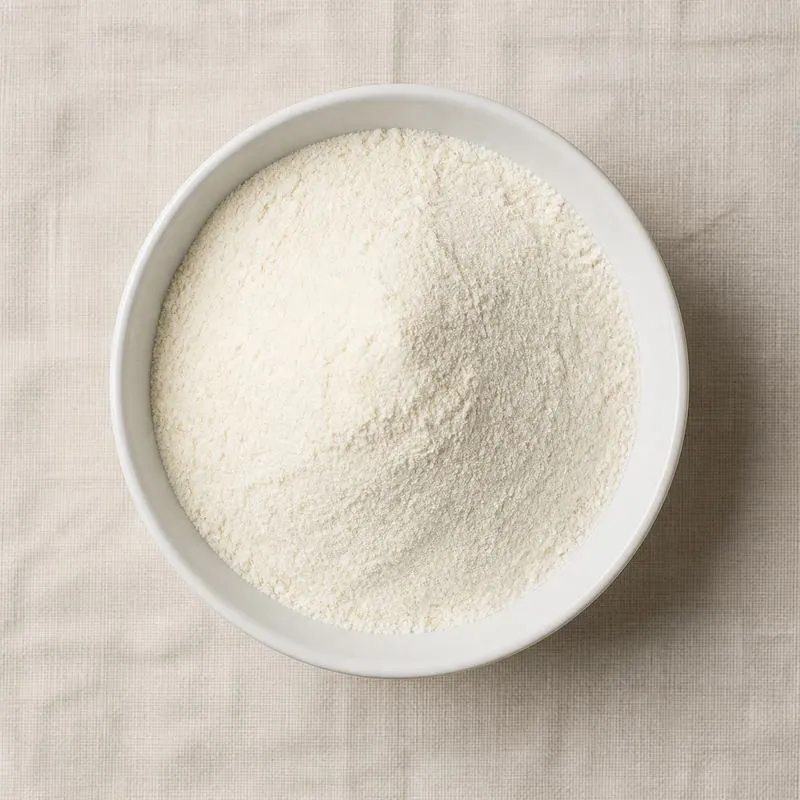
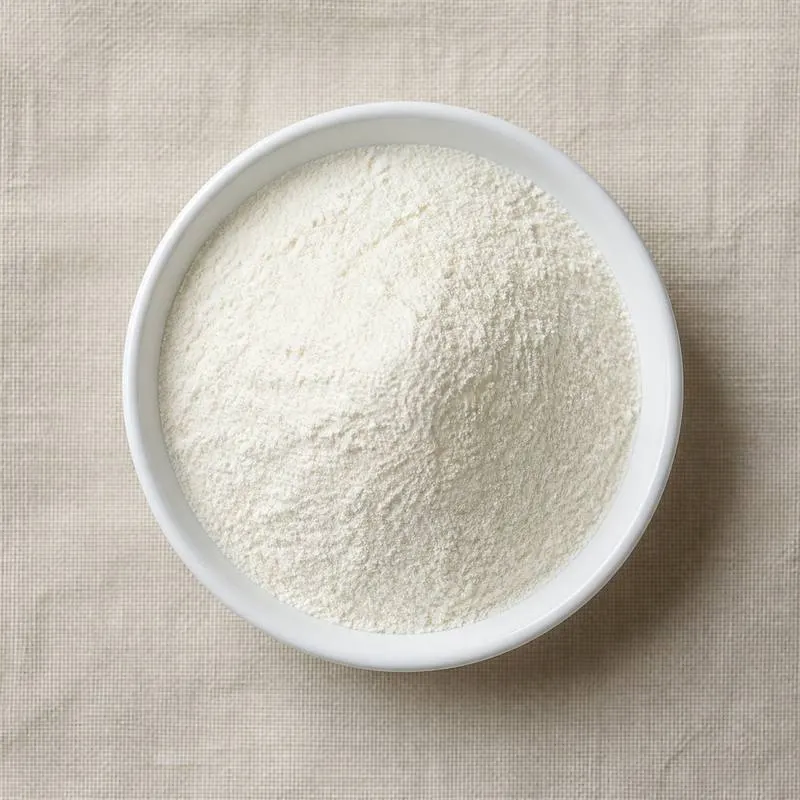
Full Cream Evaporated Milk
Full cream evaporated milk is whole milk from which about 60 percent of the water has been removed by vacuum evaporation, then homogenised, canned and sterilised in the container. A standard product carries roughly 7.5 to 8 percent milk fat and 25 to 26 percent total milk solids, which is about twice the concentration of the milk it was made from, and it is shelf stable at ambient temperature for a year or more without refrigeration.
It is not the same product as condensed milk, which is preserved by added sugar rather than by heat and is not sterilised. Evaporated milk contains no added sugar, and its stability comes entirely from the in container sterilisation, which is also what gives it its characteristic cooked, slightly caramelised flavour and its darker ivory colour, both consequences of the Maillard reaction between lactose and milk protein during heating.
The technical problem at the centre of the product is heat stability. Concentrating milk brings the casein micelles closer together and raises the calcium concentration, so the concentrate is far more likely to coagulate during sterilisation than fresh milk would be. Manufacturers control this by adjusting the salt balance with a stabiliser, usually a phosphate or citrate, and by forewarming the milk before evaporation, and a can that gels or separates on the shelf is almost always a failure of that control.
We source bulk Full Cream Evaporated Milk from top China manufacturers for our partners. The manufacturer is in Zhejiang. A smaller requirement can ship in a combined container with other ingredients.
Please send the grade you need, the volume and your destination port, and we will come back with a solution and a price.
or call +86-21-6858 0751

- Function
- Protein
Specifications
| Item | Specification |
|---|---|
| Appearance | Homogeneous ivory to light cream liquid, free from lumps and separation |
| Odour and Taste | Clean cooked dairy flavour characteristic of the product |
| Milk Fat | Not less than 7.5 percent |
| Total Milk Solids | Not less than 25.0 percent |
| Milk Solids Not Fat | Not less than 17.5 percent |
| Protein (in solids not fat) | Not less than 34.0 percent |
| Viscosity at 20 C | Conforms to reference, free from gelation |
| pH at 20 C | 6.2 to 6.6 |
| Titratable Acidity | Not more than 0.35 percent as lactic acid |
| Stabilising Salts | Within the level permitted for the market of sale |
| Lead | Not more than 0.05 mg/kg |
| Tin (in tinplate cans) | Not more than 200 mg/kg |
| Commercial Sterility | No growth after incubation at 37 C for 14 days |
| Container Seam Integrity | Conforms to seam specification, no leakage |
| Total Plate Count after Incubation | Not more than 10 cfu/g |
| Salmonella | Negative in 25 g |
Common Markets Grades
Grades follow fat and solids content. Full cream or whole evaporated milk sits at around 7.5 to 8 percent fat and 25 percent total solids, evaporated semi skimmed at about 4 percent fat, and evaporated skimmed below 1 percent, each subject to the compositional definitions of the market it is sold in. Some markets also recognise a higher concentration product with elevated total solids for industrial use.
Beyond composition, the practical distinctions are in processing route and packaging. Conventional in container sterilised product is heated in the sealed can in a retort and carries the most pronounced cooked flavour. Ultra high temperature evaporated milk is sterilised in flow and filled aseptically, which gives a lighter colour and cleaner flavour at the cost of requiring aseptic packaging. Recombined evaporated milk, made by reconstituting skimmed milk powder with butter oil and water rather than from fresh milk, is a substantial trade in markets without a local milk supply and is specified and sold separately. Can size runs from small retail tins to catering formats, with bulk aseptic bags for industrial users.
Applications
- Coffee and tea whitening, the largest retail use in many markets
- Hong Kong style milk tea and Southeast Asian beverage preparation, where the cooked note is part of the expected flavour
- Baking and dessert making, in custards, flans, pumpkin pie and tres leches
- Confectionery and caramel manufacture, where the concentrated milk solids brown readily
- Ice cream and frozen dessert bases in ambient supply chains
- Savoury cooking, in sauces, soups and curries as a cream substitute that resists curdling
- Institutional and military catering, where ambient stability is the requirement
- Infant feeding in some historic markets, and as an ingredient in recombined dairy products
- Bakery fillings and dairy toppings made from ambient stable ingredients
Brands Using Full Cream Evaporated Milk
Widely-distributed consumer products that list Full Cream Evaporated Milk on the ingredient label.
Brand names, product names and logos are the property of their owners. They appear here as published evidence that the ingredient is used, taken from the brand's own label or website. Their appearance is not an endorsement, and it does not mean the brand buys from us or from any manufacturer listed on this site.
China Manufacturers of Full Cream Evaporated Milk
Top Full Cream Evaporated Milk manufacturers in China.
Company names and logos are the property of the manufacturers themselves. They are listed here because our own directory records them as producing this ingredient. A listing is not an endorsement by them, and we do not represent them or speak on their behalf.
Regulatory Status
In the United States evaporated milk has a standard of identity in Title 21 of the Code of Federal Regulations, which sets the minimum milk fat and milk solids requirements, requires vitamin D fortification, permits vitamin A addition, and names the stabilising salts that may be used and their maximum level. The product must be sealed in a container and processed by heat to prevent spoilage, and low acid canned food regulations apply to the thermal process, including establishment registration, process filing and the operator training requirements those rules impose. Milk is a major food allergen requiring declaration.
In the European Union the directive on certain partly or wholly dehydrated preserved milk covers evaporated milk and defines the compositional categories, the permitted treatments and the reserved descriptions. Processing falls under the hygiene rules for food of animal origin. Stabilising salts are food additives that must be authorised for the category under the food additives regulation and declared with their E numbers. Milk is a listed allergen under the food information regulation. Codex maintains a standard for evaporated milks that sets composition, permitted additives and labelling, and it is the reference used in international trade.
Manufacturing Process
Raw milk is received, tested, clarified and separated, then standardised to the fat and solids ratio that will give the target composition after evaporation, with the ratio rather than the absolute figure being what matters at this stage. The standardised milk is then forewarmed, a heat treatment of typically 90 to 120 degrees Celsius held for several minutes, which is not primarily about pasteurisation: it denatures the whey proteins onto the casein micelles and gives the heat stability that the concentrate will need in the retort. Skipping or shortening it produces a product that coagulates during sterilisation.
The forewarmed milk is concentrated in a multiple effect falling film evaporator under vacuum, at a temperature low enough to limit further heat damage, until the total solids reach the target. The concentrate is homogenised in two stages to reduce fat globule size and prevent creaming in the can, cooled, and the salt balance is adjusted with a stabiliser such as disodium phosphate or sodium citrate, with the dose determined by a heat stability trial on each batch rather than by a fixed recipe. The stabilised concentrate is filled into cans, seamed, and sterilised in a rotary or still retort at around 115 to 120 degrees Celsius for a validated time, then cooled, coded and palletised. Aseptic production replaces the retort with an ultra high temperature heater and a sterile filler.